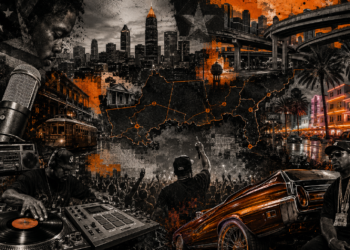

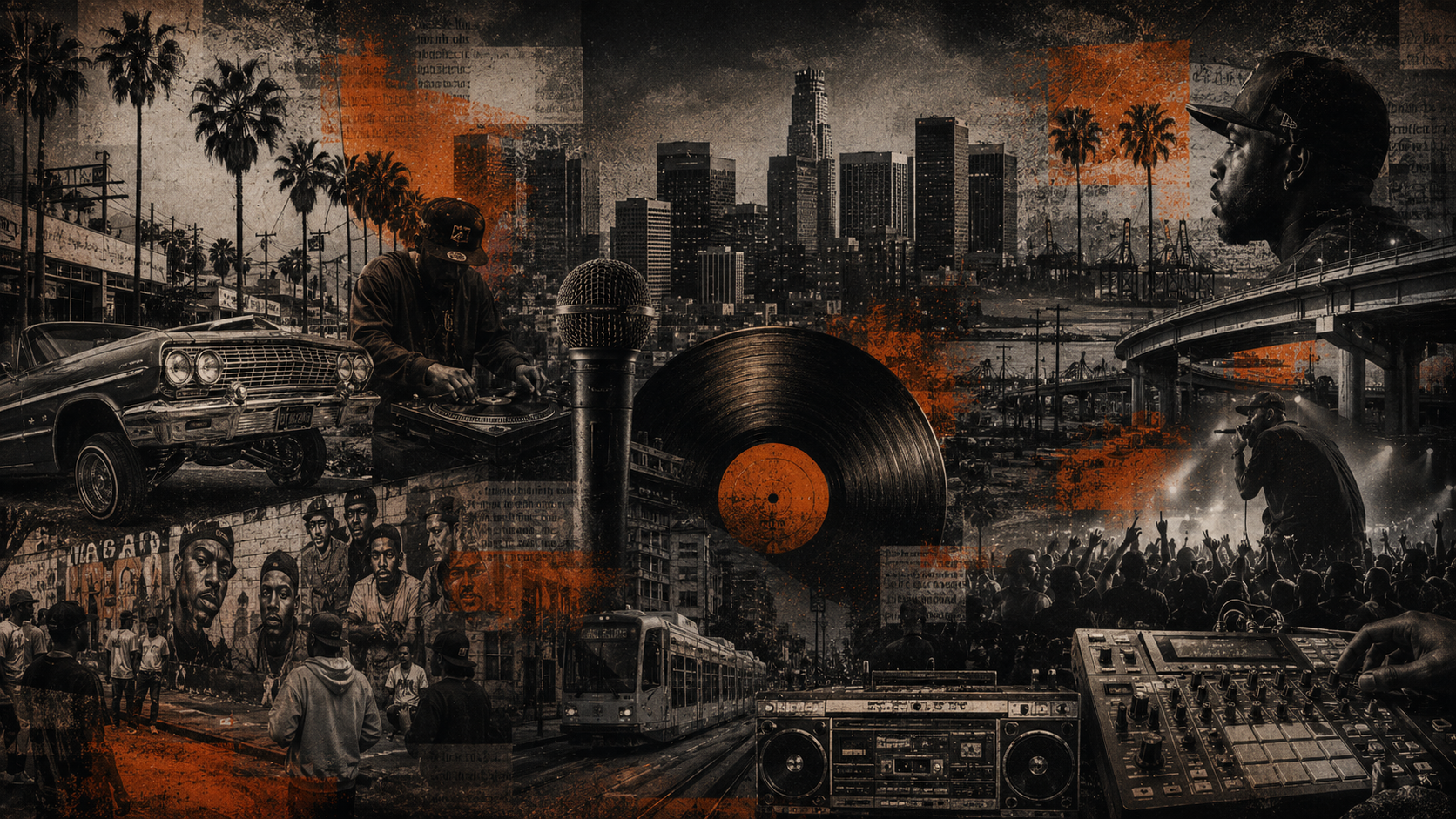
West Coast hip-hop emerged in pieces rather than as one movement: drum machines in Compton, cassettes sold from Oakland car trunks, open mics in Leimert Park, and a Los Angeles radio station that went all-rap in 1983. Those scattered roots grew into one of rap’s most consequential regional traditions.
Key Facts
- Topic: West Coast hip-hop
- Roots: Compton drum machines; Oakland trunk tapes; LA open mics
- Key moment: LA radio goes all-rap (1983)
- Region: California / West Coast
- Foundational element: Origin/history
West Coast hip-hop did not arrive as a unified movement. It came up in pieces — drum machines in Compton rec rooms, cassette tapes sold out of car trunks in Oakland, open mics in Leimert Park health food stores, a single radio station in Los Angeles that decided to go all-rap in 1983 before the rest of the industry believed that was a viable thing to do. What those separate roots eventually produced was one of the most consequential regional contributions in the history of American music: a sound that normalized street reportage, a business model that made artist ownership central to the genre, and a creative tradition that runs from N.W.A’s FBI warning letters to Kendrick Lamar’s Pulitzer Prize.
This is the story of how that happened.
I. The Foundation: Electro, Party Rap, and the First Wave (1981–1988)
The first commercially documented West Coast rap records appeared in 1981. In Southern California, Disco Daddy and Captain Rapp’s “The Gigolo Rapp” established that L.A. had its own scene developing independently from New York. In the Bay Area, Motorcycle Mike’s “Super Rat” served the same function for Northern California. These were not polished major-label productions. They were artifacts of local scenes, built on DJ culture, drum machines, and the direct inheritance of funk and electro.
The figure who most clearly defined this first era in Southern California was Egyptian Lover. Moving through Uncle Jamm’s Army — the massive party-DJ collective that dominated the early L.A. scene — he brought 808-driven, dance-floor-first electro into recorded form with On the Nile in 1984. His influence runs through any West Coast production that treats the drum machine as its primary instrument, which is most of them. [Los Angeles Times]
The institutional breakthrough came in 1983, when KDAY became the first radio station in the United States to play hip-hop 24 hours a day. Music director Greg Mack converted the station to an all-rap format, and within 90 days it was the second most popular station among Black listeners in L.A. Dr. Dre and DJ Yella became the first mixer DJs at the station. KDAY gave N.W.A., MC Hammer, Tone Loc, and LL Cool J their first radio airplay, and it gave the entire Southern California scene a local amplifier before the national industry fully bought in. [LA Times via Yahoo]
While L.A. was building its radio infrastructure, Oakland was building something different. Too Short had been selling tapes out of his car since the early 1980s, establishing what would become the Bay Area’s signature business model: self-recorded, self-distributed, regionally specific product sold directly to the community before any label deal existed. His stripped-down funk beats and street-level Oakland storytelling made him one of the Bay’s foundational figures — not despite his independence, but because of it. The trunk-sale model he pioneered became a through-line in Bay Area rap economics for the next four decades.
II. Ruthless Records and the Gangsta Rap Explosion (1988–1991)
In 1986, a 22-year-old Eric “Eazy-E” Wright founded Ruthless Records in Compton with $7,000 of his own money and 5,000 pressed copies of “Boyz N the Hood.” The label started as a vehicle for N.W.A and Eazy’s solo work, distributed initially through Macola and later through Priority Records. What it became was one of the most durable independent-label myths in American music: proof that a Black-owned rap label from the projects could manufacture superstars, generate controversy, and earn a platinum record without a major’s infrastructure. [Britannica]
The detonation came on January 25, 1989. Straight Outta Compton was released on Ruthless and Priority without significant radio airplay outside of Los Angeles, without a conventional promotional campaign, and with lyrics explicit enough that the FBI sent Ruthless a formal warning letter. It became the first gangsta rap album to go platinum. MTV banned its video. Police departments refused to provide security for N.W.A concerts. None of it stopped the album — in 2016, it was inducted into the Grammy Hall of Fame; in 2017, it was added to the Library of Congress National Recording Registry for being culturally and historically significant. [Library of Congress] [History.com]
The individual talent inside N.W.A guaranteed that the fallout from its breakup would be as consequential as the group itself. When Ice Cube left in 1990 and recorded AmeriKKKa’s Most Wanted in New York with Public Enemy’s Bomb Squad, the result was a cross-coastal fusion that introduced many East Coast listeners to the West Coast gangsta sound for the first time while proving Cube’s solo authority immediately. [Britannica] What N.W.A launched was not just a genre — it was a business template, a media controversy engine, and a launchpad for careers that would individually reshape the next two decades of rap.
III. Death Row and the G-Funk Era (1991–1997)
In 1991, Dr. Dre, Suge Knight, The D.O.C., and Dick Griffey co-founded Death Row Records. The label’s first release on December 15, 1992 was The Chronic — and it did not just succeed commercially; it rewired the sound of mainstream hip-hop. [Music Gateway]
Dre and multi-instrumentalist Colin Wolfe built The Chronic explicitly around Parliament-Funkadelic as their template. “We wanted to make a real Parliament-Funkadelic album,” Wolfe later told Wax Poetics. The result — fat bass lines, whining synths, soulful backing vocals, and a slower groove than the East Coast boom-bap that had dominated rap production — became G-funk, the most commercially dominant West Coast sound of the decade. The Chronic peaked at No. 3 on the Billboard 200 and sold three million copies in the United States. [uDiscoverMusic] [Library of Congress]
In 1993, Snoop Dogg’s Doggystyle debuted at No. 1 — confirming that the Death Row pipeline was bigger than a single-album phenomenon. That same year, the Bay Area’s underground was announcing itself through Souls of Mischief’s “93 ‘til Infinity,” a track that signaled the Hieroglyphics collective’s lyrical ambition and the beginning of one of hip-hop’s earliest formal artist-owned labels.
Tupac Shakur joined Death Row in 1995 and gave the label its most complex and contradictory voice. Me Against the World — recorded largely while Tupac was incarcerated — was the first rap album to debut at No. 1 on the Billboard 200 while its artist was in prison. All Eyez on Me in 1996 went Diamond. His murder on September 13, 1996 remains the defining rupture of the era — not just a death, but the visible collapse of an entire cultural infrastructure. Dre had already left to launch Aftermath Entertainment before Tupac’s killing. Snoop followed two years later. Death Row’s imperial phase was over inside of five years. [Wikipedia — Tupac Shakur]
IV. The Bay Area’s Parallel Empire: Ownership as Philosophy
While Death Row was building its mainstream dominance in Southern California, the Bay Area was doing something structurally different and arguably more durable. E-40, based in Vallejo, founded Sick Wid’ It Records in 1988 — one of hip-hop’s earliest artist-owned imprints — and spent the 1990s building a catalog, an audience, and a slang vocabulary that he wholly controlled. His approach to distribution, language invention, and regional brand-building predated the “independent” conversations that would dominate rap business discourse in the 2000s and 2010s by a decade. The Recording Academy specifically credits E-40’s entrepreneurial model as influential on later independent rap strategy. [GRAMMY]
Hieroglyphics Imperium, founded in 1993 by the Oakland collective, formalized what Too Short had demonstrated with cassette tapes: that the Bay could build a sustainable music economy outside of major-label pipelines. The crew — Souls of Mischief, Del the Funky Homosapien, Casual, Pep Love — operated as a unified creative and business entity, releasing music on their own label and controlling their masters years before “ownership” became a hip-hop talking point. Their official history describes Hieroglyphics Imperium as one of the first artist-owned labels in hip-hop.
The Bay’s model was not glamorous in the Death Row sense. It did not generate the same national controversy or tabloid heat. What it generated was longevity — infrastructure that remained functional and locally rooted long after Death Row’s implosion, and long after the next wave of major-label rap cycles burned through their own artists.
V. Underground L.A.: Project Blowed and the Alternative Track
Not every significant Los Angeles rapper was chasing Death Row’s commercial template. Starting in 1989, the Good Life Café in what was then called South Central L.A. hosted a weekly open-mic night that became the incubator for some of the West Coast’s most technically ambitious underground talent. The rule was simple: if the crowd shouted “please pass the mic,” you were off the stage. Skill was the only currency. [Wikipedia — Good Life Cafe]
In 1994, Good Life regulars formalized the scene into Project Blowed at Leimert Park — an open workshop and performance space the Los Angeles Times described as an incubator for the West Coast’s most creative underground talent. Freestyle Fellowship, Abstract Rude, Aceyalone, and the collective that became Jurassic 5 all passed through this orbit. The sonic signature was virtuoso flow patterns, freestyle-tested lyrical density, and a complete indifference to commercial gangsta formulas. [Wikipedia — Project Blowed]
Project Blowed represents something essential about West Coast hip-hop that the Death Row narrative sometimes obscures: the coast always ran parallel economies. For every commercially dominant G-funk wave, there was a lyrical underground operating on entirely different values. That infrastructure fed directly into the generation of Compton and Inglewood artists who would eventually produce Kendrick Lamar.
VI. Aftermath, Recovery, and the Post–Death Row Era (1996–2011)
Dr. Dre launched Aftermath Entertainment in 1996 and spent three years rebuilding before releasing 2001 in November 1999. The album debuted at No. 2 on the Billboard 200 and proved that the G-funk blueprint could be updated for a post-Death Row landscape without losing its authority. It also introduced Eminem to the mainstream, establishing Aftermath as a pipeline that would operate across two decades and eventually house Kendrick Lamar. [Wikipedia — Dr. Dre 2001]
Through the 2000s, the Bay reasserted itself with hyphy. The word — short for hyperactive — was coined on record by Oakland rapper Keak Da Sneak, but the movement’s spirit was most associated with Mac Dre, whose death in November 2004 transformed him from a beloved regional artist into the symbolic heart of a scene that crystallized in his absence. E-40, Mistah F.A.B., Too Short, and Keak Da Sneak carried the movement into its mainstream peak in 2006, when E-40’s “Tell Me When To Go” and My Ghetto Report Card — debuting at No. 3 on the Billboard 200 — translated years of local energy into national visibility. [KQED] [Complex]
In Southern California, a different micro-movement was developing. Jerkin’ — a street-born dance and accompanying rap style centered on nimble footwork, bright synths, and youth-specific fashion codes — spread out of the Inland Empire and San Gabriel Valley before New Boyz’ “You’re a Jerk” carried it to national audiences in 2009. It was among the first West Coast youth movements to scale primarily through YouTube rather than radio or label promotion, and it pointed directly toward the DJ Mustard ratchet era that followed — spare drum programming, handclap-driven grooves, and a sound built for car systems and clubs simultaneously.
VII. Kendrick Lamar and the Modern Canon (2012–Present)
Kendrick Lamar signed to Top Dawg Entertainment in 2003, built a local reputation across a series of mixtapes, and by 2012 released good kid, m.A.A.d city — a major-label debut that peaked at No. 2 on the Billboard 200 and restored cinematic, city-specific storytelling to the center of mainstream rap. The album’s architecture — a single day in Compton rendered as a coming-of-age film — was both a callback to the narrative ambitions of West Coast rap’s first generation and something that generation had never quite attempted at that scale or polish. [Wikipedia — good kid m.A.A.d city]
To Pimp a Butterfly in 2015 was the logical extension of everything the West Coast underground had been building since Project Blowed — jazz, funk, spoken word, and the full weight of Black L.A.’s cultural inheritance collapsed into a single album cycle. It debuted at No. 1. DAMN. in 2017 did the same, and on April 16, 2018, the Pulitzer Prize Board awarded Kendrick Lamar the Pulitzer Prize for Music — the first time in history the award had gone to a work outside classical music or jazz. The committee called it “a virtuosic song collection unified by its vernacular authenticity and rhythmic dynamism.” [NPR] [Pulitzer.org]
In November 2024, GNX dropped as a surprise release and debuted at No. 1 on the Billboard 200. “Not Like Us” — the diss record against Drake that became a West Coast anthem — won five Grammy Awards at the 67th Annual Grammy Awards in February 2025, including Record of the Year, Song of the Year, and Best Rap Song. GNX returned to No. 1 following the Super Bowl. The conversation about whether “the West is back” had become moot — it had never left. [Billboard]
VIII. Nipsey Hussle and the Ownership Ethic
Nipsey Hussle ran his independent marathon for the better part of a decade before Victory Lap in 2018 debuted in the Billboard 200 top five and translated his long-game into mainstream breakthrough. His importance was never just the music — it was the infrastructure around it. The Marathon Clothing store in Crenshaw. Vector 90, the STEM learning center and co-working space he built in his neighborhood. The deliberate choice to reinvest in the community that shaped him rather than relocate the moment he could afford to.
On March 31, 2019, Nipsey Hussle was shot and killed outside his Marathon Clothing store in South Central Los Angeles. He was 33. His death produced something beyond grief — it produced civic action. Gang leaders used his legacy to broker truces across L.A. and Compton. The intersection of Crenshaw and Slauson was officially renamed Nipsey Hussle Square in 2026. The GRAMMY’s entrepreneurship coverage and subsequent reporting on his death both underscore the same point: his music and his community work were never separate things. [GRAMMY] [NBC News]
Nipsey’s death crystallized something that was already true: West Coast hip-hop’s deepest value is not a sound. It is an ethic of ownership — of music, of community, of the terms on which you engage the industry. That ethic runs from Too Short’s trunk sales to Eazy-E’s $7,000 label investment to E-40’s independent imprint to Hieroglyphics Imperium to Nipsey’s block to Kendrick’s TDE deal. It is the actual through-line.
What the West Means Now
In February 2025, Kendrick Lamar performed at the Super Bowl halftime show — the capstone of a run that included a No. 1 debut, five Grammy wins, and a diss record that became an anthem. Death Row Records is active again under Snoop Dogg. Top Dawg Entertainment remains a pipeline. In the Bay, E-40 and Too Short are still working; Larry June, P-Lo, Kamaiyah, and LaRussell are keeping regional vocabulary and business logic alive for a new generation. [Hollywood Reporter]
West Coast hip-hop is not a nostalgic category. It is one of American music’s most durable operating systems — built on locality, independence, and a refusal to wait for someone else to authenticate what the coast already knows about itself. From “The Gigolo Rapp” in 1981 to a Pulitzer Prize in 2018 to the Super Bowl in 2025, the West has been telling the same story in different keys: make it yourself, own what you make, and never let geography be an excuse to think small.