
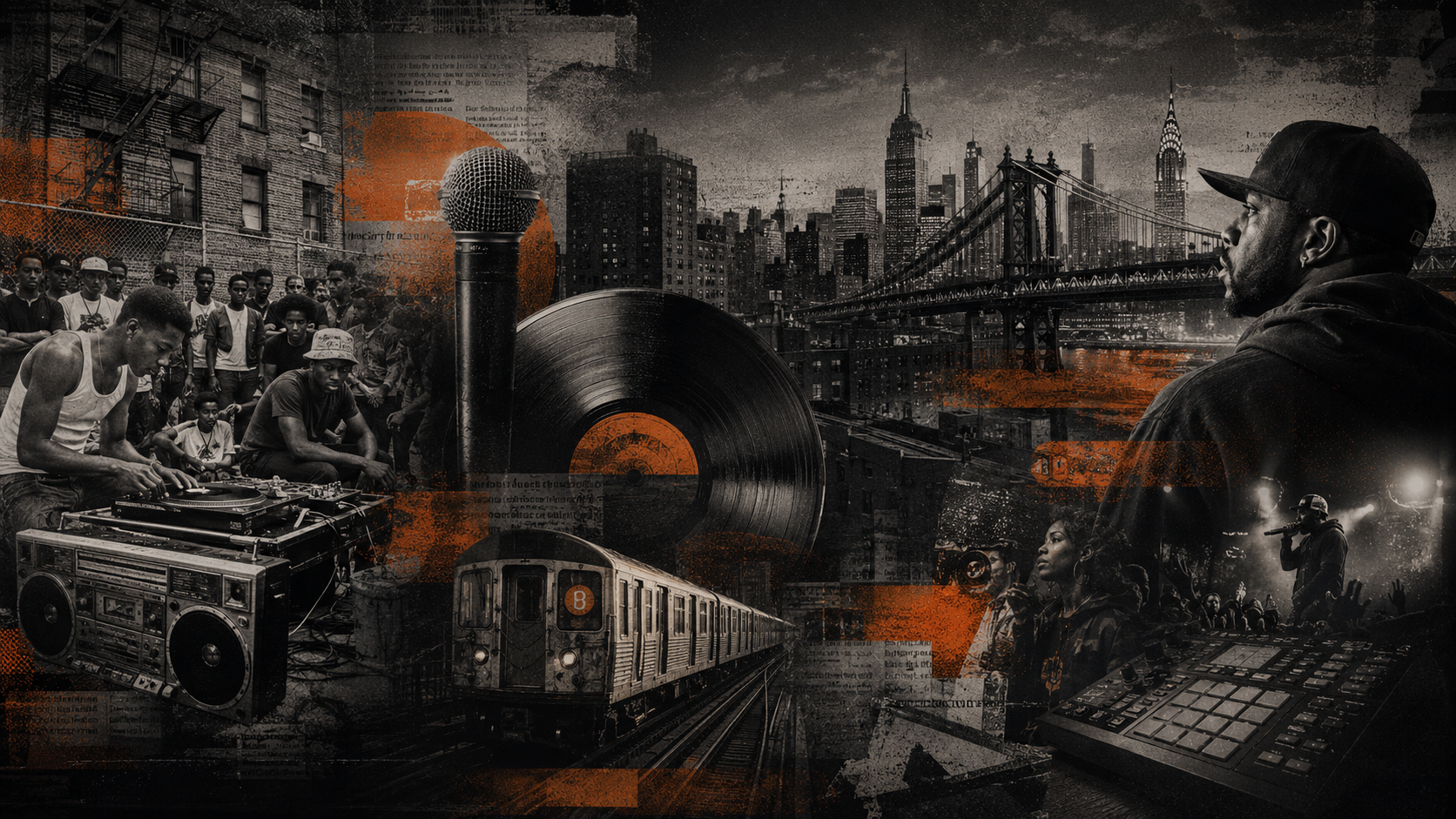
East Coast hip-hop is the branch of rap rooted in New York City and the broader Northeast. Historically it begins with the early-1970s Bronx block-party scene, especially the August 11, 1973 party by Cindy Campbell and DJ Kool Herc at 1520 Sedgwick Avenue, widely treated as a foundational hip-hop moment.
Key Facts
- Topic: East Coast hip-hop
- Roots: Early-1970s Bronx block parties
- Key moment: Aug 11, 1973, 1520 Sedgwick Ave
- Region: NYC + Northeast/Mid-Atlantic
- Foundational element: Origin/history
East Coast hip-hop is the branch of rap music rooted first in New York City and then, more broadly, in the Northeastern and Mid-Atlantic United States. In the historical sense, it begins with the Bronx block-party ecosystem of the early 1970s, especially the August 11, 1973 back-to-school party organized by Cindy Campbell and DJ Kool Herc at 1520 Sedgwick Avenue, an event widely treated by museums and historians as a foundational hip-hop moment. In its earliest phase, all recorded rap effectively emerged from this New York–centered culture, so “East Coast hip-hop” is not just a regional tag; it is the original institutional, social, and sonic base from which the genre spread nationally.1
Sonically, East Coast hip-hop is most strongly associated with breakbeat-based DJ culture, dense rhyme writing, sample-heavy production, and, from the late 1980s forward, the “boom bap” template: hard kicks, crisp snares, chopped funk/soul/jazz loops, and strong emphasis on the MC’s verbal performance. That sound was never monolithic. The same regional tradition produced the stripped-down aggression of Run-D.M.C., the layered noise and political urgency of Public Enemy, the jazz-inflected looseness of Native Tongues, the grim street realism of Mobb Deep and Wu-Tang Clan, and, much later, the UK-influenced percussion of Brooklyn drill and the melodic/sample-driven mutations now associated with “sexy drill.”2
Culturally, East Coast hip-hop is inseparable from the four-element framework of hip-hop culture: DJing, MCing, breaking, and graffiti. It also helped define the battle ethic, mixtape circulation, radio/club gatekeeping, independent-label entrepreneurship, and the idea of the rapper as both street reporter and cultural entrepreneur. Institutions such as Def Jam, Tommy Boy, Bad Boy, Loud, Roc-A-Fella, Jive, and later Mass Appeal were not just businesses; they were infrastructure for turning local scenes into national and then global movements.3
Its broader significance inside hip-hop is difficult to overstate. East Coast hip-hop established the genre’s earliest professional models, repeatedly reset the standards for lyricism and production, and continued to reinvent itself after each perceived decline: through the Native Tongues expansion of rap aesthetics in the late 1980s and early 1990s, the East Coast renaissance of 1993–1996, the corporate/mogul era embodied by Jay-Z and Bad Boy/Roc-A-Fella, the mixtape/blog-era revival, and the rise of Brooklyn drill and newer New York hybrids. Even when it has not been the industry’s most commercially dominant regional style, East Coast hip-hop has remained one of rap’s main reference languages.4
Timeline
- 1973: DJ Kool Herc’s August 11, 1973 party at 1520 Sedgwick Avenue in the Bronx, organized with Cindy Campbell, is widely cited as a foundational hip-hop event because it crystallized the break-focused DJ style that became central to rap culture.5
- 1979: The Sugarhill Gang released “Rapper’s Delight,” the record broadly recognized as the breakthrough commercial hip-hop single; the track later entered the National Recording Registry, underscoring its historical importance.6
- 1982: Grandmaster Flash and the Furious Five released “The Message,” a landmark record that shifted rap from party-centered boasting toward social commentary and urban realism.7
- 1983: Run-D.M.C. emerged from Hollis, Queens and began translating rap into a harder, more stripped-down sound that would become one of the key templates for East Coast hardcore hip-hop.8
- 1984: Def Jam was founded by Rick Rubin and Russell Simmons; that same year, the label’s early release of T La Rock and Jazzy Jay’s “It’s Yours” helped establish Def Jam as a serious rap institution.9
- 1985: LL Cool J’s Radio became Def Jam’s first album release and one of the early statements of New York rap as a commercially scalable album form.10
- 1986: Beastie Boys released Licensed to Ill on Def Jam; Def Jam’s own anniversary site notes that it became the first rap album to top the Billboard 200 and later achieved diamond certification.11
- 1986: Run-D.M.C.’s partnership with Adidas became one of the first major corporate sponsorship deals in hip-hop, showing that East Coast rap could drive fashion and mass-market branding.8
- 1987: Eric B. & Rakim’s Paid in Full arrived and became foundational for modern MC technique, especially Rakim’s internal-rhyme structure and calm, authoritative delivery.12
- 1988: Def Jam released Public Enemy’s It Takes a Nation of Millions to Hold Us Back, one of the core records in politically confrontational East Coast rap.13
- 1988: The Native Tongues collective began to cohere around Jungle Brothers, De La Soul, A Tribe Called Quest, Queen Latifah, and others, broadening East Coast rap’s palette toward jazz, Afrocentricity, and playful experimentation.14
- 1989: De La Soul released 3 Feet High and Rising, a debut that Britannica describes as one of the most influential albums in hip-hop history.15
- 1989: Queen Latifah’s rise from Newark helped open a major lane for women in rap and for more overtly political and feminist themes within East Coast hip-hop.16
- 1990: A Tribe Called Quest released People’s Instinctive Travels and the Paths of Rhythm, bringing a jazz-soul sensibility and a new kind of alternative East Coast cool into the mainstream conversation.17
- 1991: Gang Starr’s Daily Operation further sharpened a Brooklyn-centered underground sound built from DJ Premier’s hard drums and Guru’s restrained, streetwise delivery.18
- 1992: RZA assembled Wu-Tang Clan, and the group’s independent circulation of “Protect Ya Neck” became an early model of grassroots East Coast street promotion.19
- 1993: Wu-Tang Clan released Enter the Wu-Tang (36 Chambers), a pivotal album in the East Coast renaissance that returned grimy, low-fi New York rap to the center of the genre.20
- 1993: Sean Combs founded Bad Boy Records after leaving Uptown, setting up the label that would soon become a dominant New York rap and R&B machine.21
- 1994: Nas released Illmatic, which GRAMMY later described as a crucial record in restoring East Coast rap’s stature in a moment when West Coast rap dominated the charts.22
- 1994: The Notorious B.I.G. released Ready to Die, Bad Boy’s flagship breakthrough album and one of the most durable debuts in East Coast rap.23
- 1994: Craig Mack’s “Flava in Ya Ear” gave Bad Boy its first major hit and helped establish the label’s early momentum before Biggie’s full commercial breakthrough.21
- 1995: Mobb Deep’s The Infamous deepened the Queensbridge strain of cold, paranoid street realism that became central to mid-1990s East Coast hardcore rap.24
- 1996: Fugees released The Score, a massively successful East Coast album that fused hip-hop with soul, reggae, and pop without losing regional identity.25
- 1996: Jay-Z released Reasonable Doubt, the opening statement of Roc-A-Fella’s run and one of the canonical New York mafioso-rap albums.26
- 1997: The Notorious B.I.G. was murdered in Los Angeles on March 9, 1997, making his death one of the darkest turning points in the East Coast–West Coast era.27
- 1997: Roc-A-Fella entered a 50/50 partnership and distribution deal with Def Jam, an important step in Jay-Z’s move from independent hustler to institutional power.28
- 1997: Wu-Tang Clan released Wu-Tang Forever, a double album that confirmed how far New York hardcore rap had moved into the commercial center.29
- 1998: Lauryn Hill’s The Miseducation of Lauryn Hill debuted at No. 1 on the Billboard 200 and later became the first female-rapper album to receive an RIAA diamond certification.30
- 1998: Billboard later recognized DMX as the first artist whose first five charting albums all debuted at No. 1 on the Billboard 200, starting with It’s Dark and Hell Is Hot in 1998.31
- 2001: The Jay-Z/Nas feud reached its defining recorded phase with “Takeover” and “Ether,” making lyrical combat itself a headline East Coast event.32
- 2003: 50 Cent’s Get Rich or Die Tryin’ turned the New York mixtape-to-major-label pipeline into a blockbuster national model.33
- 2005: DatPiff launched and became one of the central digital hubs for mixtape circulation, helping sustain the internet/blog-era ecosystem that East Coast revivalists later used.34
- 2007: Grandmaster Flash and the Furious Five became the first rap group inducted into the Rock & Roll Hall of Fame, a major act of institutional recognition for New York hip-hop.35
- 2012: Joey Bada$$ released 1999, a breakthrough Brooklyn mixtape that consciously revived 1990s East Coast aesthetics during the blog era.36
- 2016: A Tribe Called Quest returned after 18 years with We Got It from Here… Thank You 4 Your Service, showing that classic East Coast groups could still speak forcefully to the present.37
- 2019: Pop Smoke’s rise made him the clearest mainstream face of Brooklyn drill before his death the following year.38
- 2020: Pop Smoke was killed on February 19, 2020, but his debut album Shoot for the Stars, Aim for the Moon soon reached No. 1 on the Billboard 200.39
- 2023: Mass Appeal, MLB, Live Nation, and the Yankees staged Hip Hop 50 Live at Yankee Stadium on August 11, 2023, explicitly tying the contemporary industry to the Bronx’s foundational history.40
- 2023: De La Soul’s first six albums finally reached streaming services after Reservoir’s acquisition of Tommy Boy, an important archival and access milestone for East Coast rap history.41
- 2024: A Tribe Called Quest entered the Rock & Roll Hall of Fame, further cementing jazz-rap and Native Tongues as central—not marginal—to the East Coast canon.42
- 2024: Pitchfork’s coverage of Cash Cobain documented how a lighter, melodic “sexy drill” offshoot had become a notable new New York direction after the first wave of Brooklyn drill.43
- 2025: Mass Appeal’s Legend Has It… campaign culminated with Nas and DJ Premier’s Light Years, foregrounding late-career East Coast mastery as a current, not merely nostalgic, force.44
- 2026: RCA relaunched Jive Records as a standalone label on February 3, 2026, reviving one of the historic companies that once housed major East Coast rap acts.45
Key Figures
- DJ Kool Herc — Origin: Bronx, via a Jamaican-born background central to the culture’s migration history. Years active: active in New York party culture by 1973. Contribution: developed the break-focused party format that became the basis of hip-hop DJing. Key moment: the August 11, 1973 Sedgwick Avenue party. Lasting influence: virtually every later East Coast rap form begins from Herc’s breakbeat logic.5
- Grandmaster Flash — Origin: Bronx. Years active: late 1970s onward. Contribution: transformed turntablism with quick-mix theory and helped push rap toward social realism. Key moment/albums: “The Message” and the work of Grandmaster Flash and the Furious Five. Lasting influence: helped turn the DJ from party functionary into a technical auteur.46
- Russell Simmons — Origin: not independently confirmed in the sources reviewed for this section. Years active: active in a foundational executive role by 1984. Contribution: co-founded Def Jam and helped build the first major rap-label infrastructure. Key moments: Def Jam’s launch, Columbia distribution, and the label’s early management pipeline. Lasting influence: made East Coast hip-hop legible to the mainstream music industry without stripping away its identity.47
- Run-D.M.C. — Origin: Hollis, Queens. Years active: early 1980s onward. Contribution: hardened rap’s sound, style, and visual language. Key moments/albums: “It’s Like That,” Raising Hell, and the Adidas deal. Lasting influence: made rap look and sound like a global youth movement rather than a local novelty.8
- LL Cool J — Origin: Queens. Years active: active by 1985 and still recording/performing decades later. Contribution: proved a rapper could be both battle-hardened and pop-accessible. Key albums/moments: Radio, “I Need Love,” and his long Def Jam run. Lasting influence: helped define the commercial solo-rap superstar template.48
- Rakim — Origin: Long Island/Wyandanch. Years active: active by 1986. Contribution: revolutionized MC technique through internal rhyme, measured cadence, and elevated lyrical architecture. Key album: Paid in Full. Lasting influence: later East Coast lyricists—from Nas to Jay-Z’s generation—work in a landscape Rakim fundamentally changed.12
- Queen Latifah — Origin: Newark, New Jersey. Years active: active by the late 1980s. Contribution: helped open rap to a new generation of women artists while foregrounding dignity, politics, and authority. Key album/moment: All Hail the Queen and her role in Native Tongues-adjacent culture. Lasting influence: helped redefine rap as not exclusively male terrain.16
- De La Soul — Origin: Amityville, New York. Years active: since 1988. Contribution: expanded East Coast rap through collage-like sampling, wit, and anti-formula imagination. Key albums/moments: 3 Feet High and Rising, De La Soul Is Dead, and the eventual 2023 streaming restoration of the catalog. Lasting influence: made left-field, arty rap a permanent East Coast option.49
- A Tribe Called Quest — Origin: Queens. Years active: formed in 1985, with major commercial activity through the 1990s and a final album in 2016. Contribution: codified jazz rap and alternative East Coast rap. Key albums/moments: The Low End Theory, Midnight Marauders, and We Got It from Here… Thank You 4 Your Service. Lasting influence: changed how rap could groove, think, and sample.17
- RZA — Origin: Brooklyn/Staten Island nexus in the Wu-Tang story. Years active: active in released form by 1991 and as Wu-Tang architect by 1992. Contribution: created Wu-Tang’s raw production style and a business model that let group members pursue solo deals without dissolving the collective. Key moments/albums: “Protect Ya Neck,” Enter the Wu-Tang (36 Chambers), Wu-Tang Forever. Lasting influence: fused gritty production, mythology, and entrepreneurial structure into one of rap’s most copied models.20
- DJ Premier — Origin: Houston-born, but crucially relocated into Brooklyn’s East Coast scene. Years active: active with Gang Starr by 1989. Contribution: became one of the definitive architects of boom bap and hardcore New York rap production. Key albums/moments: Gang Starr’s run from Step in the Arena through Moment of Truth, and the 2025 Light Years collaboration with Nas. Lasting influence: scratch hooks, chopped jazz/soul samples, and drum programming across East Coast rap all bear his imprint.50
- The Notorious B.I.G. — Origin: Brooklyn. Years active: early 1990s to 1997. Contribution: elevated storytelling, flow control, and mafioso-era charisma within East Coast rap. Key albums/moments: Ready to Die, Life After Death, and Bad Boy’s rise. Lasting influence: remains one of the central MC models in rap history.23
- Sean Combs — Origin: not independently confirmed in the sources reviewed for this section. Years active: active as a key executive by 1993. Contribution: founded Bad Boy and built an in-house hit system that fused rap, R&B, radio polish, and image strategy. Key moments: Bad Boy’s launch, Biggie’s breakout, and the label’s mid-1990s peak. Lasting influence: made executive branding and producer-mogul visibility central to East Coast rap business.51
- Nas — Origin: Queensbridge, Queens. Years active: early 1990s onward. Contribution: became the defining poet-historian of New York street rap and a key figure in the 1994 East Coast revival. Key albums/moments: Illmatic, “Ether,” and, much later, Light Years with DJ Premier. Lasting influence: set a long-term benchmark for lyrical realism and career longevity.52
- Jay-Z — Origin: Brooklyn. Years active: active in released form by 1996. Contribution: united mafioso rap, entrepreneurial ambition, and executive power more successfully than any earlier East Coast MC. Key albums/moments: Reasonable Doubt, the Roc-A-Fella/Def Jam era, and his later role as label president and empire builder. Lasting influence: normalized the rapper-as-chairman model.53
- Lauryn Hill — Origin: New Jersey; the specific city was not independently re-checked in the strongest sources reviewed for this section. Years active: active nationally by the mid-1990s. Contribution: fused rap, soul, reggae, and autobiographical writing at the highest artistic and commercial level. Key albums/moments: The Score with the Fugees and The Miseducation of Lauryn Hill. Lasting influence: expanded what an East Coast rap album by a woman—and a rap/soul hybrid record more broadly—could be.54
- Pop Smoke — Origin: Brooklyn. Years active: 2018–2020. Contribution: pushed Brooklyn drill into the global mainstream. Key moments/albums: “Welcome to the Party,” “Dior,” and Shoot for the Stars, Aim for the Moon. Lasting influence: became the principal bridge between local New York drill and international rap audiences.55
- Joey Bada$$ — Origin: Brooklyn. Years active: active in breakthrough form by 2012. Contribution: helped lead the blog-era revival of 1990s East Coast rap aesthetics. Key moment/project: 1999. Lasting influence: proved that boom bap could reenter youth culture without simply functioning as museum rap.56
Key Albums
Where Billboard 200 peaks or certification levels were not independently verified from a strong source in the materials reviewed, that is noted explicitly rather than guessed.
- Raising Hell — Year: 1986. Artist: Run-D.M.C. Label: not independently verified in the sources reviewed for this entry. Billboard 200 peak: not independently verified in the sources reviewed for this entry. Certification: not independently verified in the sources reviewed for this entry. Significance: consolidated Run-D.M.C.’s hard-edged Queens style and helped make rap a mass-market form.8
- Licensed to Ill — Year: 1986. Artist: Beastie Boys. Label: Def Jam. Billboard 200 peak: No. 1. Certification: Diamond. Significance: Def Jam identifies it as the first rap album to top the Billboard 200, making it one of the clearest commercial turning points in East Coast hip-hop history.11
- Paid in Full — Year: 1987. Artist: Eric B. & Rakim. Label: not independently verified in the strongest sources reviewed for this entry. Billboard 200 peak: not independently verified in the strongest sources reviewed for this entry. Certification: not independently verified in the strongest sources reviewed for this entry. Significance: canonized Rakim’s new rhyme architecture and became a foundation text for lyric-centered East Coast rap.12
- It Takes a Nation of Millions to Hold Us Back — Year: 1988. Artist: Public Enemy. Label: Def Jam. Billboard 200 peak: not independently verified in the sources reviewed for this entry. Certification: not independently verified in the sources reviewed for this entry. Significance: one of the decisive albums in politicized, sonically abrasive East Coast hip-hop.13
- 3 Feet High and Rising — Year: 1989. Artist: De La Soul. Label: not independently verified in the sources reviewed for this entry. Billboard 200 peak: not independently verified in the sources reviewed for this entry. Certification: not independently verified in the sources reviewed for this entry. Significance: Britannica describes it as one of the most influential hip-hop albums ever, and it remains the major early statement of Native Tongues-era imagination.15
- The Low End Theory — Year: 1991. Artist: A Tribe Called Quest. Label: not independently verified in the sources reviewed for this entry. Billboard 200 peak: not independently verified in the sources reviewed for this entry. Certification: not independently verified in the sources reviewed for this entry. Significance: turned jazz-soul sampling into a stable, elegant East Coast album language.42
- Daily Operation — Year: 1992. Artist: Gang Starr. Label: Chrysalis. Billboard 200 peak: a secondary source reviewed states No. 65, but not independently verified from a primary chart source. Certification: not independently verified in the sources reviewed for this entry. Significance: sharpened the Premier/Guru formula into one of the defining underground East Coast sounds of the 1990s.18
- Enter the Wu-Tang (36 Chambers) — Year: 1993. Artist: Wu-Tang Clan. Label: not independently verified in the sources reviewed for this entry. Billboard 200 peak: not independently verified in the sources reviewed for this entry. Certification: not independently verified in the sources reviewed for this entry. Significance: a grimy, RZA-built collective statement that put hardcore New York rap back at the center of the genre.20
- Illmatic — Year: 1994. Artist: Nas. Label: Columbia, according to the RIAA page reviewed. Billboard 200 peak: not independently verified from a primary chart source in the materials reviewed. Certification: an RIAA certification listing was located, but the award level was not visible in the retrieved page. Significance: GRAMMY characterizes it as a central album in reviving East Coast hip-hop in 1994.57
- Ready to Die — Year: 1994. Artist: The Notorious B.I.G. Label: the retrieved RIAA listing shows Bad Boy/Rhino. Billboard 200 peak: not independently verified from a primary chart source in the materials reviewed. Certification: an RIAA certification listing was located, but the award level was not visible in the retrieved page. Significance: Bad Boy’s flagship debut established Biggie as the defining Brooklyn storyteller of the era.58
- The Infamous — Year: 1995. Artist: Mobb Deep. Label: not independently verified in the strongest sources reviewed for this entry. Billboard 200 peak: a secondary source reviewed states No. 18, but not separately confirmed from a primary chart page. Certification: a secondary source reviewed states platinum; not independently confirmed at the current RIAA award level. Significance: a quintessential Queensbridge document of menace, austerity, and East Coast street realism.24
- The Score — Year: 1996. Artist: Fugees. Label: Ruffhouse/Columbia in the RIAA result reviewed. Billboard 200 peak: strong secondary material reviewed indicates No. 1, not separately confirmed from a primary chart source in this pass. Certification: the RIAA listing was located, but the award level was not visible in the retrieved result. Significance: showed how East Coast hip-hop could absorb soul, reggae, and pop at blockbuster scale.25
- Reasonable Doubt — Year: 1996. Artist: Jay-Z. Label: Roc-A-Fella/Priority. Billboard 200 peak: a reviewed secondary source states No. 23; not independently verified from a primary chart page in this pass. Certification: a reviewed secondary source states platinum; not separately verified against the current RIAA page. Significance: remains the canonical Jay-Z debut and one of the key East Coast mafioso-rap albums.26
- Life After Death — Year: 1997. Artist: The Notorious B.I.G. Label: not independently verified in the strongest sources reviewed for this entry. Billboard 200 peak: a reviewed source indicates No. 1, not independently verified from a primary chart page in this pass. Certification: not independently verified in the strongest sources reviewed for this entry. Significance: a posthumous blockbuster that enlarged Biggie’s legend and cemented Bad Boy’s dominance.59
- Wu-Tang Forever — Year: 1997. Artist: Wu-Tang Clan. Label: not independently verified in the sources reviewed for this entry. Billboard 200 peak: not independently verified from a primary chart source in this pass. Certification: not independently verified in the sources reviewed for this entry. Significance: captured the collective at peak scale and translated Staten Island hardcore rap into blockbuster form.29
- The Miseducation of Lauryn Hill — Year: 1998. Artist: Lauryn Hill. Label: Ruffhouse/Columbia. Billboard 200 peak: No. 1. Certification: Diamond. Significance: a rap-soul-reggae masterpiece that remains the benchmark for East Coast hip-hop’s crossover and emotional range.30
- It’s Dark and Hell Is Hot — Year: 1998. Artist: DMX. Label: not independently verified in the sources reviewed for this entry. Billboard 200 peak: Billboard later identified it as the first of DMX’s first five charting albums to debut at No. 1. Certification: not independently verified in the sources reviewed for this entry. Significance: made Ruff Ryders-era aggression a commercial center of East Coast rap.31
- Get Rich or Die Tryin’ — Year: 2003. Artist: 50 Cent. Label: Shady/Aftermath/Interscope, according to the anniversary/source material reviewed. Billboard 200 peak: No. 1. Certification: a reviewed secondary source states multi-platinum, but not independently verified against the current RIAA page in this pass. Significance: turned mixtape momentum into one of the biggest debuts in rap history and re-centered New York rap within the early-2000s mainstream.33
- We Got It from Here… Thank You 4 Your Service — Year: 2016. Artist: A Tribe Called Quest. Label: not independently verified in the sources reviewed for this entry. Billboard 200 peak: a reviewed source states No. 1, not separately verified at the primary chart page in this pass. Certification: not independently verified in the sources reviewed for this entry. Significance: a late-career triumph that proved classic East Coast groups could still make urgent, contemporary albums.37
- Shoot for the Stars, Aim for the Moon — Year: 2020. Artist: Pop Smoke. Label: not independently verified in the strongest sources reviewed for this entry. Billboard 200 peak: No. 1. Certification: not independently verified from a primary source in this pass. Significance: the defining mainstream statement of Brooklyn drill’s first global wave.60
Subgenres and Regional Variations
Boom bap emerged in New York’s golden-age period and is still the sound most listeners reflexively associate with East Coast hip-hop: hard kicks and snares, chopped samples, sparse loop architecture, and heavy emphasis on lyrical precision. GRAMMY explicitly identifies artists such as LL Cool J, Nas, The Notorious B.I.G., Wu-Tang Clan, A Tribe Called Quest, and Mobb Deep as core exemplars, and later coverage of Joey Bada$$ shows how the style resurfaced in the 2010s as a self-conscious revival movement.61
Jazz rap grew most visibly through Native Tongues and related crews. Here the East Coast sound loosened: upright-bass-like low end, jazz and soul loops, a lighter pocket, Afrocentric or bohemian imagery, and less dependence on brute-force menace. A Tribe Called Quest, De La Soul, and Gang Starr are the most widely cited anchors of this lane, with The Roots in Philadelphia extending its musical sophistication.62
Hardcore hip-hop describes the more confrontational East Coast branch associated first with Run-D.M.C. and then, in different ways, with Public Enemy, Wu-Tang Clan, Mobb Deep, M.O.P., and later DMX. MasterClass’s general guide tracks the subgenre specifically to the East Coast in the 1980s, while Wu-Tang and Mobb Deep show how it matured into street realism, thicker menace, and more abrasive production in the 1990s.63
Conscious rap on the East Coast has usually meant rap that foregrounds social analysis, Black political thought, community memory, and critique of state violence or misogyny. Public Enemy is the most obvious example, but Queen Latifah’s early work and later New York-adjacent artists in the Mos Def/Talib Kweli tradition belong to the same moral-intellectual continuum. East Coast hip-hop’s importance here is that it normalized the idea that rap could be both musically compelling and civically argumentative.64
Mafioso rap became a defining New York mode in the mid-1990s. It took street reportage and reframed it through cinematic crime narratives, luxury symbolism, and mobster iconography. Jay-Z’s Reasonable Doubt, the Notorious B.I.G.’s mid-1990s persona, and Raekwon’s solo canon are central reference points. Sonically, the style often paired plush soul samples with colder noir textures, allowing East Coast rap to sound both elegant and dangerous.65
New York drill began by filtering Chicago drill through Brooklyn and then through UK drill production. NPR’s 2020 obituary for Pop Smoke captures the point at which Brooklyn drill had become visible to a mass audience, while later Pitchfork coverage of Cash Cobain documents how the style mutated into sample-heavy, melodic, and sexually charged “sexy drill.” Sonically, the lineage runs from sliding 808s, sparse menace, and barked ad-libs to a newer, more melodic, club-minded New York drift.66
Key Moments and Turning Points
- The Bronx origin point, August 11, 1973: The Sedgwick Avenue party matters because it gave later historians a concrete origin scene for hip-hop’s breakbeat logic and community context.5
- “Rapper’s Delight,” 1979: It was the first East Coast rap record to prove that hip-hop could live on vinyl at national scale, even if many early practitioners were initially skeptical of recording.6
- “The Message,” 1982: This was the decisive demonstration that East Coast rap could carry narrative, class analysis, and social pressure rather than only party energy.67
- The rise of Def Jam, 1984–1986: Def Jam industrialized East Coast hip-hop by combining talent scouting, visual branding, cross-market appeal, and major-label distribution.68
- Native Tongues, late 1980s–early 1990s: The collective proved East Coast hip-hop could be humorous, jazz-minded, Afrocentric, and stylistically elastic without losing credibility.14
- The East Coast renaissance, 1993–1994: Enter the Wu-Tang (36 Chambers), Illmatic, and Ready to Die collectively reset the center of gravity back toward New York rap after the commercial surge of West Coast G-funk.69
- The East Coast–West Coast rivalry, mid-1990s: Media amplification, label competition, and artist feuds turned a regional argument into a national spectacle, often flattening the music into coast-versus-coast branding.70
- Biggie’s death, March 9, 1997: The murder of the Notorious B.I.G. became the rivalry’s most traumatic East Coast event and permanently altered rap’s public discourse about violence, celebrity, and regional media warfare.27
- Jay-Z’s dominance and the mogul era, late 1990s–2000s: Roc-A-Fella’s Def Jam partnership, Jay-Z’s growing catalog, and his later executive role turned East Coast rap into a model for artist-led empire building.71
- The mixtape/blog era, 2005–2012: DatPiff and music blogs eroded old gatekeeping structures, allowing East Coast artists to build followings outside traditional label timetables; Joey Bada$$’s 1999 is one of the clearest New York examples of that shift.72
- Brooklyn drill’s mainstream leap, 2019–2020: Pop Smoke took a local drill style and converted it into an international rap language, changing how “New York rap” sounded to younger listeners.39
- Archival canonization and veteran renewal, 2023–2025: Hip Hop 50 events, De La Soul’s streaming restoration, A Tribe’s Rock Hall induction, and Mass Appeal’s Legend Has It… campaign show East Coast hip-hop functioning simultaneously as living art and as curated heritage.73
Labels and Institutions
- Def Jam — Founded: 1984. Founders: Rick Rubin and Russell Simmons. Key artists: LL Cool J, Beastie Boys, Public Enemy, later many more. Peak era: mid-1980s through the 1990s as the foundational rap-label model. Current status: active; the label remains part of the Universal system. Impact: created one of the first durable pathways from New York rap underground to global mass culture.68
- Tommy Boy — Founded: 1981 by Tom Silverman in New York. Key artists: Afrika Bambaataa, Queen Latifah, De La Soul, Naughty by Nature, and others. Peak era: late 1980s and early 1990s. Current status: Reservoir acquired Tommy Boy Music in 2021 and stated it would continue to market the catalog under the Tommy Boy label. Impact: one of the earliest and most important independent homes for East Coast rap and electro.74
- Bad Boy — Founded: 1993 by Sean Combs and Kirk Burrowes. Key artists: The Notorious B.I.G., Craig Mack, Faith Evans, Mase, The Lox, 112. Peak era: roughly 1994–1999. Current status: the brand appears to persist, but the sources reviewed suggest a much smaller current frontline footprint and stronger catalog/legacy significance than mid-1990s market centrality. Impact: fused East Coast rap with polished crossover R&B and producer-executive branding.51
- Roc-A-Fella — Founded: 1994. Founders: Jay-Z, Damon Dash, Kareem “Biggs” Burke. Key artists: Jay-Z, Memphis Bleek, Beanie Sigel, Kanye West, Dipset affiliates. Peak era: late 1990s to mid-2000s. Current status: no longer a frontline power in the form it once held; its legacy runs through Jay-Z’s later ventures and catalog structures. Impact: turned East Coast rap entrepreneurship into an empire model. Note: the founding/current-status details here rely partly on secondary summary material.75
- Loud Records — Founded: 1991 by Steve Rifkind and Rich Isaacson. Key artists: Wu-Tang Clan, Mobb Deep, Big Pun, Xzibit, dead prez. Peak era: the 1990s. Current status: revived in 2018 in partnership with Sony’s RED Music/Legacy orbit, with Axel Leon as the relaunch’s premier signee. Impact: became the home of some of the grittiest and most durable East Coast hardcore rap.76
- Jive — Founded: 1981 by Clive Calder. Key East Coast rap artists: A Tribe Called Quest, Boogie Down Productions, DJ Jazzy Jeff & the Fresh Prince, among others. Peak era: 1990s into the 2000s. Current status: Sony announced a stand-alone relaunch of Jive under RCA on February 3, 2026. Impact: showed that an institution not branded as “hardcore New York” could still be central to East Coast rap’s expansion.45
- Mass Appeal — Founded: originally as a magazine in 1996; revived as a media company in 2013 with Nas as an investor/associate publisher; now describes its music arm as a leading indie label co-founded by Nas. Key artists/projects: Nas, DJ Premier, De La Soul, Ghostface Killah, Raekwon, Mobb Deep-related legacy work, and the Legend Has It… series. Peak era: its current significance is ongoing rather than past-tense. Current status: active. Impact: functions as a bridge institution between archival hip-hop stewardship and contemporary release strategy.77
Legacy and Current State
East Coast hip-hop’s legacy rests on three unusually durable achievements. First, it provided hip-hop’s foundational grammar: the party break, the battle MC, the sample-based beat, the independent label, the tape circuit, and the idea that rap could be both neighborhood reportage and mass culture. Second, it repeatedly set lyrical standards—through Rakim, Nas, Biggie, Jay-Z, Lauryn Hill, and others—that later regional scenes either built on or consciously rejected. Third, it kept reinventing the relationship between art and infrastructure: Def Jam and Tommy Boy professionalized the scene, Bad Boy and Roc-A-Fella monetized image and empire, and newer institutions like Mass Appeal have turned preservation itself into a current cultural project.78
As of May 2026, East Coast hip-hop is not a single dominant commercial bloc in the way it was at certain points in the 1980s or 1990s. Instead, it exists as multiple live traditions. One lane is veteran excellence and canon maintenance: Nas and DJ Premier’s Light Years and Mass Appeal’s Legend Has It… campaign are explicit demonstrations that foundational New York rap still produces culturally important new work. Another lane is revivalist continuity, visible in artists like Joey Bada$$. A third is mutation: drill, and especially the newer sample-driven/sexy-drill branch described in recent Pitchfork coverage of Cash Cobain, has kept New York rap sonically current rather than merely nostalgic.79
The region’s current cultural significance also has an archival dimension. Hip Hop 50 celebrations at Yankee Stadium, the Rock Hall’s large hip-hop exhibition, De La Soul’s long-delayed streaming availability, and Jive’s 2026 relaunch all suggest that East Coast hip-hop now occupies a dual position: it is both living music and a heavily curated historical inheritance. That dual status is not a sign of decline. It is evidence that East Coast hip-hop has become foundational enough to require institutions of memory while still generating new local forms.80
Sources
- Smithsonian Magazine, “How the Block Party Became an Urban Phenomenon.” smithsonianmag.com
- Rock & Roll Hall of Fame — Run-D.M.C. inductee page. rockhall.com
- Cornell University — Def Jam Recordings exhibition. rmc.library.cornell.edu
- GRAMMY.com, “How the Native Tongues Expanded Hip-Hop’s Eclectic Sounds and Vision.” grammy.com
- Smithsonian Magazine, “How the Block Party Became an Urban Phenomenon.” smithsonianmag.com
- Library of Congress — National Recording Registry, 2011 Inductees. loc.gov
- Library of Congress — National Recording Registry essay on “The Message” (PDF). loc.gov
- Rock & Roll Hall of Fame — Run-D.M.C. inductee page. rockhall.com
- Def Jam 40th Anniversary. defjam-40.com
- Def Jam 40th Anniversary. defjam-40.com
- Def Jam 40th Anniversary. defjam-40.com
- Wikipedia — Eric B. & Rakim. en.wikipedia.org
- Def Jam 40th Anniversary. defjam-40.com
- GRAMMY.com, “How the Native Tongues Expanded Hip-Hop’s Eclectic Sounds and Vision.” grammy.com
- Britannica — De La Soul. britannica.com
- Britannica — Queen Latifah. britannica.com
- Rock & Roll Hall of Fame — A Tribe Called Quest inductee page. rockhall.com
- WRUR / NPR Music, “The Mass Appeal of Gang Starr.” wrur.org
- Britannica — Wu-Tang Clan. britannica.com
- Britannica — Wu-Tang Clan. britannica.com
- Wikipedia — Bad Boy Records. en.wikipedia.org
- GRAMMY.com, “How Nas’ Illmatic Defined East Coast Rap (30th Anniversary).” grammy.com
- Britannica — The Notorious B.I.G. britannica.com
- Wikipedia — The Infamous. en.wikipedia.org
- RIAA Gold & Platinum — Fugees. riaa.com
- Wikipedia — Reasonable Doubt (album). en.wikipedia.org
- Britannica — The Notorious B.I.G. britannica.com
- Wikipedia — Roc-A-Fella Records. en.wikipedia.org
- Britannica — Wu-Tang Clan. britannica.com
- Wikipedia — The Miseducation of Lauryn Hill. en.wikipedia.org
- Billboard, “Stray Kids Become First Group With Five No. 1 Debuts on Billboard 200” (article also documents DMX’s 1998–2003 streak as the only solo precedent). billboard.com
- Pitchfork — Nas, Stillmatic review. pitchfork.com
- The Source, “Today in Hip-Hop History: 50 Cent Dropped His Debut Get Rich or Die Tryin’.” thesource.com
- Complex, DatPiff oral history (Kemet High). complex.com
- Rock & Roll Hall of Fame — Grandmaster Flash and the Furious Five inductee page. rockhall.com
- Pitchfork, “Joey Bada$$’s Debut Mixtape 1999 Now Available on Streaming Services and Vinyl.” pitchfork.com
- Wikipedia — A Tribe Called Quest. en.wikipedia.org
- NPR, “Rapper Pop Smoke, 20, Dies” (February 19, 2020). npr.org
- NPR, “Rapper Pop Smoke, 20, Dies.” npr.org
- Hip Hop 50 — Hip Hop 50 Live (Yankee Stadium, August 11, 2023). hiphop50.com
- GlobeNewswire, “Reservoir Brings De La Soul’s Iconic Catalog to Streaming Platforms” (Jan. 3, 2023). globenewswire.com
- Rock & Roll Hall of Fame — A Tribe Called Quest inductee page. rockhall.com
- Pitchfork — Cash Cobain, Play Cash Cobain review. pitchfork.com
- Mass Appeal — Legend Has It…: “Nas and DJ Premier Drop Light-Years.” legendhasit.massappeal.com
- Sony Music, “RCA Records Relaunches Jive Records” (Feb. 3, 2026). sonymusic.com
- Rock & Roll Hall of Fame — Grandmaster Flash and the Furious Five inductee page. rockhall.com
- Cornell University — Def Jam Recordings exhibition. rmc.library.cornell.edu
- Rock & Roll Hall of Fame — LL Cool J inductee page. rockhall.com
- Britannica — De La Soul. britannica.com
- WRUR / NPR Music, “The Mass Appeal of Gang Starr.” wrur.org
- Wikipedia — Bad Boy Records. en.wikipedia.org
- Britannica — Nas. britannica.com
- Britannica — Jay-Z. britannica.com
- Wikipedia — The Miseducation of Lauryn Hill. en.wikipedia.org
- NPR, “Rapper Pop Smoke, 20, Dies.” npr.org
- Pitchfork, “Joey Bada$$’s Debut Mixtape 1999 Now Available on Streaming Services and Vinyl.” pitchfork.com
- RIAA Gold & Platinum — Nas, Illmatic. riaa.com
- RIAA Gold & Platinum — The Notorious B.I.G., Ready to Die. riaa.com
- Wikipedia — Bad Boy Records. en.wikipedia.org
- Billboard, “Pop Smoke’s Shoot for the Stars Aim for the Moon Debuts at No. 1 on Billboard 200 Albums Chart.” updated source billboard.com
- GRAMMY.com, “11 Subgenres of Hip-Hop: Jersey Club, Drill, Trap.” grammy.com
- GRAMMY.com, “How the Native Tongues Expanded Hip-Hop’s Eclectic Sounds and Vision.” grammy.com
- MasterClass, “Hardcore Rap Music Guide.” masterclass.com
- Def Jam 40th Anniversary. defjam-40.com
- Wikipedia — Reasonable Doubt (album). en.wikipedia.org
- NPR, “Rapper Pop Smoke, 20, Dies.” npr.org
- Library of Congress — National Recording Registry essay on “The Message” (PDF). loc.gov
- Cornell University — Def Jam Recordings exhibition. rmc.library.cornell.edu
- Britannica — Wu-Tang Clan. britannica.com
- GRAMMY.com, “How Nas’ Illmatic Defined East Coast Rap (30th Anniversary).” grammy.com
- Wikipedia — Roc-A-Fella Records. en.wikipedia.org
- Complex, DatPiff oral history (Kemet High). complex.com
- Hip Hop 50 — Hip Hop 50 Live (Yankee Stadium, August 11, 2023). hiphop50.com
- GlobeNewswire, “Reservoir Acquires Legendary Independent Hip-Hop and Electronic Label Tommy Boy Music” (June 4, 2021). globenewswire.com
- Wikipedia — Roc-A-Fella Records. en.wikipedia.org
- Music Connection, “Sony’s RED Music Relaunches LOUD Records with First Signee Axel Leon.” updated source musicconnection.com
- TechCrunch, “Mass Appeal Funding” (May 7, 2013). techcrunch.com
- Smithsonian Magazine, “How the Block Party Became an Urban Phenomenon.” smithsonianmag.com
- Mass Appeal — Legend Has It…: “Nas and DJ Premier Drop Light-Years.” legendhasit.massappeal.com
- Hip Hop 50 — Hip Hop 50 Live (Yankee Stadium, August 11, 2023). hiphop50.com