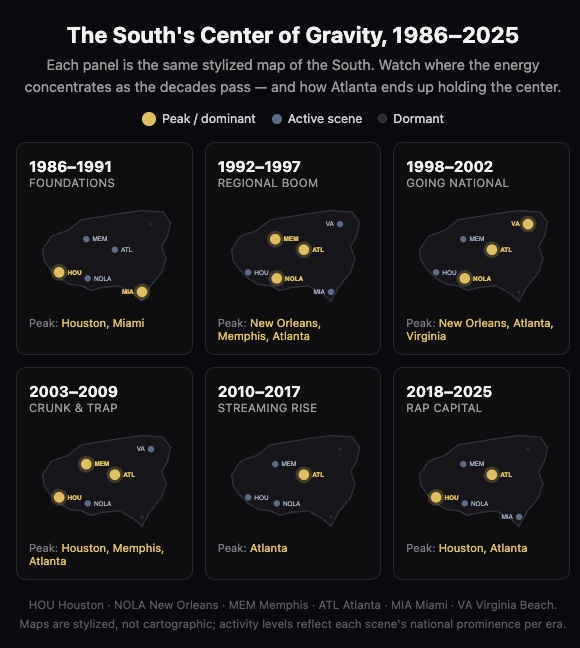

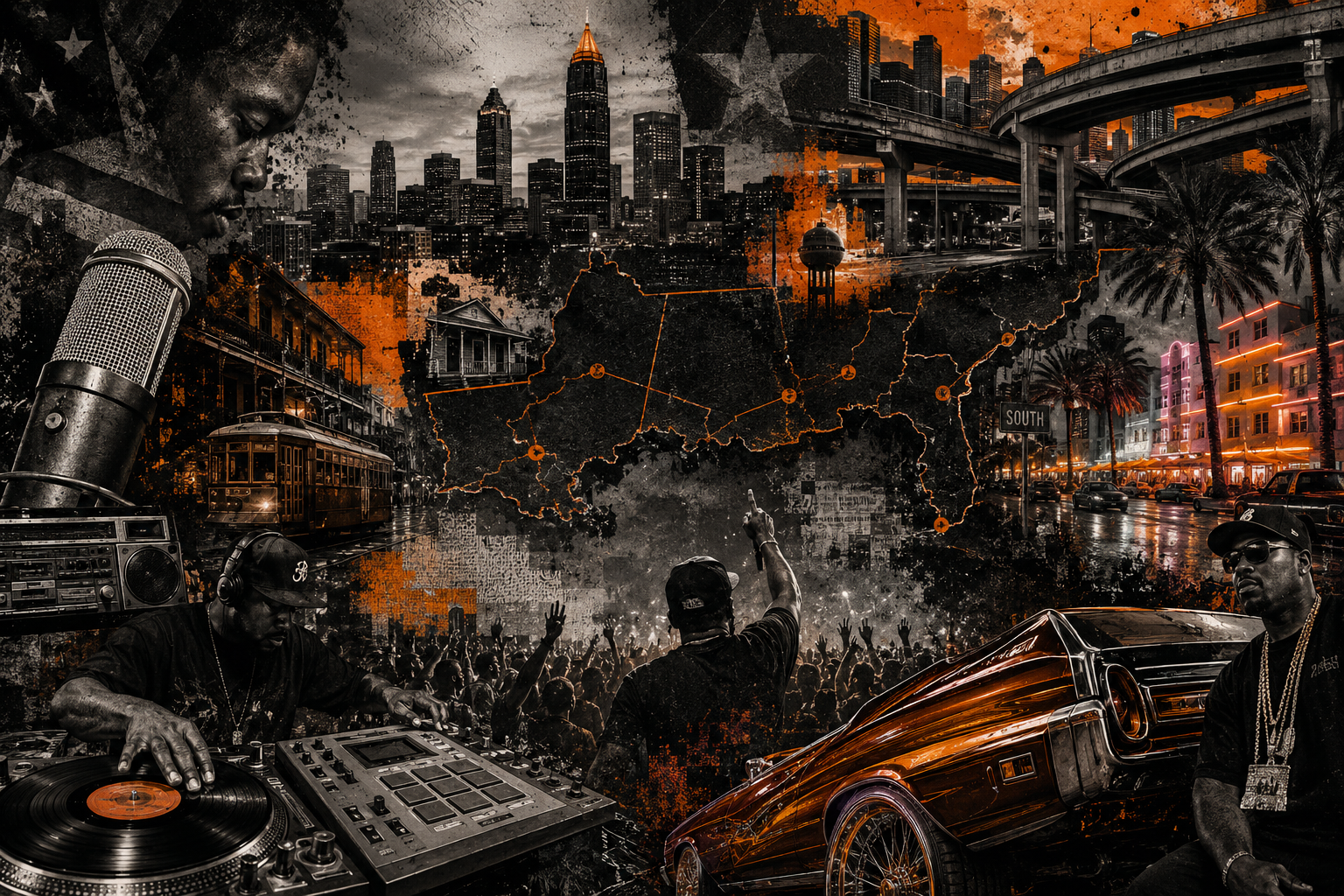
For two decades, the conventional history of hip-hop ran through New York and Los Angeles. Then it didn’t. By the mid-2000s, the genre’s commercial and cultural center had migrated south — to Atlanta, Houston, New Orleans, Memphis, Miami, and Virginia Beach — and by the 2010s, “Southern rap” had stopped being a regional descriptor and started being a synonym for rap itself. The story of how that happened isn’t really a story about beats. It’s a story about labels, distribution deals, tape culture, mixtape economies, and a stubborn regional refusal to wait for coastal permission. The sound followed the infrastructure.
I. Miami Bass and the First Southern Beachhead
Miami bass arrived in the mid-1980s as the South’s first nationally legible rap sound: 808-driven, low-end physical, built for car audio, skating rinks, and block parties rather than headphones. [WLRN] 2 Live Crew, fronted by Luther Campbell, became its commercial face, and 1989’s As Nasty as They Wanna Be turned a regional dance-rap scene into a national constitutional crisis. [Wikipedia]
The 1990 federal court ruling in Skyywalker Records v. Navarro, declaring Nasty legally obscene, was reversed on appeal, but the litigation produced a second, more lasting victory four years later: the Supreme Court’s 1994 decision in Campbell v. Acuff-Rose, which used 2 Live Crew’s parody of “Oh, Pretty Woman” to expand fair-use doctrine for sample-based music. [Cornell Law] Before Miami bass had a single classic album in the East-Coast critical canon, it had already rewritten parts of U.S. copyright and obscenity law — a Southern scene impacting the legal architecture of music itself.
That early entanglement of Southern rap with federal courts is a recurring theme. From the 2 Live Crew obscenity fight to later RICO prosecutions of trap-era artists, the South has spent four decades being treated as both a commercial frontier and a legal target. The infrastructure conversation cannot be separated from that.
II. Houston: J. Prince, Screw Tapes, and the Independent Template
Houston built the South’s first durable rap business in 1986, when James Prince — J. Prince — founded Rap-A-Lot Records and began assembling what became the Geto Boys. [Wikipedia] The 1991 album We Can’t Be Stopped, anchored by “Mind Playing Tricks on Me,” gave the South a first-rank crossover record and gave Scarface a foundation for one of the most respected lyrical careers in the genre. [Wikipedia]
What made Houston distinctive wasn’t the label model alone. It was the parallel underground that DJ Screw built starting in the late 1980s — the slowed, chopped, repeated cassette aesthetic that became “chopped and screwed.” The Screw Tapes circulated through trunk sales, neighborhood dubs, and the Screwed Up Click, creating a regional economy entirely outside major-label distribution. [University of Houston] When Screw died on November 16, 2000, his sonic language had already escaped Texas; it would resurface in everything from Drake records to Travis Scott’s entire production palette. [Houston Chronicle]
Port Arthur, ninety miles east, gave the South UGK — Pimp C and Bun B — whose 1992 debut Too Hard to Swallow, 1996’s Ridin’ Dirty, and 2007’s Underground Kingz codified the “trill” aesthetic and made the small-city Texas sound canonical. Underground Kingz debuted at #1 on the Billboard 200, arriving the same year Pimp C died and freezing UGK’s late-career triumph into legend. [Wikipedia] Two decades later, Houston would renew its commercial central role through Megan Thee Stallion, whose run since 2019 has been a deliberate reactivation of Houston-specific bravado, technique, and Southern identity. [Britannica]
III. New Orleans: Bounce, Cash Money, No Limit, and the Industrial Model
New Orleans’s contribution to Southern rap came in two parallel streams: bounce, a fast call-and-response party-rap idiom built on the Triggerman beat, and the industrial label complex that exported it. DJ Jubilee’s 1993 “Jubilee All” is widely identified by bounce historians, including Big Freedia, as the first hit bounce record — and the first recorded song to use the word “twerk.” [Oxford American] The genre was made for participatory neighborhood performance, and that local foundation later traveled nationally through Mystikal, Juvenile, and post-Katrina migration.
The institutional engine was two competing label empires. Master P founded No Limit in 1991 in Richmond, California, relocated to New Orleans in 1995, and through a Priority distribution deal turned the operation into the South’s most aggressive late-1990s independent. [Wikipedia] Cash Money, founded by Bryan “Birdman” and Ronald “Slim” Williams in the early 1990s, signed a landmark Universal deal in 1998 that moved New Orleans rap into true major-label scale — and produced Juvenile’s 400 Degreez, the Hot Boys’ Guerrilla Warfare, and the long arc of Lil Wayne’s career. [Wikipedia]
The Cash Money model is the one to study. The Williams brothers kept ownership, used Universal as a distribution partner rather than a creative master, and built a label that could break artists, retain catalog, and survive lineup changes for three decades. Lil Wayne’s Tha Carter VI in 2025 is, in business terms, a direct descendant of the 1998 deal: an artist still anchoring a city’s place in rap, on a label that has outlasted most of the 1990s major-label imprints. [Britannica]
IV. Memphis: The Underground Engine
Memphis is the part of the Southern story that the mainstream often skips, and that mistake hides where a lot of modern rap actually came from. Three 6 Mafia — Juicy J, DJ Paul, Lord Infamous, and a rotating crew — formed in 1991 and built a chant-driven, distorted, horror-inflected sound that would feed crunk, trap, drill, and most of internet rap’s darker descendants. Mystic Stylez, released in 1995, is the underground touchstone; Most Known Unknown went platinum a decade later. [Wikipedia]
The 2006 Academy Award for “It’s Hard out Here for a Pimp,” from the Hustle & Flow soundtrack, was an institutional validation no Southern rap act had received before — an Oscar going to a Memphis group whose previous decade had been spent making music that mainstream radio actively refused to play. [Pitchfork] Memphis’s broader influence is structural in a way that’s still being underestimated: the city’s chant cadences, its production density, and its willingness to push BPM up and tempo signatures sideways shaped the entire post-2010 Southern soundscape.
V. Atlanta: From Dungeon Family to Rap Capital
Atlanta is the South’s largest story and the one that gets the most attention, partly because it’s the city that ended up at the center. The lineage runs from Jermaine Dupri founding So So Def in 1993, to LaFace Records signing OutKast and Goodie Mob, to Organized Noize building the Dungeon Family production ecosystem that gave the city its first canonical sound. [So So Def] OutKast’s 1994 debut Southernplayalisticadillacmuzik announced Atlanta as a serious rap city; their 1998 album Aquemini peaked at #2 on the Billboard 200, went double platinum within a year, and is now widely treated as one of the genre’s canonical works. [WNYC]
The symbolic turning point happened earlier, in 1995, when André 3000 took the stage at the Source Awards in New York after OutKast won Best New Rap Group, faced a chorus of boos, and delivered the line that became the South’s permanent rebuttal to coastal gatekeeping: “the South got something to say.” [YouTube] Three decades later, that line gets quoted whenever a Southern artist sweeps a major-awards cycle — which is now most years.
Atlanta’s defining feature, though, isn’t any single era. It’s elasticity. The city moved from Dungeon Family soul-rap to crunk (Lil Jon, the East Side Boyz, “Yeah!” in 2004) to snap (Dem Franchize Boyz, D4L, mid-2000s) to trap (T.I.’s Trap Muzik in 2003, Jeezy’s Thug Motivation 101 in 2005, Gucci Mane’s run from 2005 onward) to streaming-era melodic trap (Future, Young Thug, Migos, Lil Baby) without losing its institutional grip on the industry. [AJC] The AJC’s history of the city’s sound treats this elasticity as the central fact — Atlanta doesn’t repeat formulas, it absorbs and forwards them.
The label model evolved with the sound. T.I.’s Grand Hustle launched in 2003. Quality Control was founded in March 2013 by Kevin “Coach K” Lee and Pierre “P” Thomas in West Atlanta, and became the home for Migos, Lil Baby, City Girls, and Lil Yachty; it now operates under HYBE America ownership. [Quality Control] Future’s Freebandz, founded in 2011, is less a mass-roster label than an artist-led brand — the modern Atlanta default. [Wikipedia] The thread connecting all of them is the Cash Money lesson: own the catalog, control the pipeline, let majors handle distribution.
VI. Virginia: The Producer-First Branch
Virginia complicates any tidy “Deep South” map of the genre. Norfolk produced Timbaland. Portsmouth produced Missy Elliott. Virginia Beach produced Pharrell Williams and Chad Hugo of the Neptunes, and Clipse — Pusha T and Malice — whose 2002 debut Lord Willin’ proved Virginia Beach could carry a major rap album with a distinct voice. [Pitchfork]
The Virginia branch made its contribution less through one regional sound than through radical production methods. Missy Elliott’s 1997 Supa Dupa Fly, produced almost entirely by Timbaland, broke the rules for what rap and R&B percussion could do; the syncopated, sparse, off-kilter Timbaland palette reshaped hip-hop and mainstream pop from the late 1990s forward. [Britannica] Pharrell and the Neptunes did similar work from a different angle — chrome-and-snap minimalism that defined a decade of crossover pop-rap. [Britannica]
What Virginia proves is that the South’s contribution wasn’t only Black storytelling traditions and 808 physicality. It was also producer-led sonic innovation that mainstream pop absorbed without always crediting where it came from. Any honest map of Southern hip-hop has to make room for it.
VII. Trap and the Streaming-Era Consolidation
Trap is now the Southern story’s longest-running export. T.I.’s 2003 Trap Muzik, released August 19 on Atlantic and his own Grand Hustle imprint, peaked at #4 on the Billboard 200 and gave the genre its canonical name — “trap” referring to the trap houses where the drug economy operated. [Wikipedia] Britannica identifies T.I., Jeezy, and Gucci Mane as the style’s “holy trinity,” with Shawty Redd, DJ Toomp, and later Lex Luger as the foundational producers. [Britannica]
The next sonic leap arrived in 2009–2010, when Lex Luger’s production with Waka Flocka Flame — especially Flockaveli (2010) — hardened trap into a louder, more festival-scaled form. [Britannica] By 2017, Future became the first artist to replace himself at #1 on the Billboard 200 in consecutive weeks, with FUTURE and HNDRXX — a chart feat that crystallized Atlanta trap’s move from regional powerhouse to the music industry’s center of gravity. [Billboard] The same year, Britannica notes, trap dominated U.S. charts strongly enough to help make R&B/hip-hop the country’s #1 genre. [Britannica]
Streaming-era consolidation kept going. Lil Baby’s My Turn debuted at #1 on the Billboard 200 in 2020. Megan Thee Stallion’s Good News followed that year. In 2024, Future and Metro Boomin released We Don’t Trust You and We Still Don’t Trust You three weeks apart — both debuted at #1. [Billboard] In 2025, Lil Baby’s WHAM debuted at #1, and Lil Wayne added Tha Carter VI to a career that’s now anchored New Orleans’s place in rap for three decades. The South isn’t dominating in any one moment — it is dominating in the aggregate, year after year, across multiple cities and label structures.
VIII. Why the South Actually Won
The sound mattered. The 808s mattered. The chant cadences and the Auto-Tune and the chopped tape culture mattered. But the deeper reason Southern hip-hop displaced coastal rap as the genre’s commercial center is structural, not stylistic. Southern artists developed in places with weaker legacy music infrastructure, and that absence forced an unusually strong local entrepreneurship: independent labels, trunk sales, mixtape circuits, car culture, strip-club records, neighborhood DJs, regional radio, and self-contained talent pipelines.
That do-it-yourself logic produced not just stars but institutions. Rap-A-Lot, No Limit, Cash Money, So So Def, LaFace, Suave House, Grand Hustle, Quality Control, Freebandz — each of these labels broke artists nationally without first asking coastal scenes for permission. [AJC] Each of them owned masters, retained leverage, and survived its founders’ arrests, business reversals, and creative reinventions. That is the part of the story that doesn’t show up on a “best Southern albums” list, and it is the part that explains why no coastal counter-movement has been able to dislodge the South in twenty years.
Where the Sound Goes Next
As of 2026, no honest version of the Southern story still calls the region an “emerging” challenger inside rap. It is the form rap most commonly takes. Atlanta is the rap capital. Houston is still producing top-tier mainstream stars. New Orleans remains anchored by Lil Wayne. Memphis’s underground keeps feeding new waves — the chant patterns and BPM choices that powered Three 6 Mafia in 1995 are audible in a generation of streaming-era rappers most of whom couldn’t name them. Virginia keeps producing rooms-full of producers. Miami bass is back as a TikTok aesthetic.
The honest question now isn’t whether Southern rap matters — it’s whether anyone is still trying to argue it doesn’t. André 3000 said “the South got something to say” in 1995. Three decades and a few dozen institutions later, the South has said it, and it’s still talking