
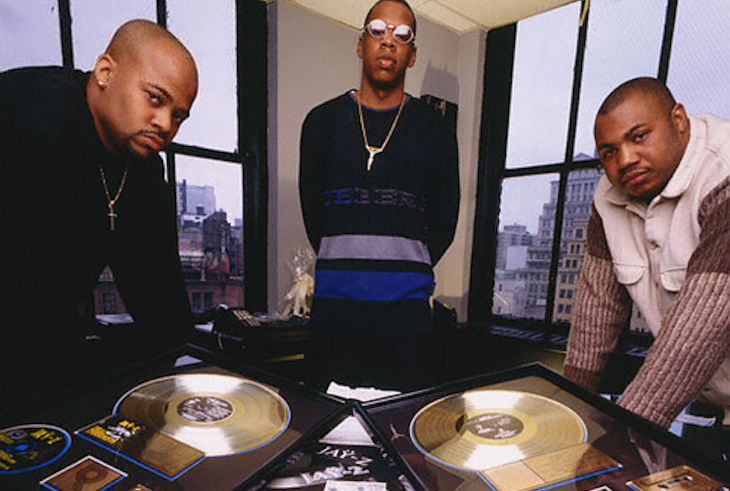
Roc-A-Fella Records was founded in 1995 by Damon Dash, Jay-Z, and Kareem ‘Biggs’ Burke after labels passed on Jay-Z. Launched with 1996’s Reasonable Doubt, it grew into a hip-hop empire spanning music, film, and fashion before partner disputes, especially between Dash and Jay-Z, fractured the label and its legacy.
Key Facts
- Type: Record label
- Founded: 1995 — Damon Dash, Jay-Z, Kareem ‘Biggs’ Burke
- Launched with: Reasonable Doubt (1996)
- Fall: Partner disputes (Dash vs Jay-Z)
Roc-A-Fella Records: The Rise, the Fall, and the Feud That Won’t End
Roc-A-Fella Records was not just a rap label. It was, for a brief and extraordinary window in the late ’90s and early 2000s, one of the most culturally potent independent business ventures in Black music history — a label that launched Jay-Z, introduced Kanye West, and built a brand identity that made the Roc-A-Fella diamond hand gesture synonymous with a specific kind of Harlem-rooted, aspirational, unapologetic Black success. The fact that it ended in lawsuits, public feuds, auctioned stakes, and decades of mutual recrimination is partly a story about ego and money. But it is also a story about what happens when three men build something together that only one of them can ultimately control.
Three Men, One Vision
Roc-A-Fella Records was founded in 1995 by Shawn “Jay-Z” Carter, Damon Dash, and Kareem “Biggs” Burke. [1] The three men came from different corners of New York but shared the same baseline conviction: Jay-Z was too good to be ignored, and if the major labels were going to keep passing on him, they would build the infrastructure themselves. Dame Dash, an Harlem native with relentless hustle and a talent for promotion, became the front-facing force. Biggs Burke handled operations. Jay-Z made the music. The division of labor was clear from the start, and for years it worked.
Jay-Z had been trying to land a major-label deal since the early ’90s, with little success. Roc-A-Fella gave him a vehicle to release his debut on his own terms. Reasonable Doubt, released in 1996 through Priority Records as a distribution partner, became an instant critical landmark — a dense, cinematic album of street autobiography and Mafioso imagery that established Jay-Z as a lyricist of the first order. It sold modestly on initial release but built a devoted following that never went away. [2] The album’s critical reputation has only grown; it is regularly cited among the greatest hip-hop records ever made.
Building the Empire
In 1997, Jay-Z and his co-founders sold a 50 percent stake in Roc-A-Fella to Def Jam for a reported $1.5 million — a strategic deal that gave them distribution muscle and major-label resources while retaining the other half of the company. [3] What followed was a run of commercial and critical dominance that few labels in any genre have matched. Jay-Z released a new album almost every year, stacking platinum certifications from In My Lifetime, Vol. 1 through Vol. 2… Hard Knock Life to The Blueprint (2001), which arrived on September 11, 2001 and still managed to debut at number one.
The roster expanded to match. Memphis Bleek, Beanie Sigel, and the State Property collective gave Roc-A-Fella its Philadelphia wing. Freeway, Young Gunz, and others filled out a label that felt like a movement rather than a business. [4] The most consequential addition came when Jay-Z signed Kanye West — then primarily a producer known for his sped-up soul samples — and backed the making of The College Dropout (2004) over the resistance of executives who doubted West could sell records as an artist. That album debuted at number two, went triple platinum, and turned Kanye West into a star. Roc-A-Fella, at its peak, had both the most commercially dominant rapper in the game and the most creatively exciting new voice in it.
The Def Jam Deal and the Beginning of the End
Seven years after selling the first half, Def Jam purchased the remaining 50 percent of Roc-A-Fella in 2004 for $10 million — a sale that effectively ended the label as an independent entity and placed the entire enterprise inside the Universal Music Group apparatus. [3] In 2005, Jay-Z was named president and CEO of Def Jam itself — a deal that elevated him from artist to executive while sidelining Dame Dash, whose power base had been the independent Roc-A-Fella structure rather than the major-label world Jay was now running. [5]
The partnership had been fraying for years before the formal split. The two men had fundamentally different styles: Dame was flamboyant, confrontational, and resistant to compromise — the energy that made him an effective street promoter was the same energy that created friction with label executives and corporate structures. Jay-Z, operating with increasing sophistication as a businessman, was moving toward exactly those structures. By the time Def Jam bought the second half of Roc-A-Fella, the relationship between its two most visible founders was essentially over. The label’s catalog — including Reasonable Doubt — was now split three ways, with Jay-Z, Dame Dash, and Biggs Burke each holding a one-third interest. [6]
In 2008, Jay-Z launched Roc Nation — his own entertainment and sports management company — as a joint venture with Live Nation, closing the chapter on Roc-A-Fella entirely and establishing a new platform that reflected how far his ambitions had grown beyond the original label. [5]
The NFT Lawsuit: Reasonable Doubt as a Battlefield
For years after the split, the Dame Dash–Jay-Z relationship simmered in public statements, interviews, and occasional podcasts where Dame relitigated grievances about credit, respect, and who really built Roc-A-Fella. The tensions went legal in 2021 when Dame attempted to mint and sell his interest in Reasonable Doubt’s copyright as a non-fungible token at auction. Roc-A-Fella — controlled enough by Jay-Z’s interests to act — filed suit in New York, arguing that Dash had no right to sell the copyright or any individual ownership interest in the album, because he owned a partial stake in the company that held the copyright, not the copyright itself. A judge blocked the NFT sale. [7]
Dame publicly called the lawsuit “embarrassing,” framing it as Jay-Z using the legal system as a weapon against a former partner rather than handling a dispute between men who had built something together. [8] The case settled with Dame retaining the right to sell his one-third stake in Roc-A-Fella Records, but permanently prohibited from disposing of any property interest in Reasonable Doubt itself. [9]
The Financial Collapse: From Roc-A-Fella to $100
Dame Dash’s post-Roc-A-Fella trajectory became one of the most dramatic falls from cultural prominence in hip-hop business history. By 2024, he faced an estimated $25 million in combined debt, including federal and state taxes, child support, and civil judgments. [10] His one-third stake in Roc-A-Fella — his most significant remaining asset from the label’s founding days — was auctioned at a Manhattan sale in November 2024 to satisfy his tax debt. New York State entered the winning bid of $1 million, purchasing the 33.3 percent stake on behalf of the state’s tax authority to help recover $8.7 million in unpaid taxes; the bid also covered more than $193,000 in outstanding child support. [11]
The auction had its own drama. Dame’s lawyer publicly accused Jay-Z of actively working to suppress the sale price, alleging that he had withheld paperwork critical to properly valuing the stake — making it difficult for potential buyers to assess what they were actually bidding on, and effectively keeping bids low on an asset that should have been worth far more than $1 million. [12] Jay-Z did not publicly respond to the allegation. The sale proceeded, and New York State became the owner of a piece of the label that once defined an era.
The losses continued. In December 2025, Dame’s film company, Poppington LLC — a vehicle he had used for years to pursue an independent film career after leaving the music business — was auctioned off to satisfy nearly $1 million in additional judgments against him. The winning bid was $100.50. The buyer was Mike Muntaser, CEO of a rival film company and holder of a $973,000 defamation claim against Dash arising from comments Dame had made on the Earn Your Leisure podcast. Muntaser described the purchase as “a jab” at Dash for prolonging years of litigation. [13] The man who once co-ran one of the most valuable labels in hip-hop watched his film company change hands for less than the price of dinner.
Jay-Z Fires Back: The Roots Picnic Freestyle
Jay-Z had, for years, chosen silence over engagement when it came to Dame Dash. His pattern was to let the legal system speak and to decline the kind of public back-and-forth Dame clearly preferred. That changed, partially, on May 30, 2026, when Jay headlined the Roots Picnic in Philadelphia and opened his set with a freestyle that addressed a long list of critics — Dame Dash explicitly among them — alongside Drake, Kanye West, Nicki Minaj, Tory Lanez, and others. [14] The bars directed at Dame were sharp and specific, hitting at physical decline and the distance between where Dash stood now and what he had once been. The crowd’s reaction confirmed that the lines landed.
Dame’s response was characteristically loud. He publicly said he was “embarrassed” for Jay-Z and took to social media to mock Jay’s new hairstyle — the afro Jay had unveiled at the Roots Picnic. [15] It was a deflection as much as a response: when someone fires bars at your situation, mocking their hair is a way of refusing to engage with the substance. The exchange illustrated the entire dynamic of their post-Roc-A-Fella relationship in miniature. Jay-Z speaks through lawyers, then through music on rare occasions. Dame speaks constantly, loudly, and through every platform available. Neither is really listening to the other.
What Remains
Roc-A-Fella Records still exists as a legal entity, though the Def Jam-era sale and the decades of subsequent litigation have reduced it to a catalog and a corporate shell. Jay-Z owns his one-third interest. New York State now holds Dame Dash’s former one-third, which it is trying to liquidate to recover his tax debt. Biggs Burke’s stake remains in his hands. Reasonable Doubt — the album that started everything, recorded by a man nobody wanted to sign — is still split three ways, still generating licensing and streaming income, and still the subject of ongoing legal attention whenever one of its owners tries to do something with their share that the others won’t allow.
The story of Roc-A-Fella is ultimately about the gap between building something and owning it. Dame Dash, more than anyone, understood the culture and the energy that made the label possible. Jay-Z, more than anyone, understood how to convert that energy into lasting institutional power. For a moment in the late ’90s and early 2000s, those two capacities were in productive alignment. What remains — auctions, lawsuits, $100 film companies, Roots Picnic freestyles — is what happens when that alignment permanently breaks down, and neither side can let go of what they built together.
Sources
[1] Billboard Magazine Archive — Roc-A-Fella founding
[2] Hip Hop Around the World — Reasonable Doubt (1996)
[3] Jay-Z, Dame Dash Sell Roc-A-Fella; Jay Named Def Jam Prez — MTV News
[4] Jay-Z — Google Books (Memphis Bleek, Beanie Sigel, Kanye West)
[5] Jay-Z Starts New Entertainment Company — The New York Times
[6] What’s Happening With Dame Dash’s Shares of Roc-A-Fella? — Rolling Stone
[7] Roc-A-Fella Sues Damon Dash Over NFT of Jay-Z’s Reasonable Doubt — Pitchfork
[8] Dame Dash Says Jay-Z Lawsuit Is “Embarrassing” — AllHipHop
[9] Jay-Z, Dame Dash Settle Reasonable Doubt NFT Lawsuit — Rolling Stone
[10] Dame Dash Could Be Forced to Auction Off More Assets to Satisfy Hefty Debts — HipHopDX
[11] Dame Dash’s Share of Roc-A-Fella Purchased by New York State to Help Settle Tax Debt — HipHopDX
[12] JAY-Z Sabotaging Dame Dash’s Roc-A-Fella Auction, Says Lawyer for City of New York — Yahoo News
[13] Dame Dash’s Film Company Sells for $100 as He Faces Mounting Legal Debts — Yahoo Entertainment
[14] JAY-Z Opens 2026 Roots Picnic Set with a Scathing Freestyle — Revolt TV
[15] Dame Dash Says He Is “Embarrassed” for Jay-Z, Criticizes His Hair — HotNewHipHop