
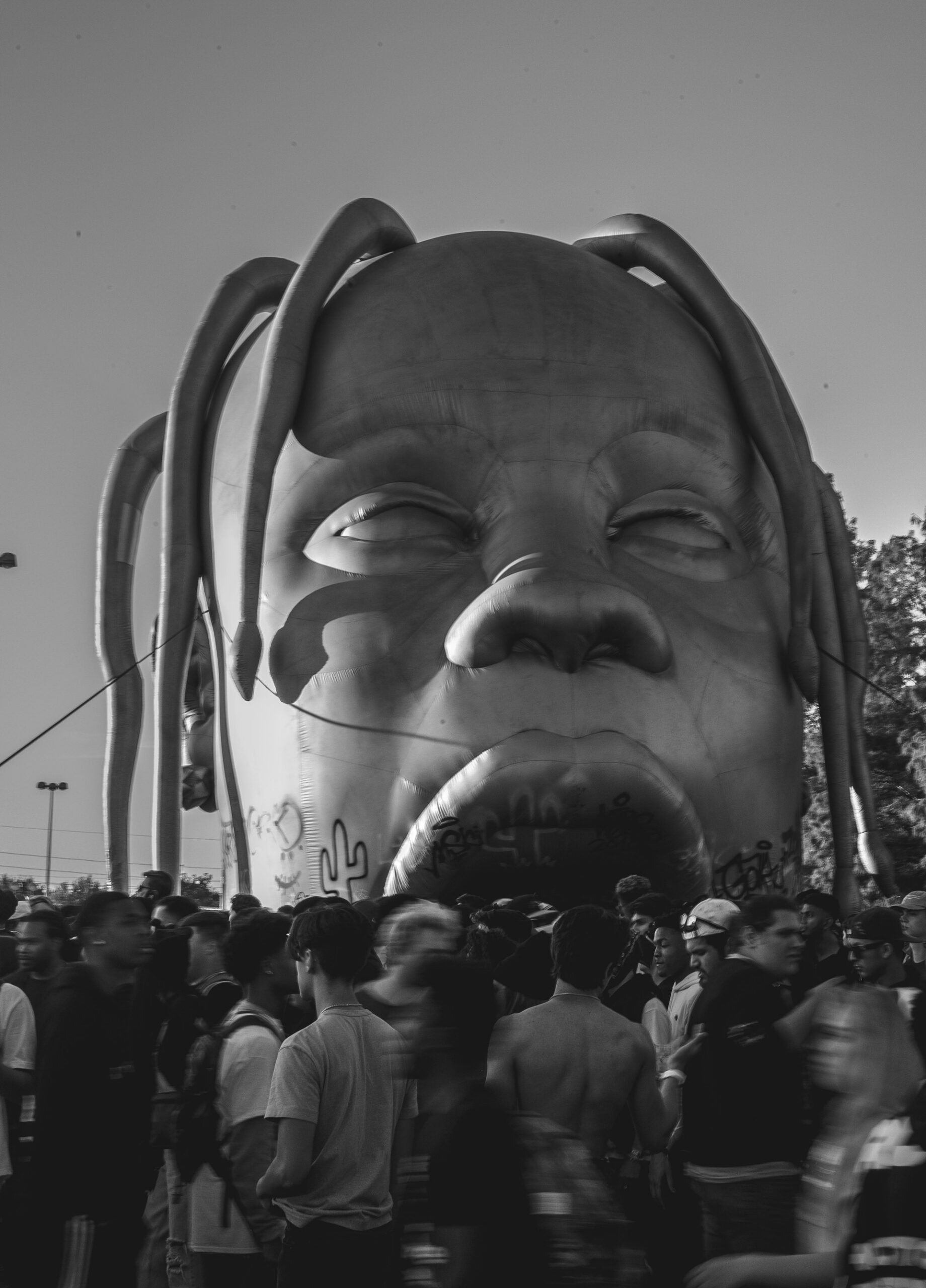
Today’s hip-hop tape is all tension and legacy: Travis Scott may have quietly tugged at a rising Houston rival, Drake is fighting off both a streaming fiasco and a beat-theft allegation, Jay-Z’s aura reportedly cools a Rick Ross flare-up, Lauryn Hill reframes her long silence as resistance, and the culture keeps stretching—from Lupe’s Food & Liquor anniversary run to Wu-Tang’s film experiment in Europe, Yachty’s Concrete Boys sneaker ambitions, and a long-awaited turn in the Young Dolph case.[hiphopsince1987]
Travis vs. The Panther: Houston Subtweets Get Cinematic
Travis Scott—who almost never tweets in full sentences—suddenly jumped on X to talk about “movies” and a “chase” inside them, right as Houston upstart RKM Legend is rolling out his Phase 1 project as a literal short film built around a predator alter ego called The Panther.[hiphopsince1987] The overlap isn’t subtle: RKM has framed his whole identity as a hunt inside cinematic language, and Travis randomly invoking that same world reads like a quiet signal that he sees the kid in his rearview.
If it’s a sneak diss, it’s also a status check. Legacy star acknowledging underground pressure—without naming names—is how local tension becomes narrative. Houston has a “secret” buzzing in the underbelly; once a superstar engages that ecosystem, those whispers are one blog post away from becoming a storyline the rest of the internet has to care about.[hiphopsince1987]
Learn more about Travis vs. The Panther
Drake vs. The System: Streams, Stans, and a Beat Allegation
Spotify had to publicly walk back a record-breaking claim for ICEMAN cut “Make Them Cry” after admitting manual review errors merged two different tracks’ streams, inflating the song’s debut.[allhiphop] They re-ran the data, gave Drake back the macro titles—most-streamed artist and most-streamed album in a single day in 2026—while confirming BTS still owns the year’s biggest individual song debut with “Swim.”[allhiphop] The real shock was procedural: a trillion-dollar platform essentially hand-counting streams in 2026, cracking open long-held suspicions about opacity in the streaming era.[allhiphop]
Layer that with the fact “Make Them Cry” literally name-checks BTS, helping their ICEMAN reaction clip go viral, and you get a fandom proxy war—OVO diehards vs. ARMY—supercharged by corporate sloppiness.[allhiphop] Then, on a different front, Florida rapper 1900Rugrat is accusing Drake of lifting the beat for ICEMAN cut “Little Birdie” from “Intro,” a track Rugrat says he once sent Drake’s team when they expressed interest, only to later decline using it on Drake’s album.[hiphophero]
He claims the intro was the only beat he ever produced himself, and that when he heard ICEMAN he immediately recognized a repitched version of his work.[hiphophero] Allegation isn’t guilt, but this is the modern remix of an old story: power-artist discovers underground talent, boosts them publicly, and later gets accused of raiding the hard drive. In the streaming age, these disputes don’t just test ethics—they test what “influence” and “reference” even mean when everything is one DM away.
Learn more about Drake vs. The System
Jay-Z, Rick Ross, and Conflict Management as Quiet Power
Rick Ross recently fired at Kareem “Biggs” Burke—Roc-A-Fella co-founder, long framed as the money, strategist, and sometimes muscle behind the Roc—and also at podcasters Rory and Mal, one of whom is Biggs’ brother.[allhiphop] For anyone who understands that era, going at Biggs is essentially poking at Jay-Z’s original infrastructure, not just an industry suit.
Whatever sparked Ross’s outburst remains unclear, but what matters is the aftermath: he’s already backpedaling, and the streets are reading that as Hov quietly stepping in to cool things down.[allhiphop] If true, it’s classic Jay—no public speech, just phone calls and pressure. In an age where most rap conflict is content, this has the opposite energy: powerful people deciding a storyline doesn’t even deserve to exist.
Learn more about Jay-Z, Rick Ross, and Conflict Management
Lauryn Hill Explains the Silence—On Her Own Terms
Lauryn Hill jumped into an Instagram comment section to push back on narratives about why she never followed up 1998’s The Miseducation of Lauryn Hill, instead offering her own framing.[hiphophero] She describes the “drain” of trying to create with integrity, the difficulty of finding safety, and how wild success can breed greed that “degenerate[s] the art for the money.”[hiphophero]
Positioning herself as a “Harriet Tubman figure,” she argues that systems fear uncompromised creativity and that her contribution was introducing new standards and possibilities to a generation.[hiphophero] Whether you agree with the self-mythology or not, it clarifies something crucial: for Hill, the absence is not about inability or indifference—it’s protest against conditions she refuses to work under. In a moment where every rapper is told to feed the algorithm, her stance lands like a counter-programming manifesto.
Learn more about Lauryn Hill Explains the Silence
Young Dolph: A Legal Chapter Closes, The Cultural One Doesn’t
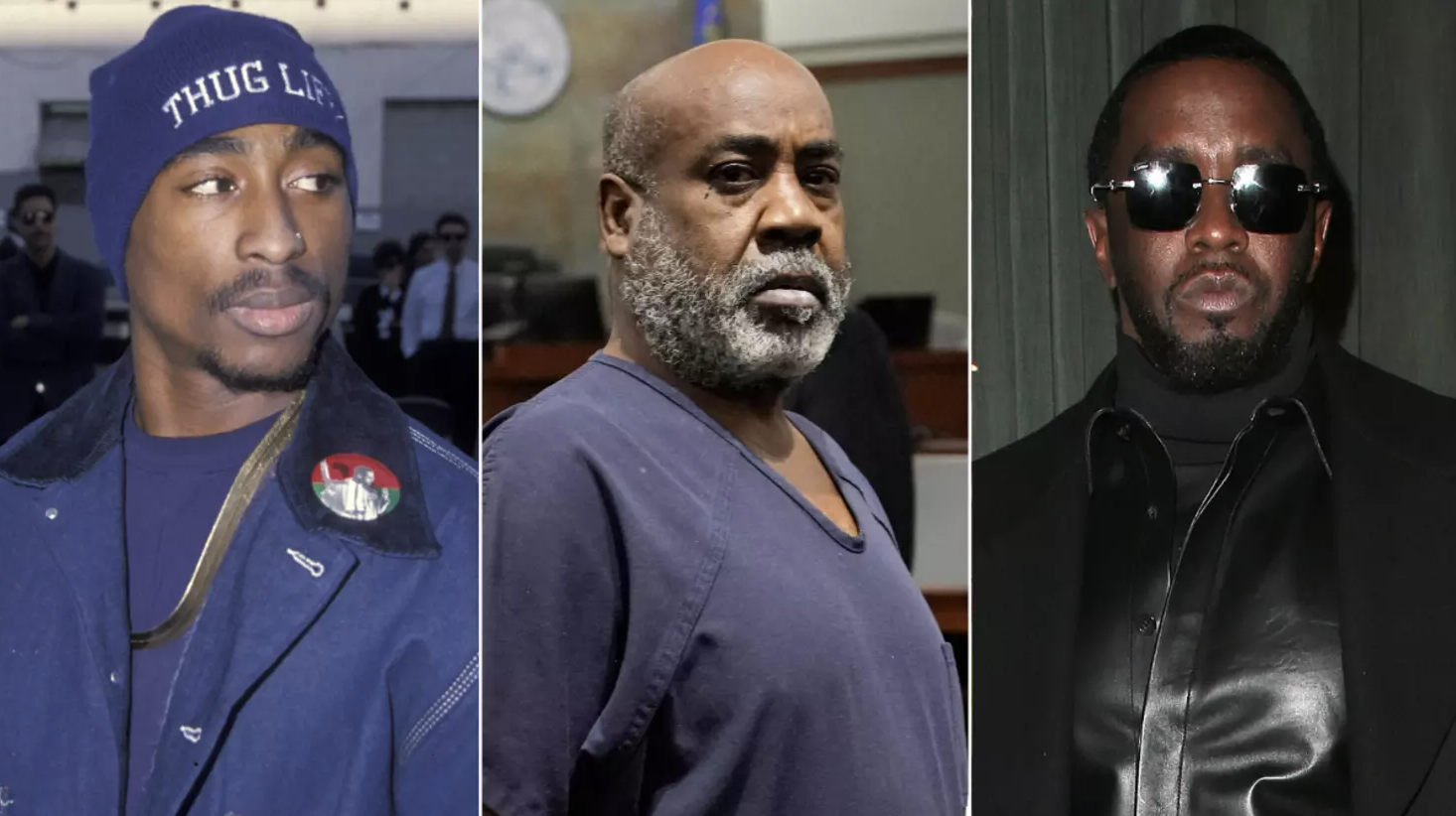
Cornelius Smith, the final man charged in Young Dolph’s 2021 murder, pleaded guilty to second-degree murder and received a 20-year sentence, which he’ll have to serve in full.[hiphophero] Prosecutors say he cooperated, testifying that he and Justin Johnson carried out a planned gang-related hit; Johnson is already serving more than a life term after his conviction and failed appeal.[hiphophero]
Deputy DA Paul Hagerman emphasized Dolph not just as an artist but as a “cherished Memphian” and city believer, underlining how local the loss remains even as the legal process winds down.[hiphophero] This doesn’t heal the trauma around a rapper gunned down while supporting a neighborhood business, but it does close the official narrative. The unresolved part is what Memphis hip hop looks like without one of its most outspoken independent voices.
Learn more about the Young Dolph Case
Legacy Work: Wu-Tang, Lupe, and the Long Tail of Classic Albums
RZA’s A Wu-Tang Experience is rolling out as a traveling, cinematic format across Europe, with first stops locked for Amsterdam and Rome.[mrcnnlive] Framed as more than a standard film release, it’s designed as a curated journey that plugs directly into local scenes, backing up Wu-Tang’s long-held mythology as global, not just New York.[mrcnnlive] It’s legacy management in motion: moving the brand from just music and merch into ritualized cultural events.
In LA, Lupe Fiasco ran through Food & Liquor front to back at a sold-out Wiltern, part of his 20th-anniversary tour for the 2006 debut.[undergroundhiphopblog] Fans got the full album experience, reminding everyone that his blend of sharp lyricism and social commentary still hits two decades later.[undergroundhiphopblog] In a streaming ecosystem obsessed with new drops, these curated retrospectives are doing real work: teaching younger heads how to sit with albums again, while monetizing catalog in a way that feels like ceremony, not nostalgia-bait.
Learn more about Wu-Tang, Lupe, and the Long Tail of Classic Albums
Brand Futures: Lil Yachty’s Concrete Boys and the AF1 Canvas
Lil Yachty’s Concrete Boys collective is testing a Concrete Boys x Nike Air Force 1 Low sample, leaning on his existing relationship with Nike and the AF1’s deep history in hip hop.[hotnewhiphop] The low-top white Force has been one of the culture’s main canvases since the ’80s; it’s over-collaborated, but that’s the point—if you get to put your flag on that silhouette, it’s a sign your imprint is real.[hotnewhiphop]
This isn’t just merch. Concrete Boys has been slowly building out as a creative ecosystem, and a potential AF1 retail release would mark a shift from “Yachty and friends” to a fully-branded movement living in closets, not just playlists.[hotnewhiphop] No release info yet, but even the sample leak shows how every serious rap collective now thinks in terms of IP and product, not just projects.
Learn more about Lil Yachty’s Concrete Boys and the AF1 Canvas
Global & Underground Notes: From Belgrade to Christian Hip Hop Stages
In Belgrade, rapper Ukov dropped his second studio album Borčanski Jazz, a 15-track set with region-wide features and videos shot for every song, all directed by him.[blackouthiphop] He makes it explicit that the “jazz” in the title is about the spirit of the Danube and local life, not the sonics, pitching it as a record “for everyone who is awake.”[blackouthiphop] It’s another data point in Eastern Europe’s ongoing build-out of self-defined hip hop narratives that don’t lean on U.S. co-signs.
On the niche-but-growing side, Christian hip hop artist tonyxtrotter is jumping straight from no CHH performances to one of the biggest festivals in that lane, bypassing the usual grind of small shows and cutting his teeth in front of a massive crowd.[rapzilla] Coupled with his insistence on East Coast-influenced boom-bap over his West Coast roots, it’s a reminder that even in micro-scenes, regional stylistic lines are more porous than ever.[rapzilla]
Learn more about Global & Underground Notes
Bottom Line
Today’s stories all orbit the same gravity: control. Control of narrative (Travis vs. RKM, Ross vs. Biggs), control of numbers (Spotify’s manual counting, Drake vs. BTS), control of art and labor (Lauryn Hill’s refusal, Rugrat’s accusations), and control of legacy (Wu-Tang’s film roadshow, Lupe’s anniversary tour, Concrete Boys stepping into sneaker culture).
Hip hop is in a phase where every move—tweet, tour, collab—doubles as a statement about who owns the work and what the culture will and won’t accept from its institutions.