
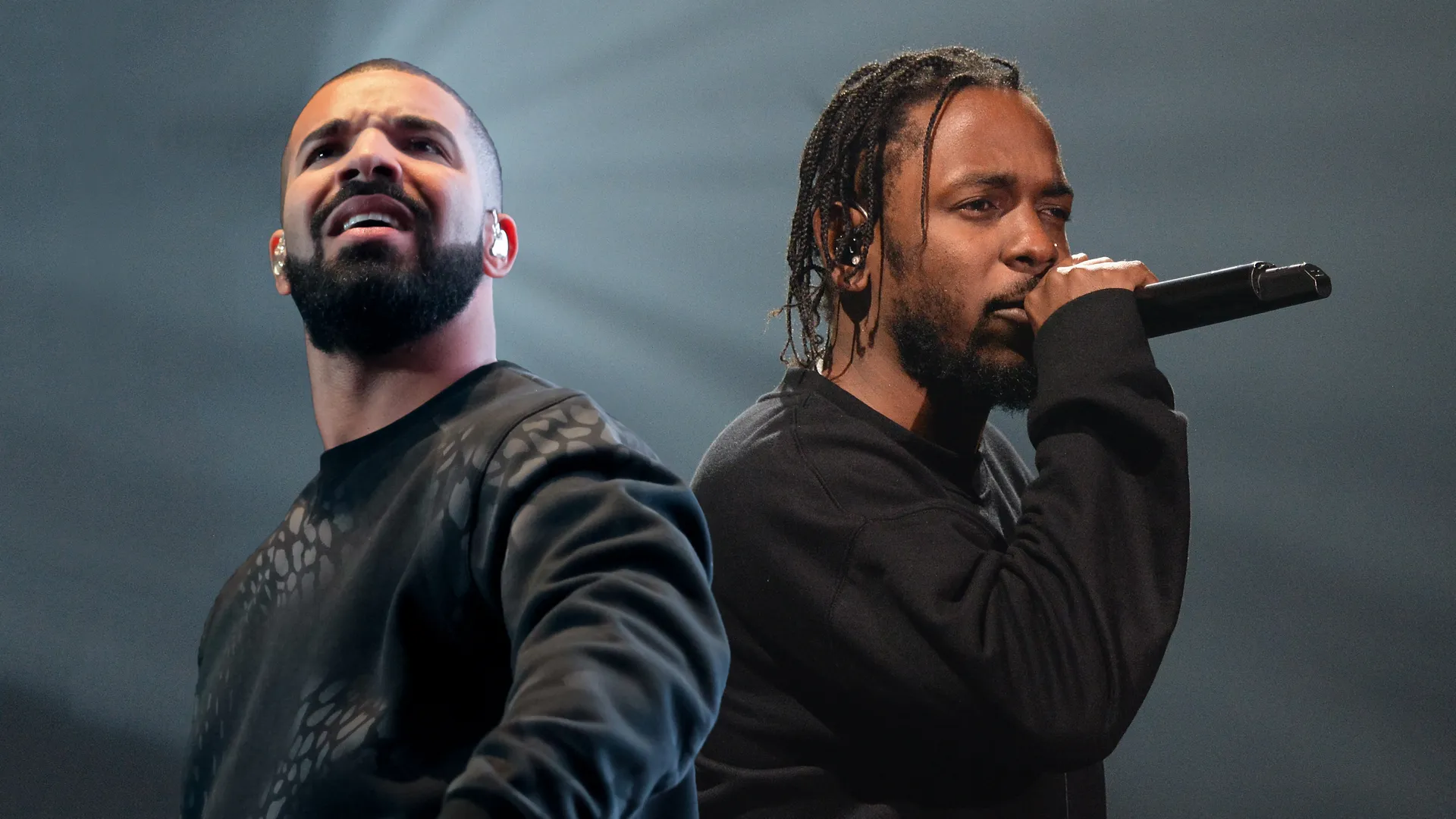
Drake versus Kendrick Lamar was less a traditional beef than a case study in modern rap warfare. The on-record battle ran roughly eight weeks from March to May 2024, producing ‘Not Like Us’ and a near-consensus Kendrick victory. Drake then tried to win it back in the press, on the charts, and in court.
Key Facts
- Parties: Drake; Kendrick Lamar
- Music battle: ~March–May 2024 (~8 weeks)
- Flashpoint: ‘Not Like Us’
- Outcome: Kendrick widely seen as winner
- Aftermath: Drake’s chart/press/legal counter (UMG suit)
Drake vs. Kendrick Lamar: The Complete Record
A comprehensive breakdown of the battle, the legal war, and where it stands in 2026
Drake vs. Kendrick Lamar is not a beef story in the traditional sense. It is a case study in what happens when the biggest rapper of a generation loses a public war on the mic and then tries to win it back in court, in the press, and on the charts. The actual music battle — running from March 2024 through May 2024 — lasted barely eight weeks and produced what most of the culture now treats as a closed verdict. The legal war that followed has already consumed more time, more paper, and more institutional energy than the music ever did, and as of early 2026, it remains unresolved. Together, these two arcs have generated a federal court ruling that could define what artists can sue each other over for decades, a major precedent on how labels bear responsibility for amplifying accusations in diss records, and a live demonstration of how a 10-year competitive cold war can erupt, burn through a news cycle, and calcify into settled history in the span of a single summer.
The short version: Kendrick won on the mic. Drake is still fighting everywhere else.
Origins: From “Control” to the Cold War (2013–2023)
The competitive tension between Drake and Kendrick Lamar is not a product of 2024. It was planted in 2013, when Kendrick appeared on Big Sean’s “Control” and called out Drake by name — not as a threat exactly, but as a declaration that he intended to outrap every peer he had. [AllHipHop] That verse didn’t launch a response cycle, but it drew a line: Kendrick as the one willing to name names when everyone else was playing nice. It established him as the aggressor in the lyrical hierarchy conversation at a moment when Drake was dominating the charts and the culture without serious challenge.
What followed over the next decade was a cold war. Both artists publicly downplayed any real beef, but their records told on them — sneak disses, competitive bars, and a slowly escalating tension around the question of who the actual best rapper of the era was. The “Big Three” narrative that emerged (Drake, J. Cole, and Kendrick as the era’s dominant trio) gave both artists a comfortable framing that kept hostilities at a distance. They were peers. They coexisted at the top. That framing held for ten years. [AllHipHop] Then Kendrick blew it up in a single verse.
Ignition: “Like That” and the Death of the Big Three (March 2024)
The quiet ended in March 2024. On Future and Metro Boomin’s “Like That,” Kendrick rejected the Big Three framing entirely and declared himself the era’s sole leader. [AllHipHop] That’s not just a shot — it’s an attempt to rewrite the mythology of an entire era in real time. J. Cole, to his credit, read the room quickly and stepped back. Drake did the opposite. He engaged, responding with “Push Ups” and “Taylor Made Freestyle” and choosing direct war over the more defensible position of treating Kendrick’s verse as beneath acknowledgment. By engaging, Drake removed any plausible deniability. The beef was now official.
Behind the scenes, 21 Savage later claimed he saw what was coming and warned Drake to sit this one out when Kendrick’s first full reply dropped — telling him directly, several times, not to keep escalating. [HipHopHero] That warning went unheeded, and the decision to keep pushing would shape everything that followed.
Full-Scale War: euphoria Through Not Like Us (April–May 2024)
In late April 2024, Kendrick dropped “euphoria” — a six-minute surgical dissection of Drake’s persona, artistry, and alleged manipulations. [AllHipHop] He called Drake a “scam artist” and a “pathetic master manipulator,” signaling clearly that this wasn’t just a verse-for-verse competition — he was going after Drake’s entire mythology, the construction of the persona itself. It’s the moment the beef shifted from competitive to existential.
A few days later, Kendrick posted “6:16 in LA” directly to Instagram with cover art showing a Maybach glove on a table — the “gloves are off” visual playing on Drake’s own timestamp-song tradition. The track introduced one of the most unsettling angles of the entire battle: the suggestion that people inside OVO were feeding Kendrick information. “Have you ever thought that OVO is workin’ for me? / Fake bully, I hate bullies, you must be a terrible person / Everyone inside your team is whispering that you deserve it.” [AllHipHop] Whether or not any of that was literally true, the rhetorical damage was real — it introduced paranoia as a weapon.
Hours later, Drake answered with “Family Matters.” He acknowledged Kendrick had crossed a line by invoking his son Adonis, and he retaliated by dragging Kendrick’s partner Whitney into the conflict. That’s the moment the beef officially tipped from competition into family warfare. [AllHipHop] The rules of engagement, such as they were, had dissolved.
Then came the nuclear stretch. On May 3 and 4, Kendrick released “Meet the Grahams” and “Not Like Us” — back to back, less than 24 hours apart. Both records zeroed in on accusations about Drake’s alleged behavior with minors, framing him as a predator in ways that went well beyond standard battle hyperbole. [AllHipHop] “Not Like Us,” in particular, became the cultural earthquake — an anthem, a meme engine, and the track that in most public narratives cemented Kendrick’s win before Drake had time to respond. Drake answered with “The Heart Part 6” on May 5, a meta-commentary that was musically clever but arrived into a verdict that had already been rendered. [AllHipHop] The culture had already moved on. The question was no longer who won. It was why Drake was still in the ring.
Find Our How Outlets Are Reporting on the Drake and Kendrick Battle? →
Drake vs. Kendrick: Full Timeline
Click any event to expand. Filter by phase below.
Why It MattersOn Big Sean's "Control," Kendrick names Drake and others as peers he intends to outrap. Sets Kendrick as the aggressor in the lyrical hierarchy conversation and plants the seed of a decade-long tension.
Why It MattersA decade of competitive tension with no open warfare. The "Big Three" (Drake, Cole, Kendrick) framing holds the peace while both artists trade subliminals in their records. This pressure builds everything that explodes in 2024.
Why It MattersOfficial start of open hostilities. Kendrick attempts to rewrite the era's power structure in real time. J. Cole backs down. Drake engages with "Push Ups" and "Taylor Made Freestyle" — removing all plausible deniability about a feud.
Why It MattersDrake chooses war over silence. 21 Savage later reveals he warned Drake to sit this one out after Kendrick's first reply, telling him multiple times not to escalate. The warning goes unheeded.
Why It MattersWidely seen as the turning point. Kendrick calls Drake a "scam artist" and "pathetic master manipulator." The beef shifts from competitive to existential — he's not just battling verses, he's attacking Drake's entire mythology.
Why It MattersFlips Drake's timestamp-song tradition. Introduces the suggestion that OVO insiders are feeding Kendrick information. Whether true or not, the paranoia weapon lands hard inside Drake's camp.
Why It MattersThe moment the beef tips into family warfare. Drake acknowledges Kendrick crossed a line with Adonis, then retaliates by targeting Whitney Alvarado. The rules of engagement are now gone.
Why It MattersThe nuclear phase. Both records accuse Drake of predatory behavior toward minors. "Not Like Us" becomes the cultural earthquake — an anthem, a meme engine, and the track that cements Kendrick's win before Drake can respond. The court later calls this a "seven-track war of words." Every legal filing that follows traces back to these 48 hours.
Why It MattersFinal major diss in the core exchange. Musically clever, but the verdict is already in. Most of the culture treats this as too little, too late. The question shifts from "who won?" to "why is Drake still going?"
Why It MattersGKMC, TPAB, and DAMN. surge simultaneously. Every one of Drake's charting albums falls. The first time Drake's catalog stickiness — his most reliable metric of dominance — visibly cracks. The numbers confirm what the culture already felt.
Why It MattersBecomes a visual referendum on who the culture stands with. Drake later fires back on "What Did I Miss," calling out those he felt switched sides. The subliminal response itself confirms he's still scorekeeping.
Why It MattersConfirms internal doubts existed in Drake's own circle. 21 says he warned Drake multiple times that public perception was stacked against him before the first full Kendrick reply even dropped. The advice went unheeded.
Why It MattersInstitutional validation at the highest level. The NFL doesn't give that stage to anyone they consider publicly toxic. The booking is a quiet verdict — corporate America has made its read on who came out of the beef with their reputation intact.
Why It MattersTransforms the mic battle into a legal war. Petition 1 alleges UMG used bots and payola to boost "Not Like Us" streams. Petition 2 alleges defamation — that UMG knowingly promoted false pedophile accusations. Introduces the label conflict-of-interest narrative. Industry and legal experts immediately call the filings tenuous.
Why It MattersThe financial scoreboard becomes explicit. Kendrick's catalog boost from the beef is significant; Drake's catalog slumped in the same period. Confirms what the chart movement suggested: the battle was a net positive for Kendrick and a net negative for Drake.
Why It MattersEscalates to direct litigation. Drake claims UMG's promotion of "Not Like Us" around the Super Bowl and Grammys contributed to a shooting outside his Toronto home and forced his family to relocate. The framing shifts from competitive injury to physical danger.
Why It MattersCrystallizes the opposing legal theories. UMG: these are hyperbolic insults protected by rap battle tradition. Drake: the record and cover art were designed to convey a specific, unmistakable false factual allegation of pedophilia. The entire case turns on which frame the court accepts.
Why It MattersDrake amends to emphasize UMG's post-release marketing as the aggravating factor. Judge Vargas denies UMG's motion to stay discovery — the case involves "fact-intensive" questions that need evidence before any ruling. A procedural win for Drake; the case stays alive.
Why It MattersWhile Drake litigates, Kendrick's commercial upswing continues. Coverage ties the chart history directly to the 2024 diss run, reinforcing the narrative that the beef was a career accelerant for Kendrick and a drag on Drake.
Why It MattersMajor precedent. In the context of a "seven-track rap battle" and "war of words," reasonable listeners would not treat "Not Like Us" as a factual claim about Drake's conduct. Sets legal limits on diss-track defamation suits. A significant loss for Drake — legally and symbolically.
Why It MattersDrake argues UMG's "aggressive rollout" blurred the line between entertainment and factual allegation, making the reasonable listener standard inapplicable. UMG's posture: he lost a rap battle he started. Appellate outcome pending — could reshape diss-record defamation law.
Why It MattersDrake's 60-page brief and UMG's 83-page response are now cited as the clearest modern articulation of how federal courts separate artistic hyperbole from actionable defamation in rap battles. The case's legacy is already forming independent of its outcome.
Why It MattersRetrospective coverage treats Kendrick's win as canon. "Not Like Us" crowned with year-end honors. The beef has moved into "era-defining" territory. Drake continues releasing music and stray subliminals. The cultural verdict is in. The legal chapter is not.
The Verdict: Cultural Consensus, Catalog Numbers, and the Pop Out
By mid-2024, the consensus was locked. Kendrick had won both the narrative and the streets, and the data backed the perception. In May 2024, Kendrick’s back catalog made huge climbs on the Billboard 200 — good kid, m.A.A.d city, To Pimp a Butterfly, and DAMN. all surging simultaneously. Drake’s catalog, historically one of the most chart-stable in rap history, experienced a rare simultaneous slump: every one of his charting albums fell in position. [HipHopDX] That shift mattered beyond symbolic terms — it was the first time in years that Drake’s usual metric of dominance, consistent catalog stickiness, had visibly cracked.
In June 2024, Kendrick’s “Pop Out” show in Los Angeles became a visual referendum on the beef. Celebrities including LeBron James attended, turning what could have been just a concert into a public statement about whose side the culture was standing on. [AllHipHop] Drake later addressed it on “What Did I Miss,” firing at people he felt had switched sides: “I saw bro in the Pop Out with them but been d*ckriding gang since ‘Headlines.'” The subliminal confirmed he was still watching, still scorekeeping — which itself reinforced the narrative of a man struggling to let the loss go.
Veterans weighed in from the outside. Rick Ross publicly suggested Drake should fall back. Kurupt urged restraint amid rumors of real-world unrest near Drake’s home. Ice Cube noted the stakes felt heavier in an era where every bar is livestreamed to a global audience simultaneously. [HipHopHero] The culture’s elders were treating this as something that had gone further than a rap battle should, and that concern landed before any legal filings had been made.
The Legal Pivot: Drake vs. Universal Music Group
In late 2024, Drake did something no major artist in his position had done before in quite this way: he took the beef to federal court. He filed two pre-action petitions against Universal Music Group, his own label. The first alleged that UMG used bots and payola to artificially inflate streams for “Not Like Us,” boosting Kendrick’s numbers at Drake’s direct expense. The second was a defamation-focused petition accusing UMG of knowingly supporting the release and promotion of a song that contained what Drake characterized as false allegations of pedophilia. [AllHipHop]
The conflict-of-interest argument Drake laid out was structurally coherent, even if legally uphill. Both Drake and Kendrick were signed to UMG-affiliated labels. Drake alleged the label had used its position over both artists to devalue his brand and boost Kendrick’s leverage during contract negotiations, including through undisclosed payments and discounted licensing arrangements for “Not Like Us.” [AllHipHop] In other words: a label using internal competition as a business tool, at one artist’s expense. It’s a compelling theory. Whether it’s a provable one in court is a different question, and industry and legal experts were skeptical from the start. Audiomack co-founder Brian Zisook and multiple entertainment lawyers described the filings — particularly the defamation angle in a rap battle context — as tenuous and unclear in their strategic endgame. [History.HipHop]
Dr. Umar Johnson, in a widely circulated interview, unexpectedly amplified Drake’s core narrative, calling UMG’s dual relationship with both artists a “conflict of interest” and claiming he personally heard “Not Like Us” far more in public spaces than any Drake music — anecdotal, but symbolically significant in terms of who was picking up the label-manipulation framing. [The Source] Kevin Durant publicly stood by Drake as well, a signal that his celebrity alliances remained intact even as he was battling the very institution that powered his career. [The Source]
In Court: Escalation, Amendments, and a Ruling on Discovery
In early 2025, Drake escalated from pre-action petitions to a full-blown lawsuit. He claimed UMG bore responsibility for shootings and break-ins tied to the real-world fallout from Kendrick’s accusations — arguing that the label’s decision to aggressively promote “Not Like Us,” including around the Super Bowl and the Grammys, fueled public belief in the allegations and contributed directly to a shooting outside his Toronto home, a temporary relocation of his family, and a measurable drop in public favorability. [AllHipHop] The framing had shifted: this was no longer just about competitive injury in a rap battle. It was about physical danger, family safety, and what Drake characterized as a “reckless campaign” against him by his own label. [The Source]
UMG pushed back hard and early. A January 2025 filing sought dismissal of Drake’s petition for lack of evidence and characterized his legal wave as “strategic legal retaliation” designed to pressure UMG into limiting “Not Like Us” distribution. They called his filings a “nationwide effort to harass and retaliate” for UMG exercising its free speech rights and asked the court to suspend discovery until a ruling on the merits. [AllHipHop]
The two sides’ core legal positions crystallized in March 2025. UMG filed a memo arguing that Kendrick’s lyrics were rap battle hyperbole — protected artistic expression that no reasonable listener would treat as literal factual claims. Drake countered that the record and its cover art were “intended to convey the specific, unmistakable, and false factual allegation that Drake is a criminal pedophile” — not hyperbole, but character assassination dressed as art. [Complex]
In April 2025, Drake amended his lawsuit to emphasize UMG’s post-release marketing as the aggravating factor, arguing that the label’s “aggressive rollout” crossed the line between publishing a song and actively weaponizing it. Judge Jeannette Vargas denied UMG’s motion to stay discovery, ruling that the case involved “fact-intensive” questions that required evidence-gathering before any dispositive decision could be made. [The Source] It was a procedural win for Drake — not a ruling on the merits, but confirmation that the case wouldn’t be dismissed without a real look at the evidence.
The Dismissal: What the Court Said About Rap Battles and Defamation
In October 2025, Judge Vargas delivered the kind of ruling that could reshape how artists think about suing over diss records. She dismissed Drake’s UMG lawsuit in full, holding that Kendrick’s lyrics in “Not Like Us” were not legally defamatory. Her reasoning was grounded in context: this was a “seven-track rap battle,” a “war of words” that had attracted massive media and public scrutiny from the moment it began. In that context, even a serious accusation like pedophilia does not automatically become defamatory, because a reasonable listener — someone aware of the battle, the genre’s conventions, the hyperbolic tradition of diss records — would not treat the lyrics as verifiable factual statements about Drake’s real conduct. [HotNewHipHop]
The ruling does several important things at once. It draws a legal line around rap battle hyperbole and says that line is meaningful — courts won’t treat what happens in a lyrical war as equivalent to a published factual accusation in a news article. But it also implicitly blesses the idea that aggressive promotion of a battle record does not, by itself, transform protected speech into actionable defamation. For hip-hop, a genre that has long worried about rap lyrics being used against artists in courtrooms, this has a double edge: it protects the creative tradition, but it also means that even the most damaging accusations, if delivered in battle context, may have no legal remedy. [AllHipHop]
Many in the culture had already framed Drake’s choice to sue over lyrics as a violation of hip-hop’s own internal code — the idea that battle rap has always had its own resolution mechanisms, and that walking into federal court to relitigate a mic loss was itself a kind of cultural concession. Vargas’ reasoning nodded to that concern without making it the legal basis for her decision. The 2025 Oscars had already captured the public mood: a joke about “time for Kendrick Lamar to come out and call Drake a pedophile. Don’t worry. I’m lawyered up.” [AllHipHop] Drake had become a punchline in spaces that once treated him as untouchable.
The Appeal: Drake Keeps Fighting (2026)
Drake did not accept the dismissal as the final word. In January 2026, he filed an appeal of Vargas’ ruling, leaning heavily on the rollout argument his amended lawsuit had introduced: that UMG’s “aggressive rollout” of Kendrick’s record and video blurred the line between entertainment and factual allegation in a way that made the reasonable listener standard inapplicable, or at minimum, a question for a jury rather than a judge. [HotNewHipHop]
UMG’s appellate posture, evident from earlier filings, was essentially that Drake lost a rap battle he started and needed to accept that outcome the way any artist who claims to be “unbothered” would. Label as antagonist, but also label as cultural interpreter — pointing out that Drake’s own public persona had been built on confidence and dominance, and that running to court after a competitive loss contradicted both. [AllHipHop]
For the broader industry, the appellate documents themselves have become required reading. Drake’s 60-page brief and UMG’s 83-page response now represent the clearest modern articulation in federal court of how to separate artistic hyperbole from actionable defamation in a rap battle context, and how the republication doctrine might apply when diss records are aggressively marketed on mainstream platforms. [Rap Industry] Every manager and entertainment attorney advising artists on lyrical escalation now has a case file to study. That’s a legacy of the dispute that has nothing to do with who won the battle.
Kendrick’s Post-Beef Trajectory
While Drake fights in courtrooms, Kendrick has been consolidating his win on every other front. The Super Bowl Halftime Show slot — announced in September 2024 and performed in early 2025 — was institutional validation at the highest possible level. The NFL and its broadcast partners do not hand that stage to anyone they believe is carrying meaningful public toxicity. The booking was a quiet verdict. [AllHipHop]
By September 2025, Kendrick was making chart history as the GNX tour continued, with pieces tying his current commercial peak directly back to the 2024 diss run. [AllHipHop] Earnings figures published in December 2025 confirmed what the chart movement had suggested: the beef had been a significant financial accelerant for Kendrick’s catalog, turning a competitive moment into a long-tail revenue event. Drake’s catalog numbers told the opposite story. [HipHopDX]
Even Kendrick’s post-beef creative and touring choices have become micro-analyzed. When he brought Playboi Carti onstage in Atlanta in 2025, critics debated whether it contradicted his earlier jabs at Drake for allegedly leveraging Atlanta for credibility — others countered that Drake had long genuinely supported Atlanta artists, making the criticism misapplied. [AllHipHop] The scrutiny itself is evidence of how central Kendrick has become to rap’s moral and strategic debates in the post-beef era. His decisions are now read as statements, which is its own kind of cultural weight.
Where Drake Stands Now
The question of where Drake goes from here has two parallel tracks that don’t quite connect. On the music side, analysts and critics are split. Some argue he hasn’t fully recovered creatively since the battle, knocked off balance by the scale of a loss he didn’t anticipate. Others maintain he remains capable of making strong records but insists his next direction is crucial — he can’t coast on formula after this. [History.HipHop] Meanwhile, he keeps releasing material — including a loosie project, 100 Gigs — and tossing in stray Kendrick subliminals and trolling clips. Analysts on The Breakfast Club put it plainly: if Drake had won, the entire narrative would be different. But he “got his ass kicked” and remains Drake, just with a very public loss on the résumé. [HipHopHero]
On the legal and brand side, Drake is wagering that the system — not the mic — will validate his grievances. His lawsuit claims UMG’s actions exposed him to real-world harm, including a shooting at his home and forced family relocation. His appeal argues the court applied the wrong standard and that the label’s post-release marketing machine crossed a line that pure battle rap tradition cannot protect. [AllHipHop] Whether those arguments ultimately succeed matters both for Drake specifically and for every artist who comes after him trying to figure out where the legal limits of battle rap actually sit.
The core tension as of early 2026 is straightforward: Drake is still trying to relitigate — legally and symbolically — what hip-hop has already decided on the mic. The culture’s verdict is in. The court’s final verdict is not.
What This Battle Means Beyond the Artists
Three questions now sit at the center of this dispute that matter well beyond Drake and Kendrick individually. First: how far can diss records go before they threaten the genre’s own creative freedom? Vargas’ ruling protects battle rap as a space, but it does so by saying that even the most serious accusations are not legally meaningful in context — which has its own uncomfortable implications for everyone named in those records. Second: how much responsibility does a label bear when it takes a diss record and turns it into a mainstream marketing event? Drake’s theory that UMG crossed a line by aggressively promoting “Not Like Us” around major award shows hasn’t been validated by the courts yet, but it’s a question that will outlast this case. Third: what does it look like when an A-list artist tries to litigate a loss the culture already memorialized in a hook?
Those three questions don’t have clean answers yet. The appeal is pending. The discovery record, if it ever becomes public, may reveal things about how labels operate that go beyond this specific dispute. And hip-hop, for its part, is still working out what it believes about the line between bars and accountability — a conversation this battle made urgent in a way that won’t be resolved by any single court ruling.
Iceman: The Three-Album Gambit and the Lyrical Counter (May 2026)
On May 15, 2026 — eight days after this article was first published and one year after “Not Like Us” detonated the culture — Drake released three albums simultaneously: Iceman, Habibti, and Maid of Honour. The strategy was explicit: flood every playlist, every algorithm, every conversation at once, making it impossible for any single narrative to contain him. [1] NPR described the move as “aimed at max consumption” — a volume play from someone who had learned, painfully, that losing the cultural argument does not necessarily mean losing the commercial one. [2]
The numbers delivered. Iceman — the rap LP in the trilogy, 18 tracks with production from 40, Boi-1da, and Tay Keith — opened with 463,000 album-equivalent units in the United States and debuted at No. 1 on the Billboard 200. [3] It was Drake’s 15th No. 1 album — the record for most chart-toppers by a male artist in US history and a tie with Taylor Swift for the most by any solo artist. [1] Whatever the cultural verdict on the beef, the commercial infrastructure still held.
The Shots: Kendrick, Jay-Z, LeBron, and More
Iceman is dense with targets, and Kendrick runs through it like a red thread — never named directly, always clearly the subject. The most decoded bar came on “Janice STFU,” where Drake wrote: “White kids listen to you ’cause they feel some guilt and that’s how your soul gets fulfilled / Handin’ out turkeys on camera inside of your hood, then you go back to the hills.” [4] The framing is a pointed argument: that Kendrick’s cultural authority rests on white liberal guilt rather than authentic hip-hop standing, and that his community engagement is performative. Whether fans found it effective or not, it was a real argument — the kind Drake rarely makes in diss context, usually preferring personal attacks over ideological ones.
The Muggsy Bogues bar — “Muggsy Bogues dunked for once, even I’m a bit amazed” — was decoded as Drake acknowledging Kendrick’s victory while diminishing it as a fluke from someone who should never have been competitive with him in the first place. [5] The reference to Bogues — the 5-foot-3 NBA guard, smallest in league history — implied Kendrick as an undersized anomaly who got one dunk but isn’t really in Drake’s weight class. The choice not to name him made the bars more deniable but no less transparent to anyone paying attention.
Jay-Z drew fire too — connected to Hov’s Roots Picnic freestyle, which had taken specific shots at Drake. On Iceman, Drake wrote: “We know how you OGs rocking already, my n***a, the jig is up.” The line was read as dismissing Jay-Z’s standing as an active voice rather than a legacy figure — a “Janice” argument about relevance mirroring the one he made about Kendrick. [6] The implication that Jay’s continued presence in the conversation was itself embarrassing directly inverted the Roots Picnic dynamic, where Jay had fired first.
LeBron James appeared on the album’s target list as well, an extension of the line that ran from LeBron attending Kendrick’s “Pop Out” show in June 2024 — treating the NBA superstar’s visible alignment with Kendrick as a betrayal worth addressing on record. [4] That a hip-hop beef had expanded to include one of the most prominent athletes in the world was itself a marker of how much the Drake–Kendrick conflict had escaped the boundaries of its genre.
Two days before the album’s official release, a track tentatively titled “1AM in Albany” leaked on social media, giving fans a preview of the Kendrick and LeBron bars and generating pre-release decoding sessions that primed the audience for every hidden reference in the full project. [7] Whether the leak was intentional or not, it functioned as marketing: the album arrived into a conversation that had already been dissecting its contents for 48 hours.
What Iceman Changes — and What It Doesn’t
The honest answer is that Iceman changed the chart picture and opened a new chapter of the lyrical dispute without shifting the cultural verdict on the original battle. Drake’s 15th No. 1 album is a real commercial achievement, and the three-album volume strategy demonstrated that his infrastructure — fanbase, streaming pull, marketing machine — remains largely intact even after the most public loss of his career. [1] The charts did not treat “Not Like Us” as the end of Drake’s commercial run.
But Iceman also confirmed something about Drake’s relationship to the loss: he cannot let it go, and he is not pretending otherwise. The album is, among other things, a sustained argument that the culture got the verdict wrong — that Kendrick’s credibility is artificial, that Jay-Z’s intervention was hypocritical, that the people who attended the Pop Out were performing allegiance rather than expressing genuine preference. Those arguments may or may not be true. What they are not is an acknowledgment that the battle is over. Drake is still in the ring, still explaining, still counting the people he believes switched sides. [7]
The state of play as of mid-2026, with Iceman now in the record: Drake has a new No. 1 album containing disses at Kendrick, Jay-Z, and LeBron. His appeal of the UMG lawsuit is pending. Kendrick’s Super Bowl performance and GNX tour are in the rearview as settled cultural wins. Jay-Z fired back at the Roots Picnic the same week Iceman dropped. The beef is not over. It has simply moved into a phase where the original war is canonical history and the current hostilities are its sequel — a sequel with more targets, a more diffuse audience, and a central figure who has chosen to keep fighting rather than accept the loss the culture has already recorded.
Whether that strategy ultimately works — whether Iceman recalibrates the narrative or simply adds another data point to the story of a man who couldn’t absorb a defeat — will depend on what comes next. Kendrick has not publicly answered Iceman’s shots directly. That silence has its own meaning, coming from the same artist who once answered every escalation within hours. Whether it signals indifference, a strategic pause, or a longer game playing out on a different timeline is the question the culture is now working through.
The article will be updated as the appeal proceeds and new developments emerge.
Iceman Sources
[1] Drake Drops ‘Iceman’ Plus Surprise Albums ‘Habibti,’ ‘Maid of Honour’ — Variety
[2] Drake’s Three-Album ‘Iceman’ Drop Aims for Max Consumption — NPR
[3] Drake’s ‘Iceman’ Becomes No. 1 Album on Genius for 2026 — The Source
[4] From Kendrick Lamar to LeBron James: All of Drake’s Disses on Iceman — Consequence
[5] Drake Didn’t Say Kendrick’s Name But These 5 Bars Had Fans Connecting Every Dot — Atlanta Black Star
[6] From DJ Khaled to Kendrick Lamar, Here’s Everyone Drake Appeared to Diss on ‘Iceman’ — Billboard
[7] Drake Is Still Not Over the Kendrick Lamar Beef. Here’s All the Proof. — HuffPost