
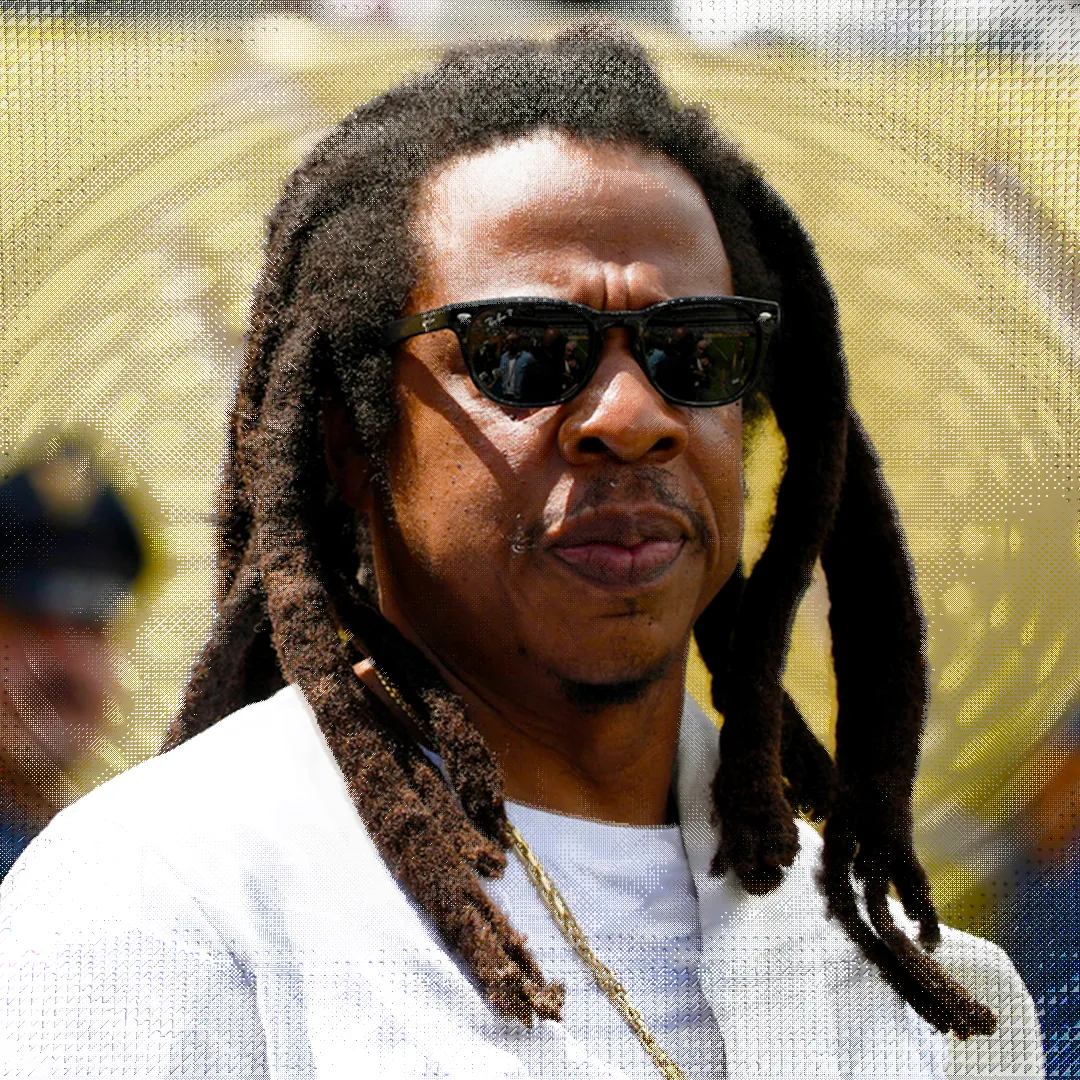
Jay-Z’s name is not on the Nets’ ownership ledger anymore. What survives is the photo: a giant billboard hanging over Madison Square Garden in the early 2010s, two men side by side — a smiling new majority owner Mikhail Prokhorov in a suit, and Shawn “Jay-Z” Carter staring dead ahead as the public face of a franchise he only ever owned a sliver of. [The Washington Post] The image tells you most of what you need to know. The Brooklyn Nets stake made him look like an owner. The next decade would be about owning the pipes instead.
That’s the throughline from Roc-A-Fella to Roc Nation to Roc Nation Sports to Marcy Venture Partners: a slow shift from “piece of the asset” to “control over the infrastructure that assets move through.” The Nets episode — acquiring a small minority share when the team was still in New Jersey, then selling it as he launched Roc Nation Sports — is the hinge. [The Root] [Billboard] It’s not a story about giving up ownership. It’s a story about trading one kind of ownership for another: from a thin equity slice inside someone else’s system to building the system itself.
The Nets Era: When Visibility Outran Control
The Nets investment is often mythologized as Jay’s big entrance into sports ownership. What the record actually supports is more modest and more revealing. Around 2003, he acquired a minority share in the then–New Jersey Nets; reports at the time pegged it at roughly a $1 million buy-in for a “1/15th stake,” though later coverage and insiders have debated the exact percentage. [The Root] [NetsDaily] However the math pencils out, it was a fractional position — controlled through the Nets Sports and Entertainment ownership group — in a team whose real power bloc sat with Bruce Ratner and, later, Prokhorov. [The Washington Post]
But culturally, Jay’s stake was outsized. He became the visible co-owner in New York media, the one helping reopen the Barclays Center with concerts that doubled as civic baptisms and telling the city the Nets were now under “new management” after beating the Knicks. [HotNewHipHop] A Washington Post feature underscored it: the towering MSG billboard cast Prokhorov as the billionaire in the suit, Jay-Z as the cool partner who made the move to Brooklyn feel like culture, not just real estate. [The Washington Post]
That asymmetry — tiny equity, maximum visibility — is the first tension. The numbers say minority investor; the image says owner. It’s the same tension artists have always lived under with labels: face of the product, but not the one who owns the master servers. Jay’s exit came when the optics finally ran into the rulebook. In 2013, he launched Roc Nation Sports as a joint venture with CAA, and because NBA rules bar agents from simultaneously holding a stake in a team, he had to sell his slice to be certified. Billboard reported him offloading his roughly 0.15–0.16 percent position, closing the loop between a decade-old suggestion from Jason Kidd to buy in and Kidd later acquiring part of those shares. [Billboard] [NetsDaily]
On paper, that’s a downgrade: from “owner,” however small, to service provider. In practice, it’s where the infrastructure story starts. The Nets stake gave him a narrow vote in one room. Roc Nation Sports promised control of the hallway — the pipeline through which players, deals, and cultural moments would flow.
Roc Nation: Building a Company, Not Just a Label
By the time Jay sold out of the Nets, Roc Nation had already quietly become his real power base. He founded the company in 2008, a year after stepping down as president and CEO of Def Jam, as a full-service entertainment firm reaching artists, producers, and songwriters. [Wikipedia] [Variety] Its scope went far beyond a traditional label: Roc Nation’s divisions span records, publishing, management, sports, film and TV, festivals like Made In America, even a school of music and sports — headquartered in New York, serving, explicitly, “worldwide.” [Wikipedia]
The structure matters. Jay is founder and chairman, with Desiree Perez as CEO, Jay Brown as vice chairman, and executives like Michael Yormark running international sports and operations. [Wikipedia] That’s not a vanity imprint; it’s corporate infrastructure with multiple business lines, and Live Nation sits as a co-owner — cementing Roc Nation as a joint venture between a superstar and one of the most powerful promoters on earth. From the jump it positioned itself as working “in every aspect of modern entertainment,” representing marquee names from Alicia Keys and J Balvin to Megan Thee Stallion and Rihanna. [Rap Industry] When it signed a global deal with Universal in 2013, UMG’s Lucian Grainge called it one of the most successful brands in music and framed the pact as both a homecoming for Jay and an extension of UMG’s relationship with Rihanna. [Variety]
There’s also been a notable evolution in how Roc Nation wants to be seen in the deal stack. Jay has said the company shifted “from a traditional label to more of a distribution model because that’s what he believes artists need.” [HotNewHipHop] That claim gets structural backing from the 2024 decision to merge the label and equity-distribution units into Roc Nation Distribution, with a stated mission to “support and empower independent artists” while letting creators “retain ownership of their masters and creative control” and access a proprietary data dashboard. [Music Business Worldwide]
On paper, that’s a direct answer to decades of label control over masters and opaque accounting — a distribution play, not a classic 360 deal. But the tension is obvious: Roc Nation still profits from being the infrastructure, and its Live Nation co-ownership means it participates in the same ecosystem of power that regulators and artists have criticized elsewhere in the industry. [Wikipedia] [Rap Industry] The rhetoric is artist empowerment; the reality is a Black-founded, Live Nation–backed middle layer between talent and platforms.
From Team Equity to Athlete Representation
The decision to leave the Nets and open Roc Nation Sports is often framed as a compliance move to satisfy NBA rules. It was that. But it was also a strategic bet that controlling representation beats holding a fractional piece of one franchise. Roc Nation Sports launched in partnership with CAA Sports, which already managed more than 800 athletes across multiple sports, and was co-headed by Jay and Roc Nation president Juan Perez — tying the new division directly into the existing executive spine. [The Hollywood Reporter] Jay’s pitch was to port the artist-management model into sports: because of his love of sports, he said, it was a natural progression to help top athletes the way he’d helped artists for years. [The Hollywood Reporter]
The calculus is straightforward. A tiny minority stake in a single team gives you limited upside and heavily mediated influence. Representation gives you a direct cut of every major contract, endorsement, and branding decision an athlete makes, and it plugs you into the league-wide marketplace instead of a single zip code. Instead of being a name on the cap table, you sit in on the meetings. That move also syncs with Jay’s broader ecosystem: Roc Nation already managed artists who crossed into sports culture, co-owned the 40/40 Club sports bars, and had Live Nation’s touring and sponsorship machinery on call. [The Source] [Wikipedia] Adding an agency let the company control more of the cross-traffic — halftime shows, shoe deals, festival slots, film soundtracks — turning athletes into the same multi-platform assets Roc Nation already cultivated in music.
But the power story cuts both ways. Representation can be liberating or extractive. On one side, athletes get the bespoke career-building stars like Rihanna enjoyed: holistic brand strategy, a global network, someone who knows the trap doors in legacy contracts. On the other, you have a company that now sits between athlete and league, athlete and brand, athlete and media — taking commissions at every gate. The available record is thin on hard critiques from clients or detailed contract terms. That’s the gap. We know the logic of the pivot; we don’t yet have granular, sourced examples proving Roc Nation Sports consistently delivers better financial or ownership outcomes than a traditional agency would. Without that, the move from Nets owner to athlete rep is structurally compelling but still ethically ambiguous.
Infrastructure as Strategy: Live Nation and Marcy
If Roc Nation shows Jay’s shift from label boss to infrastructure owner, Live Nation and Marcy Venture Partners show how far he’ll extend that logic. On the music side, Live Nation is the quiet co-owner of Roc Nation. [Wikipedia] The promoter a federal jury recently found to have built an illegal touring monopoly is also the partner that lets Roc Nation mount massive shows — like the dual Yankee Stadium concerts marking the anniversaries of Reasonable Doubt and The Blueprint. [Rap Industry] [Rap Industry] Those events aren’t just legacy exercises; they’re demonstrations of integrated power — the Shawn Carter Foundation funds education and justice work through them, Roc Nation reinforces Jay’s centrality to the canon, and Live Nation keeps its grip on top-tier touring.
At the same time, Jay and Live Nation have quietly moved out of the old recorded-music game. Live Nation has let many of its 360 recorded-music deals sunset and largely exited the recorded-music business, while continuing to operate Roc Nation’s management and recorded-music businesses as a joint venture. [Billboard] That’s infrastructure thinking: let the fixed costs of owning catalogs and pressing records fall away; keep the relationship business, where margin and leverage are higher.
On the tech and venture side, Marcy Venture Partners extends that philosophy to the platforms themselves. Jay’s portfolio includes stakes in blockchain platform Alchemy, wellness company Therabody, and alternative-meat company Impossible Foods, alongside exits like Uber and JetSmarter that have reportedly boosted his fortune by over $1 billion since 2022. [The Source] Together with Beyoncé, his combined net worth is estimated at $2.6 billion, with U.S. property holdings valued at least $350 million. [The Source] This isn’t celebrity angel investing; it’s a pattern — take minority positions in companies sitting under consumer behavior (ride-sharing, wellness, food, now the online watch market Wristcheck) and use cultural capital to legitimize or accelerate adoption. In parallel, Roc Nation experiments with financializing music itself, partnering with South Korean firm Musicow to let fans buy fractions of songs, framed by vice chairman Jay Brown as giving “everyone access to the financial opportunities the music industry offers.” [HipHopDX]
Again, the tension. One reading is that Jay has graduated from being the talent to owning the rails — touring, management, tech platforms, even financial products around songs. Another is that we’re watching a new form of financialization enter hip-hop: fan “ownership” of slivers of songs, corporate co-ownership of a Black-founded label, venture bets that tie culture more tightly to speculative markets. The infrastructure is Black-fronted, but the underlying power relationships look familiar.
Ownership or Black-Branded Middleman?
The question hanging over all of this is whether Jay’s infrastructure play materially changes ownership outcomes for artists and athletes — or simply swaps old gatekeepers for a more culturally legible one. There are strong data points on the empowerment side. Rihanna’s post–Def Jam move is the cleanest example: after completing her contract she gained control of her masters and launched Westbury Road Entertainment under Roc Nation, releasing Anti and benefiting more directly from her catalog. [The Root] Roc Nation Distribution says artists keep their masters and creative control, with the label providing tools, services, and analytics. [Music Business Worldwide]
This lines up with a broader shift in how the industry talks about catalogs: ownership is infrastructure, not ideology — owning rights or stakes only matters if it’s paired with the systems to exploit and protect them. [HipHop Since 1987] Deals can now sell only percentages of catalogs, retain creative approval or sync rights, build in reversion clauses, and keep artists in the future upside. [HipHop Since 1987] In that world, a player controlling management, distribution, and touring can, in theory, help artists stitch together more flexible, protective structures than a one-size-fits-all major deal.
But the counter-argument is equally grounded. Labels — even artist-friendly ones — have spent decades stamping “work made for hire” language onto contracts to claim ownership over recordings they didn’t creatively author. An artist-backed filing in ongoing litigation against UMG argues that performers and producers, not labels, are the “most likely authors” of sound recordings, and that record companies’ roles are “purely logistical and financial.” [AllHipHop] That critique doesn’t single out Roc Nation, but it challenges the entire model of label-centric control — a model Roc Nation inevitably participates in when it signs clients and negotiates rights, even if its paper is softer.
There’s also the governance problem. Jay co-owns Roc Nation with a company a federal jury found to have abused its market power in touring, with independent venues reported as 64 percent unprofitable in a fragility tied directly to that monopoly behavior. [Rap Industry] When the infrastructure you own is fused with a legally validated monopoly, the line between “Black ownership” and “participation in structural exploitation” blurs. And the public record is thin on Roc Nation’s own internal frictions: we know Jay defended his catalog hard against Dame Dash’s attempt to mint Reasonable Doubt as an NFT, and that legal disputes have affected his ability to secure loans and contracts, with knock-on effects for Roc Nation. [AllHipHop] [HotNewHipHop] What’s largely missing are lawsuits or testimonies directly interrogating Roc Nation’s treatment of its own clients. That silence isn’t proof of clean hands; it’s a reporting gap.
Artist vs. Mogul: The Internal Tension
There’s also an artistic cost baked into the shift to infrastructure. The narratives around Jay now emphasize his billionaire status as much as his catalog: The Root recently pegged his net worth at $2.8 billion and framed it as the cumulative result of early Nets equity, a 2008 label he fully owned, a stake in Uber, and assets like Ace of Spades champagne. [The Root] Meanwhile Roc Nation promotes events like the dual Yankee Stadium shows that lionize Jay as a cultural vanguard whose work shaped not just music but business, fashion, and sports. [Rap Industry] True as far as it goes — but it raises a practical question: how much space is left for the artist when the mogul is this busy?
Jay himself has leaned into the idea that his highest value now is building systems, downplaying traditional label power and talking up distribution, equity, and leverage. [HotNewHipHop] The Shawn Carter Foundation and REFORM Alliance fold his social-justice work into that same architecture: not just songs, but institutions. The tension is whether that institutional priority can coexist with the kind of artistic risk that defined his early run. When your cap table includes Live Nation and your portfolio is tied up in late-stage startups, the downside of a controversial stance — on streaming, policing, labor — isn’t just personal; it threatens the infrastructure you’ve spent two decades building. There are no explicit examples in the record of Jay soft-pedaling art to protect business. But structurally, the incentives are there.
Where the Evidence Leaves Us
Taken together, the record supports a clear arc. Jay-Z moved from owning slices of someone else’s structures — a Def Jam presidency, a minority stake in the Nets — to building and co-owning structures of his own: Roc Nation, Roc Nation Sports, a vertically integrated touring partnership with Live Nation, and a venture portfolio through Marcy that sits underneath whole categories of consumer behavior. [Wikipedia] [The Source] The Nets exit wasn’t a retreat from ownership. It was a pivot from static equity in one asset to dynamic control over the pipelines through which artists and athletes move.
Whether that’s a net gain for talent is harder to call from the available data. There are strong signals that in some cases — Rihanna’s masters, Roc Nation Distribution’s explicit “you keep your masters” stance — the infrastructure Jay built has enabled more artist-side ownership than the traditional major-label system routinely allowed. [The Root] [Music Business Worldwide] There are also structural red flags: Live Nation’s co-ownership and its anticompetitive track record, the industry-wide tendency to mask exploitation behind contract boilerplate, and the absence of robust, public, client-side scrutiny of Roc Nation’s actual deal terms. [Rap Industry] [AllHipHop]
What the evidence does show is that the center of gravity has shifted. Jay’s power no longer comes from being the star onstage or the local minority owner in a single arena. It comes from owning and co-owning the infrastructure that defines how stages are booked, how deals are cut, how catalogs are monetized, and increasingly, how fans and capital plug into the art itself. Whether that infrastructure is ultimately liberating or just a more culturally fluent form of mediation is the question the next decade — and the artists and athletes inside his system — will have to answer. The current record gets us to the threshold. It doesn’t yet let us see inside the contracts.