
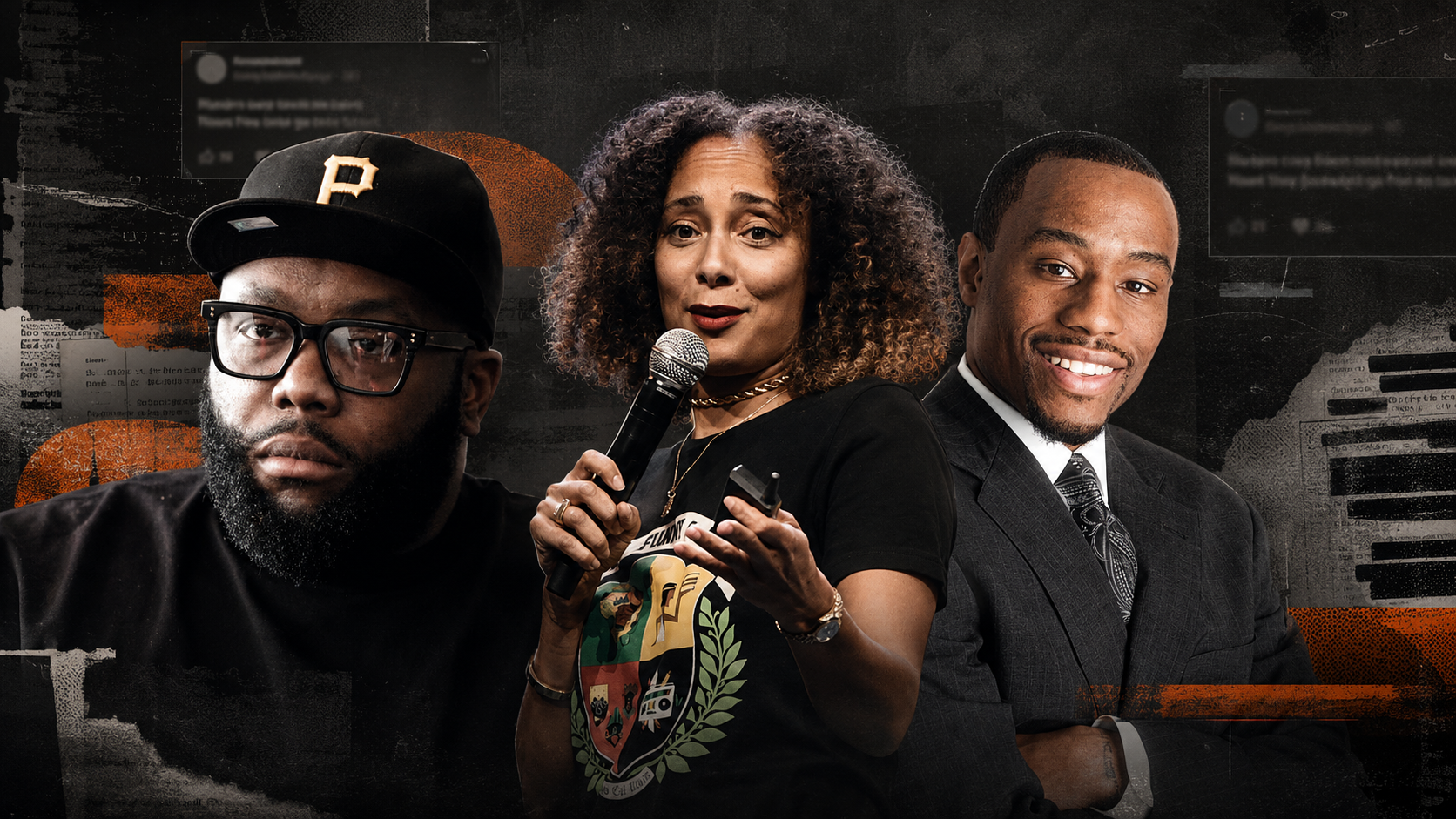
A viral online argument accuses Killer Mike, Marc Lamont Hill, and Amanda Seales of discouraging Black support for Kamala Harris in 2024, blaming them for Trump’s win and subsequent attacks on voting rights. This piece examines that ‘sellout’ charge and the larger debate over Black public figures’ political responsibility.
The shorthand that has taken hold online goes something like this: Killer Mike, Marc Lamont Hill, and Amanda Seales used their platforms in the 2024 election cycle to discourage Black voters from supporting Kamala Harris, Trump won, voting rights are now under direct institutional attack, and the three of them have to answer for the role they played. The word that keeps appearing underneath that argument is sellout — the accusation that they prioritized their own brand, ideology, or contrarian credibility over the concrete interests of a community whose franchise is now being dismantled piece by piece.
That accusation deserves to be taken seriously. It also deserves to be tested against the actual record rather than the viral version of it. Because the viral version contains a significant amount of disinformation — not in the sense of deliberate fabrication, but in the sense of flattened, decontextualized, and sometimes simply wrong claims about what these three people actually said and did. Accountability built on a bad factual record is not really accountability. It is the same problem it claims to oppose.
What “Selling Out” Actually Means — and Why It Matters Here
The sellout accusation has a specific charge. It is not just “you were wrong.” It implies betrayal — that someone leveraged community trust for personal or ideological gain at the community’s expense. In the political context of 2024, the claim is that these figures used Black cultural credibility to undermine the coalition that needed to hold to keep Trump out of office, and that Black voters are now living with the consequences: proof-of-citizenship voting requirements signed into law in March 2025, a second executive order in 2026 attempting to build a national verified voter list, and a Supreme Court ruling in April 2026 that effectively gutted Section 2 of the Voting Rights Act — the last major federal tool for challenging racially discriminatory district maps. [NPR] [Washington Post] [NPR]
Those consequences are real, and the question of who bears responsibility for the conditions that produced them is a legitimate one. But the sellout charge applied identically to all three of these figures is factually inaccurate, and spreading inaccurate versions of what public figures said is itself a form of the problem it claims to address. Here is what the record actually shows, case by case.
Marc Lamont Hill: The Clearest Case of Disinformation in the Backlash
Of the three figures being grouped together, Marc Lamont Hill has the strongest documented case that the backlash against him is based on an incomplete and misleading account of what he actually did. The viral version of his record stops at August 2, 2024. The full record does not.
On August 2, 2024, Hill appeared on Democracy Now and said Harris “very clearly is a liberal, but certainly not a progressive or a radical,” and warned that if she chose Josh Shapiro as her running mate, antiwar voters would have “absolutely no way” to justify voting for her. That is the clip that circulates. What the same interview also contains — in the same conversation — is Hill saying that keeping Trump out of the White House is a valid reason to vote for Harris. The harm-reduction logic was already present in August, sitting alongside the progressive critique. [Democracy Now]
By October 30, he was back on Democracy Now with an unambiguous message: Donald Trump is worse. [Democracy Now] By Election Day, he said publicly: “I will be voting for Kamala Harris. It is not a close call.” For someone who had voted third-party rather than Democratic for years, that was a documented, explicit shift toward the harm-reduction position. The claim that Marc Lamont Hill discouraged Black voters from supporting Harris right through Election Day is not supported by the primary-source record. It is disinformation — not invented from nothing, but a decontextualized August clip used to assign a position he publicly reversed before the election happened.
His 2026 posture is consistent. Following the Supreme Court’s VRA ruling in Louisiana v. Callais, he has been publicly and sharply critical of the institutional dismantling underway. The person who said in October “Trump is worse” and voted Harris in November is now, in 2026, reacting to exactly the consequences he identified as the reason to vote against Trump. That is not the profile of someone who sold out. It is the profile of someone whose nuanced August critique got clipped, stripped of context, and weaponized into a misrepresentation of his actual record.
Killer Mike: The Hardest Case — Not a Sellout, But Not Off the Hook
Killer Mike’s record is the most complicated of the three to evaluate, and it resists both the full sellout label and a clean exoneration. There is no well-documented moment where he told people not to vote for Kamala Harris. What the record shows instead is a pattern of anti-establishment alliances and normalizing behavior toward figures that Black voting-rights advocates regarded as dangerous — and the accumulation of that pattern is what critics are actually responding to, even when they reach for the wrong language to describe it.
In September 2020, he met with Georgia Governor Brian Kemp — a figure already widely criticized for purging 300,000 voters from state rolls while serving as his own election’s secretary of state — and described the exchange as “productive” and Kemp as “a principled human being.” The backlash was immediate and specific: this was not an abstract political disagreement. It was a public validation of decency toward someone whose actual record on Black voter access in Georgia was already a matter of documented controversy. [The Source] [BET] Kemp later signed Georgia’s 2021 voting law, which civil rights groups said restricted absentee access, limited drop boxes, and criminalized handing water to voters in line. The man Killer Mike called principled built the law activists called a new form of voter suppression.
In February 2024, he appeared in a barbershop conversation with Robert F. Kennedy Jr. as part of Kennedy’s outreach to Black voters. He did not endorse Kennedy. But he engaged him as a substantive interlocutor while Kennedy’s campaign was actively functioning as a spoiler operation designed to peel Black support away from the Democratic nominee. An MSNBC opinion piece at the time argued the conversation helped a candidate gain access to Black political spaces without adequate challenge. [MSNBC Opinion] Whether that constitutes “selling out” or a sincere expression of his anti-establishment, transactional-voting philosophy is the real question — and the honest answer is that the distinction matters less than the effect.
His actions in October 2024 complicate any flat narrative. He joined the Vote or Else campaign — two days in Atlanta registering voters alongside Pusha T, Beanie Sigel, Jadakiss, and Michael Vick — which is direct, concrete voter engagement. [Billboard] [TMZ] In May 2026, responding to the VRA ruling, he posted: “Americans, we got work to do at and beyond the polls this year. No matter what … plot, plan, strategize, organize and mobilize!”
The legitimate critique of Killer Mike is not “he sold out” — that framing implies a corruption of intent that the record does not clearly support. The legitimate critique is that his anti-establishment philosophy led him to normalize and platform figures whose relationship to Black voting rights was destructive, that this pattern compounded over years, and that his 2026 call to organize has not been paired with a public reckoning sufficient to address the credibility debt that pattern created. That is a real accountability problem. It is just not the same as selling out, and calling it that when it isn’t muddies what the actual conversation should be.
Amanda Seales: The Strongest Evidentiary Case for the Backlash — With Caveats
Of the three figures, Amanda Seales has the longest and most sustained record of public anti-Harris messaging, and she also has the most explicit retrospective acknowledgment that this posture carried costs she did not fully account for. The backlash against her has more evidentiary grounding than the backlash against Hill or Killer Mike — but the sellout framing still misidentifies what actually happened.
The record starts in 2021, when Seales wrote that Harris’s “not a racist country” comment represented “paradoxical political pandering” — establishing a frame of Harris as disingenuous and performative that persisted for three years. [Atlanta Black Star] By July 2024, she was publicly describing a face-to-face meeting with Harris in which she told the Vice President directly: “You talk out two sides of your neck.” She framed this as the duty of a critical, informed voter — which, in isolation, is a defensible position. Shared publicly with a large audience during the compressed weeks after Biden stepped aside, it functioned as something more than a private critique. [Vibe] [Atlanta Black Star]
After the election, the critique continued rather than recalibrated. On November 7, 2024, she argued publicly that Harris lost because she “ran like a white man” and abandoned her base — a framing that located primary blame in Harris’s campaign strategy while largely sidestepping the structural, judicial, and media dynamics that shaped the result. The backlash was sharp enough to drive her off Instagram. [Atlanta Black Star] In June 2025 she continued to question whether Harris would have been more peaceful on Iran policy than Trump — substantive critique rather than post-election unity.
Then, in August 2025, she appeared in the Jubilee debate and said: “I could have voted for harm reduction, which was voting for Kamala Harris, so that we wouldn’t be in this damn predicament.” [EURweb] It is not a formal apology. It is not a full ideological recantation. But it is the clearest available evidence in the record that she registered the material cost of her earlier posture in a way she could not contextualize away. The word “predicament” is doing real work in that sentence.
Where the sellout framing breaks down is here: selling out typically implies self-interest — trading community loyalty for personal gain, access, or approval from the wrong audience. Seales’ record shows a genuine, if politically costly, commitment to a critique she believed was in the community’s interest: that Black voters deserved a candidate who was substantive rather than symbolic, accountable rather than performative, and honest about her limits rather than relying on identity as a substitute for policy. That critique can be simultaneously sincere and harmful in a two-candidate race. The honest version of the accountability conversation acknowledges both.
The Disinformation Problem Inside the Backlash
It is worth naming directly what is happening with the viral version of this story, because it is an instructive case in how disinformation operates inside communities rather than just against them. The claim that all three figures told Black voters not to vote for Harris is false in its strongest form for all three. Hill voted for Harris. Killer Mike never issued a clear anti-Harris directive. Seales ran sustained anti-Harris messaging but framed it as voter responsibility rather than abstention advocacy.
The mechanism is familiar: a real grievance (public figures used large platforms to complicate Democratic coalition-building at a critical moment) gets overstated into a falsified claim (all three told people not to vote Harris), which then spreads more easily because it is simpler, angrier, and more satisfying than the complicated truth. The complicated truth — that one of the three voted Harris, one had a pattern of harmful alliances but not a clean abstention directive, and one ran the most sustained critique but later acknowledged its cost — is harder to reduce to a shareable indictment. So the shareable version circulates instead.
The problem with accountability built on false premises is that it cannot produce the specific corrections it claims to demand. If the critique of Hill is that he stayed anti-Harris to the end, and the record shows he did not, then the critique cannot produce the apology or correction it claims to want — because there is nothing there to apologize for at that level. The specific, accurate version of the critique is much narrower: his August 2024 rhetoric was picked up and used by people who did not follow his October-November shift, and the way he framed progressive critique in the compressed pre-election window had effects beyond his intent. That is a real issue. It is just a different issue than “he told people not to vote.”
What the Record Demands of Each Person
The accountability is not a flat tax. It scales to the actual record.
For Marc Lamont Hill, the ask is narrow and evidentiary: the viral version of his record is wrong, and correcting it is largely a job for the people spreading it. His own record ends in the right place. His 2026 VRA commentary is consistent with who he was by October 2024. There is no documented sellout here — there is a nuanced figure whose August critique got stripped of its October resolution and weaponized into a misrepresentation.
For Killer Mike, the ask is more substantive. His political philosophy — anti-symbolic, transactional, anti-establishment — is coherent, and it is not the same as selling out. But that philosophy led him to normalize Kemp and platform Kennedy in ways that had real-world consequences for the communities he claims to be fighting for. The 2026 call to organize needs a companion: an explicit, public accounting of how earlier alliances compromised the message. His current audience, especially in Georgia, knows the Kemp record. They are watching to see whether the organizing call includes any reckoning with how he got here.
For Amanda Seales, the ask sits between the other two. The harm-reduction remark in August 2025 shows she registered the cost. But the record between July 2024 and that remark is long, public, and well-documented. The conversation is not closed, and the “predicament” framing suggests she knows that. The question is whether the acknowledgment deepens into something more specific — not an apology for having politics, but a reckoning with the effect of how those politics were deployed in a two-candidate race against the most consequential voting-rights backdrop in a generation.
The Bottom Line on “Selling Out”
The sellout frame is emotionally legible. It assigns moral clarity to a situation that does not have it in the clean form the frame implies. None of these three figures has a record that supports “they betrayed their community for personal gain.” What the record supports is more specific and, in some ways, more useful: a public intellectual who evolved toward harm reduction but got misrepresented; an entertainer whose sincere critique had harmful practical effects in a two-candidate race; and an artist whose anti-establishment philosophy led him into a pattern of politically costly alliances he has not fully reckoned with publicly.
That is the accurate version. It is harder to fit on a caption, but it is the one that produces real accountability rather than performed outrage aimed at a distorted target. The franchise is under direct attack. The community that stands to lose the most from its erosion deserves an argument built on what actually happened — not a cleaner story that feels right but gets the facts wrong.