
After the 2018 Supreme Court ruling opened legal sports betting, gambling operators courted hip-hop’s young, global audience for instant credibility. This piece examines the resulting wave of rapper sponsorships and celebrity streams, including Drake’s Stake deals, that made high-risk offshore wagering feel like aspirational lifestyle content for fans.
In 2018, the Supreme Court cracked open legal sports betting in America and a land rush began. Casinos and online gambling operators needed customers fast, had no organic cultural credibility, and looked at hip-hop’s audience — young, global, fluent in risk as aspiration — and saw the perfect front office. What followed was a half-decade of rapper sponsorships, celebrity streams, and lifestyle content designed to make offshore wagering feel like part of the culture. Drake’s reported $100 million deal with crypto-casino Stake was the apex of that transaction.
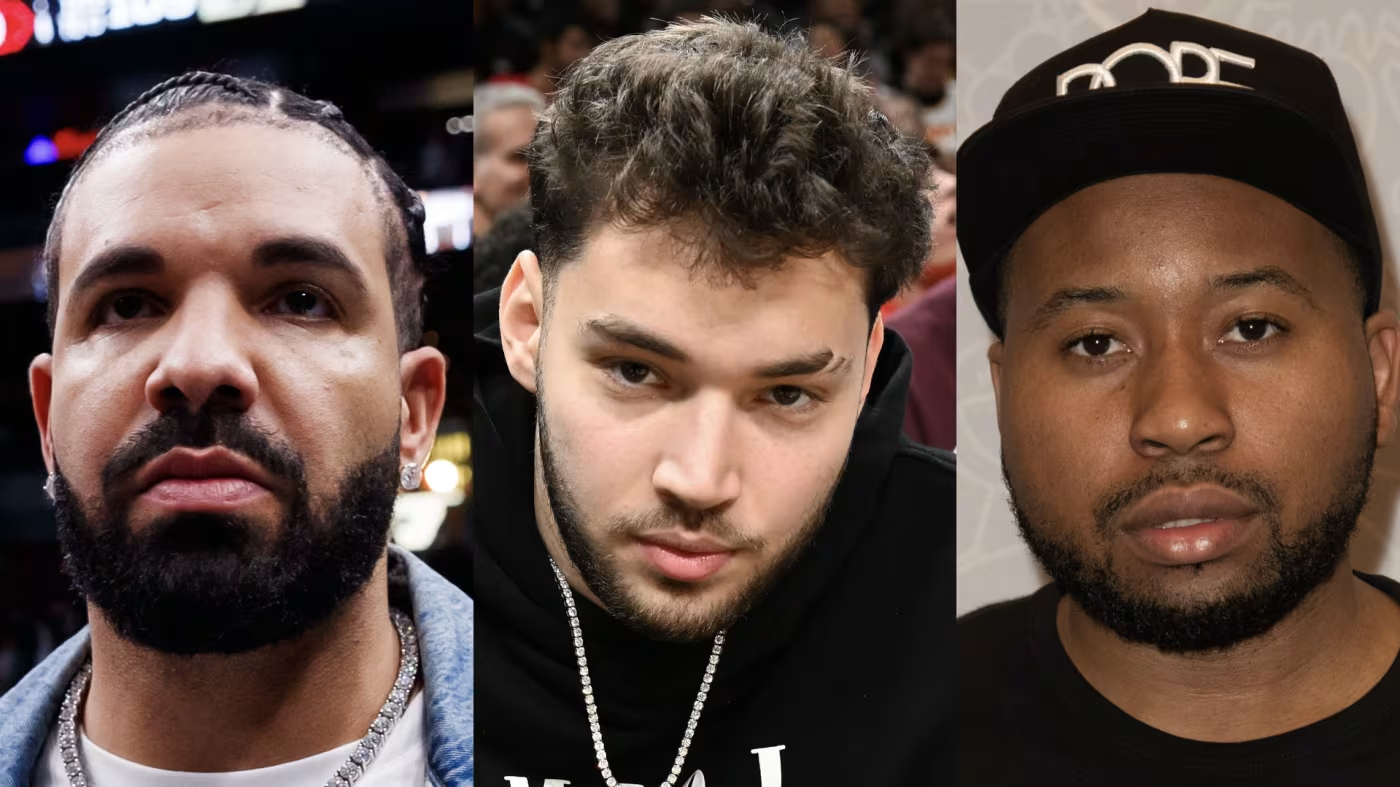
Now a federal lawsuit is asking whether the entire model was a scheme. New Jersey bettor Jason Nufio filed against Drake, streamer Adin Ross, DJ Akademiks, and Stake, alleging an illegal online gambling operation built on undisclosed financial arrangements, a virtual currency designed to obscure real money movement, and a content pipeline that blurred the line between peer participation and paid promotion. [AllHipHop] The timing is not coincidental. Juries just handed Meta and Google hundred-million-dollar verdicts for building platforms that were “addictive by design,” and plaintiffs’ lawyers are now applying that same architecture argument to a casino that runs its marketing through celebrity feeds.
This is not just a Drake story. It is a blueprint story — about what happens when an industry uses culture to manufacture the illusion of shared risk, and what the courts are starting to say about who pays when the illusion breaks.
The 2018 Switch: How Hip-Hop Became the Gambling Industry’s Marketing Department
When the Supreme Court’s 2018 ruling in Murphy v. NCAA overturned the federal ban on sports betting, it didn’t just unlock a new revenue stream. It fired the starting gun on a customer acquisition race that the gambling industry was not equipped to win on its own. Sportsbooks and online casinos had product. They didn’t have cultural fluency. They didn’t have audiences that trusted them. And they were entering a market where every new platform was chasing the same young, digitally native demographic.
So they bought it. The analysis is blunt: once legalization took hold, online casinos began actively seeking rapper sponsorships to attract young, engaged audiences — the same playbook sneaker brands and energy drinks had run through the culture for decades, now applied to wagering. Rappers and influencers offered exactly what gambling companies lacked: built-in communities, credibility, and a lifestyle that had spent thirty years making risk feel like aspiration rather than danger. The cultural infrastructure was already there. It just needed to be licensed.
Drake became the most visible example of that pivot. By 2022, Stake was reportedly offering him $100 million to be the face of the brand — a number that, if accurate, tells you everything about how much the gambling industry valued a single credible cultural voice. [The Source] What followed was a run of public bets that turned gambling into content: backing the Kansas City Chiefs to win back-to-back Super Bowls, posting wins of $1.48 million and $1.15 million. Taking notable losses — $1.2 million on Jake Paul versus Tommy Fury — that became memes about a “Drake Curse.” All of it broadcast in real time, all of it turning the act of wagering into something that felt communal, aspirational, and visible.
From a casino’s perspective, that was the dream. You’re not just selling a game. You’re selling the idea that betting is part of a lifestyle the viewer already wants. From a plaintiff lawyer’s perspective, it’s something else: a content pipeline engineered to make a legally gray offshore product feel as normal as a sneaker drop.
The “Addictive by Design” Doctrine — and Why It Travels to Gambling
The legal context that makes the Nufio complaint more than a long-shot nuisance filing is a pair of jury verdicts that established something courts had been reluctant to accept for years: that a digital platform can be held liable not just for what it hosts, but for how it is built.
In the first case, a jury ordered Meta and Google to pay $3 million to a woman who developed an addiction to Instagram and YouTube as a child. The jurors accepted that the design features of those apps — specifically the way they delivered content and feedback to maximize time on platform — caused measurable harm to her mental health. [Rap Industry] In a separate New Mexico case, Meta faced a $375 million verdict tied to findings that the company misled families about safety while knowing its platforms were being used by predators to contact minors. In both cases, the core argument was the same: these were not neutral tools. They were environments calibrated to maximize engagement and keep users locked in, even when the people running them had internal evidence of serious harm.
That logic — designed to hook, built to obscure the cost — maps directly onto what the Nufio complaint alleges about Stake’s content ecosystem. It’s not a perfect parallel. Gambling is regulated differently from social media, and the specific legal theories are distinct. But the conceptual leap juries are now willing to make is the same: if you build an environment that makes it hard for people to understand what they’re really getting into, and you profit from their confusion, that is not neutral product design. That is a choice you made, and it can be a liability. [The Breakfast Club]
That shift in legal thinking is what gives the Drake/Stake case its weight. Before the Meta verdicts, “addictive by design” lived in op-eds. Now it has a dollar amount attached to it. And the Breakfast Club was already using the phrase “attention economy” in regular rotation on daytime radio — describing how platforms slice up your time and sell it back to you — which means the conceptual vocabulary plaintiffs need to make this argument legible to a jury already exists inside the culture itself. [The Breakfast Club]
The Liability Stack: Four Layers That Make This Case Different
The Nufio lawsuit isn’t a single allegation. It’s a stack — four distinct but interlocking claims that together build the argument that this wasn’t just bad marketing, it was a designed scheme.
The disclosure failure. At the center of the complaint is a straightforward deception argument: Drake, Ross, and Akademiks allegedly promoted and streamed Stake without properly disclosing that they were financially tied to the platform. [AllHipHop] Viewers watching those streams saw someone they followed placing bets, winning, vibing. What they allegedly didn’t see was that the person on screen faced zero actual risk because they were being paid directly by Stake regardless of outcome. That asymmetry — peer on the surface, paid promoter in the back end — is the heart of the fraud argument. It’s not that Drake gambled. It’s that he made it look like something it wasn’t.
The coin architecture. Stake’s virtual “gold coin” currency is described in the complaint as a “veneer of deniability” — a superficial layer of design whose purpose is to make illegal gambling look like a social game. [AllHipHop] The mechanics of social casino products are well-documented in industry literature: virtual currencies create a psychological buffer between the player and the real money moving underneath, reducing the sense of stakes while the financial exposure remains real. When that design is layered on top of an offshore platform operating into jurisdictions where online casino gambling is illegal, the coin system stops being a game feature and starts being a legal strategy.
The jurisdiction problem. Online gambling law in the United States is a patchwork. Some states have fully legalized online sportsbooks. Others prohibit online gambling entirely. A number occupy a gray zone where residents can technically access offshore sites that aren’t locally licensed. Stake, operating from a Curaçao-based license, presented the same frictionless interface in New Jersey — where online casino gambling is legal but regulated — as it did in states where it was not. [The Source] The celebrity content pipeline didn’t come with jurisdictional warnings. It came with Drake winning. The suit argues that the combination of borderless access and culturally normalized promotion made it easy for users to step into a space they didn’t fully understand, in a jurisdiction where their activity may have been illegal.
The Akademiks dimension. This is where the case pushes from promotion into alleged racketeering. The complaint doesn’t just accuse Akademiks of undisclosed sponsorship. It accuses him of allegedly helping Drake artificially inflate streaming numbers through bot networks, compensated for this work via Stake’s tipping feature, while simultaneously using his platform to publish and promote content he allegedly knew was false. [AllHipHop] If those allegations hold, Stake isn’t just a casino in this story. It’s a payment rail and an amplification tool for a broader fraud economy — fake engagement, real money, and a media personality in the middle functioning as infrastructure rather than commentary. That’s why RICO framing makes intuitive sense to the public even before the legal specifics are established. People already believe numbers in the culture are manipulated. A lawsuit gives that belief a case number. [The Joe Budden Podcast]
Offset, Markers, and the Real-World Weight of the Aesthetic
If Drake is the aspirational face of casino culture in hip-hop, Offset is the warning label running in parallel. Separate from anything involving Stake, Detroit’s MotorCity Casino Hotel filed a civil lawsuit accusing Offset of failing to repay a $100,000 gambling marker extended in March 2024, tied to his personal Wells Fargo account. [AllHipHop] That is not a rumor or a social media claim. That is a casino going to court like any other creditor when a debt goes unpaid.
Surrounding that lawsuit is a cluster of unverified but widely circulated allegations: Dez Bryant claiming roughly $8,000 in unpaid gambling losses; Ebro Darden alleging a $5,000 debt; Lil Tjay reportedly tied to a $10,000 gambling dispute that allegedly preceded Offset being shot in the leg in Florida; influencer Celina Powell discussing a separate $15,000 claim. Reporters have been careful to note these figures aren’t proven in court, and the pattern of unverified claims needs to be read carefully. But pattern is narrative, and the cumulative picture that’s formed is one of a rapper whose relationship with gambling may have migrated from flex to liability — precisely the trajectory the Nufio lawsuit argues the entire Stake model was designed to accelerate for ordinary users. The difference is that when Offset loses, it makes the news. When Jason Nufio loses, it doesn’t.
TikTok’s Retreat and What It Signals
While Stake was pushing deeper into hip-hop through celebrity partnerships, the most powerful short-form video platform in the world was quietly moving in the opposite direction. TikTok’s creator-facing guidance is explicit: the platform “does not like casinos and gambling,” particularly unverified or unlicensed operators. [The Source] Promoting unlicensed gambling operators — or even naming and tagging them — is described as a fast path to warnings, content blocks, and account loss. The guidance recommends that even licensed operators be handled carefully, citing regulators like the UK Gambling Commission and the Malta Gaming Authority as minimum credibility bars.
This is a platform watching the Meta verdicts and drawing lines preemptively. Meta and Google didn’t draw those lines. They tried to keep everyone on the platform and sort out the harms later. Now they’re writing large checks to plaintiffs’ lawyers. TikTok is trying to ensure it isn’t the next defendant. [Rap Industry] The signal for anyone paying attention is clear: distribution platforms are moving gambling content to arm’s length. Gambling platforms are trying to pull the culture in as close as possible. The Drake / Stake lawsuit is what happens in the gap between those two instincts — and when the platforms retreat, the liability doesn’t disappear. It flows back toward the creators who stayed in.
What This Means for Every Creator Who’s Ever Done a Casino Deal
For managers, lawyers, and creators working in this space, the Nufio complaint is less a Drake problem than a blueprint problem — a map of exactly how sponsorship exposure can reframe as criminal liability depending on what a casino does with your name and likeness downstream.
The first takeaway is that sponsorship is now joined at the hip with product liability. Influencer deals with casinos and sportsbooks aren’t just ad reads anymore. They can be framed as participation in an illegal gambling scheme if jurisdiction, disclosure, and product design all cut the wrong way at the same time. The specific legal theory in the Nufio case — that the celebrities were integral to the operation, not just adjacent to it — is an argument that would apply to any creator whose content functions as the onboarding funnel for an offshore gambling product. [The Source]
The second takeaway is that “addictive design” has legal teeth now. The Meta and Google verdicts established that juries will attach dollar amounts to that phrase. Any entertainment product built around endless, frictionless wagering — especially one that uses virtual currencies to obscure the real money movement — carries that exposure. The design of the product is no longer just a UX decision. It is potential evidence. [The Breakfast Club]
The third is that platforms will protect themselves before they protect you. TikTok’s retreat from gambling content is not an act of civic responsibility. It’s legal self-preservation. When the regulatory heat arrives — and based on the Meta precedent, it will — the platform will be able to point to its own policies and say it tried to keep gambling at arm’s length. The creator who ignored those policies will not have that defense. [The Source]
The fourth is that casinos enforce their contracts in court, not on vibes. MotorCity suing Offset over an unpaid marker is a reminder that the house doesn’t care how many platinum plaques are on your wall when the debt comes due. The same institution that packaged itself as part of your lifestyle will pursue you through civil court the moment the relationship sours. That’s not a betrayal. That’s the contract you signed.
Bottom Line
Hip-hop has always been comfortable narrating risk. That is different from being the instrument through which risk gets manufactured and sold to people who don’t fully understand what they’re buying into. The gambling industry spent the years after 2018 building hip-hop into its customer acquisition infrastructure because the culture was the most credible, scalable onboarding experience money could buy. The Drake / Adin Ross / DJ Akademiks / Stake lawsuit is the first serious attempt to argue in federal court that when you wrap a casino in culture and stream it to millions, you’re not just making content. You’re building an environment — and you’re responsible for what that environment does to the people inside it.
The Meta and Google verdicts proved juries are ready to accept that argument. The Nufio complaint is a test of whether it travels from social feeds to gambling streams. The answer will reshape what casino sponsorship means for every creator in the culture — not just the ones whose names are on the filing. [AllHipHop] [The Source]
Because from here on out, any time an artist sits in front of a camera and invites fans to watch them bet, the courts won’t just be asking what they won that night. They’ll be asking who built the room, who got paid to fill it, and who was left holding the loss.