
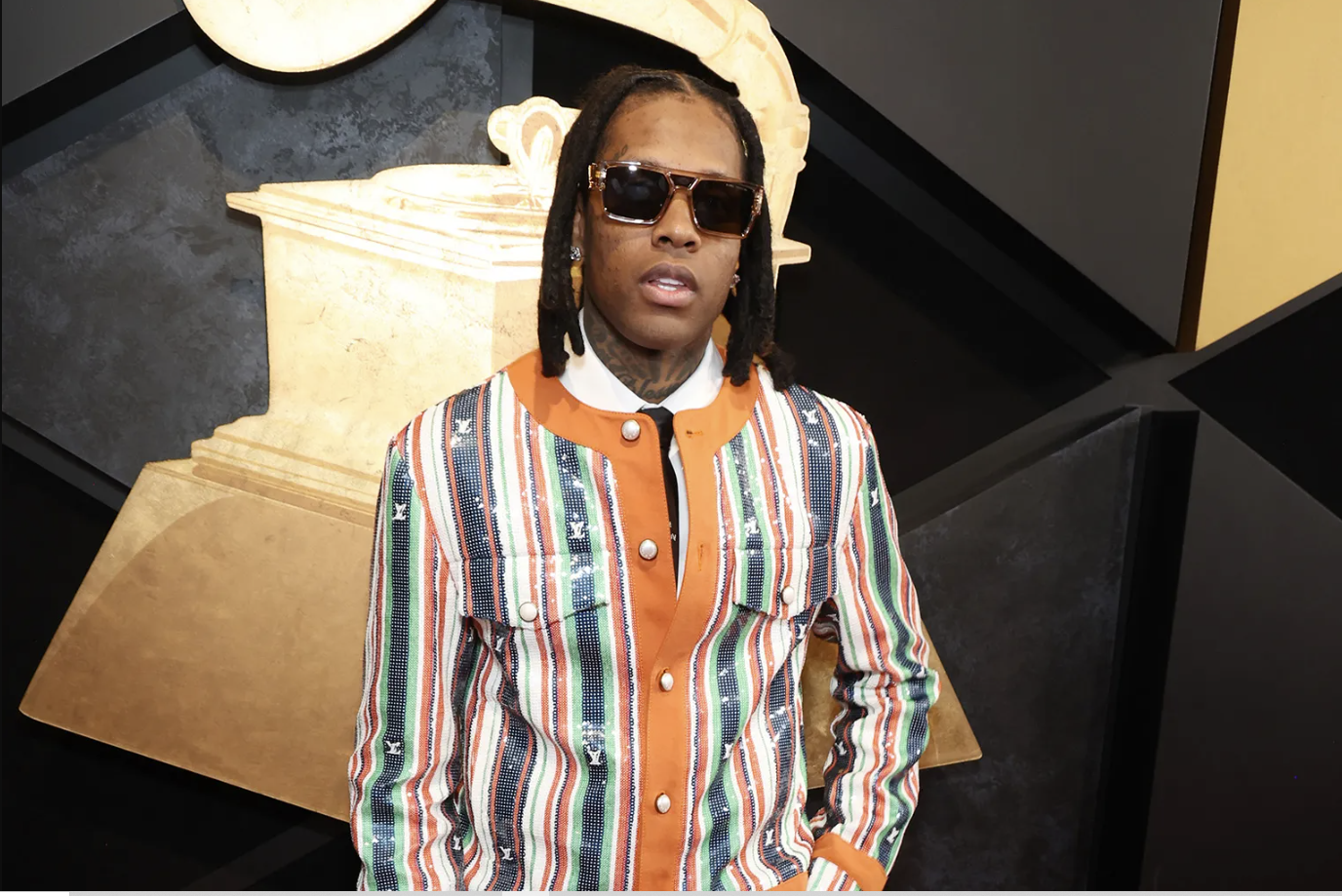
Closing arguments in the federal murder-for-hire trial of Durk Banks, the Chicago rapper who performs as Lil Durk, are set to begin today in Los Angeles, with jury deliberations expected to follow on Wednesday. [DancehallMag] Both sides rested last week without Banks taking the stand. [XXL] Banks has pleaded not guilty, and every allegation described below remains an allegation that the government still has to prove.
What follows is not a recap of the testimony. It is an attempt to explain what the last few days of pretrial rulings did to the shape of this case, because those rulings, more than any single witness, are what the verdict will turn on.
The case narrowed while nobody was watching
For two years this prosecution has been discussed in the widest possible terms: a rap label as a criminal enterprise, song lyrics as confession, a feud that began with King Von’s death in November 2020 and supposedly ended with a body outside a Los Angeles shopping center. The government’s original indictment matched that scale, charging Banks and five co-defendants with conspiracy to commit stalking, stalking resulting in death, murder-for-hire using interstate facilities, and firearms violations, with separate racketeering counts under the VICAR statute layered on top. [Wikipedia]
The version that reached the jury is much smaller. The racketeering counts were severed for a separate proceeding, a ruling that stripped out the Chicago gang narrative the government had wanted to carry into this courtroom. [Vibe] What remains is five counts, and all five run through the same bottleneck: whether Banks personally entered an agreement to have someone killed. [Los Angeles Magazine]
That narrowing is the most underreported development in the case. A jury that was never going to be asked “is OTF a gang” is instead being asked something far more specific, and far harder for prosecutors to reach with circumstantial evidence.
What the jury is actually being handed
The instructions the jury will receive ran to an 82-page filing with 59 proposed instructions, and the disputes inside that document map the real battlefield: what counts as stalking, what counts as a murder-for-hire conspiracy, and how far a defendant’s liability extends for acts committed by other people. [AllHipHop]
The five counts before the jury are conspiracy to commit stalking; stalking Quando Rondo with a dangerous weapon; stalking Saviay’a Robinson resulting in death; conspiracy to use interstate commerce facilities in a murder-for-hire resulting in death; and the substantive murder-for-hire count. [Los Angeles Magazine] One structural wrinkle sits underneath all of them: prosecutors say the intended target survived and his cousin, Saviay’a “Lul Pab” Robinson, was killed instead, which means the jury has to decide how a wrong-target killing attaches to each defendant.
Jurors were also told they may weigh alleged Chicago gang activity and a 2021 Georgia incident only as evidence of intent, motive or preparation, not as proof of the charged conduct. [Los Angeles Magazine] Instructions like that are easy to write and famously hard to follow, and defense lawyers know it. It is one of the reasons the severance mattered so much.
The bounty problem
The government’s theory has always leaned on money: a private jet on August 18, 2022, hotel rooms, ski masks bought on a credit card, phone bills that place people in the right cities at the right times. [Wikipedia] It is a familiar prosecutorial move, and in a federal murder-for-hire case it usually works, because paying for the instrumentalities of a killing tends to read to a jury as paying for the killing.
U.S. District Judge Michael Fitzgerald drew a line under exactly that. He ruled that travel costs, lodging and phone bills cannot on their own establish the reward element the statute requires. In his words: “The jury is already told that, specifically, in unambiguous English language, that paying for those sorts of instrumentalities are not enough. It has to be a bounty beyond the actual fact of those things.” [AllHipHop]
Prosecutors can still tie individual charges to specific moments in the alleged plot, and they can still argue from witness testimony that a bounty was promised. [AllHipHop] But the ruling moves the weight of the case off the paper trail and back onto the people, and the people in this case are cooperating witnesses who cut deals before they testified.
The Pinkerton fight, and why a technical ruling is the story
The most consequential argument of the past week had nothing to do with what happened in 2022. It was over the Pinkerton doctrine, the rule that lets a jury convict a conspirator of crimes committed by co-conspirators when those crimes are a foreseeable consequence of the conspiracy. Prosecutors argued that a reasonable juror could find the stalking and the killing were a “necessary or natural consequence of the unlawful agreement.” [Complex]
Banks’s lawyers pushed back with the sentence that will almost certainly show up in their closing: “Mere knowledge that others are planning to commit, are committing, or have committed a crime does not make Mr. Banks guilty of those crimes.” [Complex]
Fitzgerald could not remove the Pinkerton instruction entirely, citing binding appellate precedent, but he extracted a concession that functions almost as well for the defense. Asked whether the government would seek a conviction based on a plan that co-defendant Deandre “DeDe” Wilson organized without Banks’s knowledge, Assistant U.S. Attorney Ian Yanniello answered: “The Government will not argue that.” [DancehallMag] [AllHipHop]
Strip away the doctrine and here is what that exchange means. The government can no longer win by convincing the jury that violence happened somewhere in Banks’s orbit and he benefited from it. It has to put him inside a specific agreement. In a case built substantially on association, proximity and money moving through an artist’s accounts, that is a meaningfully higher wall.
The cooperators, and the only door the defense needs open
Three men who pleaded guilty testified for the government: Kavon “OTF Vonni” Grant, Kacey “OTF Jam” Hester, and a third cooperator known as Flacka. [AllHipHop] Hester, who identified himself as a participant in the shooting, testified in late August that he was directed to travel to California, described the planning, and said he was on the phone with a co-defendant during the getaway. [Wikipedia]
The defense did not try to prove an alternative timeline. It tried to make the cooperators unusable. Shekema Springfield, the mother of King Von’s child, testified that Grant is “a thief and a liar.” Briana Dangerfield, a sound engineer and Hester’s former partner, called him untruthful and manipulative, then conceded on cross-examination that she had lied under oath about her own record, which includes 2016 forgery and theft arrests. [XXL] [Billboard]
That last detail is the risk of the whole strategy. When you attack credibility with witnesses whose own credibility collapses on cross, you can hand the jury a reason to distrust everyone in the room. Which, for a defense that only needs one juror to hold out, is not necessarily a loss.
The strategy has an unusual assist from outside the courtroom. Hester, according to reporting on an alternate Instagram account attributed to him, posted a broadside at Banks in the days before closing arguments, complaining that the rapper called him to Los Angeles without explaining what he was walking into. [HotNewHipHop] The account’s authenticity rests on secondhand attribution, and none of it is evidence. But it is a reminder of what a cooperation deal actually is: not a conversion, just a trade.
Three defendants, no testimony
Banks did not testify. Neither did co-defendants Deandre “OTF Dede” Wilson or David “Browneyez” Lindsey. [HotNewHipHop]
Legally this is unremarkable, and the jury will be instructed not to hold it against them. Strategically it follows from everything above: once the judge had limited the bounty inference and the Pinkerton reach, the defense’s job became keeping the government’s proof at a distance rather than offering a competing story. Putting Banks on the stand would have handed prosecutors a cross-examination that could reintroduce, through his own mouth, the gang and lyrics material the severance had walked out the door.
Culturally, though, the silence lands differently. This is an artist whose entire catalog is testimony, whose commercial value rests on being taken at his word about his life. The one venue where his account would carry consequences is the one where his lawyers correctly told him to say nothing. The gap between the persona and the defendant is the quiet subject of this whole trial.
What the lyrics fight already cost
In August, Fitzgerald allowed prosecutors to introduce a 2021 Banks song and its video, over defense objections, as evidence bearing on intent. [Wikipedia] [HipHopWired] An earlier defense motion had argued that prosecutors mischaracterized the lyrics to the grand jury, noting the song predated the shooting; the second superseding indictment removed the lyrical references, and the motion was denied. [Wikipedia]
Set beside the Young Thug prosecution in Georgia, the pattern is now hard to miss. Rap lyrics keep clearing the evidentiary bar not because courts have resolved whether they are autobiography, but because the standard for admitting evidence of intent is low and the standard for excluding prejudicial material is discretionary. Every artist who has watched this case has learned the same practical lesson, and you can already hear it in what the last two years of major-label rap sound like: fewer specifics, more distance, a narrowing of what the music is willing to claim.
Whatever the jury decides about Durk Banks, that chilling effect is already banked. It does not get reversed by an acquittal.
The scale of what got built
The discovery in this case ran past 230 gigabytes of digital material and roughly 20,000 pages of documents, assembled across nearly two years between the October 2024 arrests and a trial that opened in late August 2026. [Wikipedia] Banks was denied bail repeatedly, including after his team offered a package of home equity and cash, with the court finding no conditions would reasonably assure his appearance. [Wikipedia] Prosecutors confirmed in 2025 they would not seek the death penalty. A conviction still carries the possibility of life.
All of that apparatus now compresses into a few hours of argument and a jury that has already sent the judge a note asking when this ends. [Complex] Restless juries are not a neutral fact. They tend to reward whichever side gives them the simplest path to being finished.
What a verdict settles, and what it doesn’t
A conviction would be read as the government proving that a rapper bought a killing. An acquittal would be read as the government overreaching against an artist it never really understood. Both readings will be too big for what the jury is actually deciding, which is whether the evidence puts Durk Banks inside one specific agreement, beyond a reasonable doubt, on five counts.
The more durable outcome is already fixed regardless. Severed racketeering counts still await their own proceeding. A cooperation pipeline that turns co-defendants into witnesses has been validated again in front of everyone watching. Lyrics went into evidence, and the ruling that let them in stands. Banks posted “Allah Is The Greatest” to his story as the evidence closed, which is the only statement he has made in his own voice about any of it. [The Source]
For a genre that has spent a decade arguing that its art should not be treated as a confession, this trial was never going to answer the question. It was only ever going to show how the question gets handled when there is a body, a cooperator and a federal courtroom. That answer arrives this week.
United States v. Banks
Federal murder-for-hire prosecution of Durk Banks, known as Lil Durk, in the Central District of California before U.S. District Judge Michael W. Fitzgerald. Banks has pleaded not guilty. Every allegation recorded here is unproven.
The five counts
Case chronology
Notes: Reported trial start dates differ between outlets (August 20 versus August 24). Billboard and Rolling Stone coverage is paywalled and was not read in full. All allegations described are unproven; Durk Banks has pleaded not guilty.
Status: Draft for review, current as of September 8, 2026.