
On the record
Davis was convicted of first-degree murder with use of a deadly weapon on Aug. 31, 2026. He has stated he intends to appeal; a conviction is not final while appeals are pending. Sentencing is set for Oct. 13, 2026, with a maximum of life in prison. Prosecutors did not allege Davis personally fired the shots, but argued he orchestrated the killing. Sean Combs, whose name surfaced in Davis’s own statements, has denied any involvement and was never charged.
Guilty: Keffe D Convicted of First-Degree Murder in Tupac Shakur’s Killing
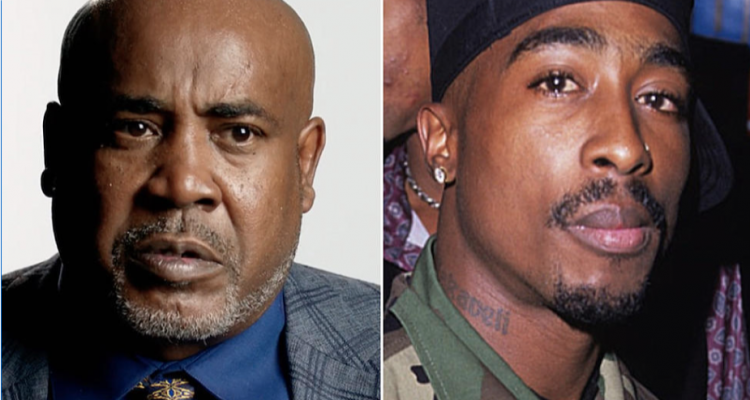
Nearly thirty years after Tupac Shakur was shot near the Las Vegas Strip, someone has finally been held to account. On Monday, a Clark County jury found Duane “Keffe D” Davis, 63, guilty of first-degree murder with the use of a deadly weapon. It is the first and only conviction ever secured in the September 1996 killing. [NBC News]
The jury of ten women and six men deliberated for less than three hours before returning the verdict around 4:30 p.m., just hours after closing arguments ended. [8 News Now] Because Davis faced an open murder charge, jurors could have landed on second-degree; they chose first. Each juror was polled in open court and affirmed the verdict. Notably, prosecutors dismissed the gang enhancement, so the conviction stands on first-degree murder with a deadly weapon. [NBC LA]
The verdict validated the theory prosecutors held from opening to close: that Davis never had to pull the trigger to be a murderer. Under Nevada law, a person who helps orchestrate a killing can be convicted of it, and the state cast Davis as the South Side Compton Crips shot caller who acquired the gun and directed the hit in revenge for the casino beating of his nephew, Orlando Anderson. Their proof was, overwhelmingly, Davis’s own three decades of talking, from a 2008 police proffer to his 2019 memoir to recorded jail calls. [TMZ]
In closing arguments that morning, Chief Deputy DA Binu Palal told jurors Davis got a gun and went hunting for Shakur and Suge Knight. In rebuttal, prosecutor Marc DiGiacomo held up the scrapbook of Tupac clippings found in Davis’s home and delivered the line of the trial: [AP] “This guy’s scrapbooking his murder, for God’s sake.” Defense attorney Michael Sanft made the case he had made all along, that Davis’s confessions were tall tales spun for money, and that he was never charged for decades because investigators knew he was [TMZ] “full of crap.” The jury did not buy it.
The courtroom broke along the lines the case always had. Tupac’s sister, Sekyiwa “Set” Shakur, wept and embraced the prosecutors; Davis’s son covered his face. Davis himself stood silent as the verdict was read, then briefly raised a fist toward the gallery as he was led out. He told Judge Carli Kierny he intends to appeal. [CNN] He remains jailed ahead of sentencing on October 13, where he faces a maximum of life in prison. [Al Jazeera]
For thirty years the Tupac case belonged to the culture, retold in documentaries, podcasts, and endless speculation, with no one ever answering for it. On Monday, twelve strangers in Las Vegas did what all of that noise never could. They returned a finding of fact. The story that Davis told and sold for so long finally became the thing that convicted him, and one of hip-hop’s oldest open wounds has, at last, a verdict attached to it. An appeal now lies ahead, but the record is no longer empty.
On the record
Davis has pleaded not guilty and is presumed innocent unless and until proven guilty. Declining to testify is his constitutional right and cannot be held against him. Prosecutors do not allege he fired the shots; their theory is that he orchestrated the killing. Nothing described here has been decided by the jury, which has not yet begun deliberations.
Day 9: The Defense Rests in Under Two Hours, and Davis Stays Silent
If the prosecution took eight days, the defense took barely two hours. On Thursday, Michael Sanft called just three witnesses, rested, and closed the evidence phase of the trial. Most notably, Duane “Keffe D” Davis, 63, did not take the stand. Both sides have now rested, and jurors return Monday for closing arguments before deliberations begin. [AP]
The defense’s three witnesses were all law enforcement, chosen to poke at the investigation rather than tell a new story. Former Las Vegas Metro officers Stan Hyt and Charlie Mangrum testified they were working overtime the night of the Tyson fight, assigned to watch Suge Knight’s Las Vegas home ahead of an expected party, testimony Sanft used to press on the timeline. [FOX5] A retired Compton gang detective rounded out the trio. The sharpest defense note came from an officer who testified he was told to “stand down,” a detail Sanft used to argue the original investigation was mishandled and that authorities never treated Davis as a real suspect at the time. [Rolling Stone]
Keeping Davis off the stand was the expected call, and a telling one. His entire defense rests on the argument that his confessions in books, interviews, and jail calls were fabricated for money and notoriety. Putting him under oath would have invited prosecutors to cross-examine the very man they spent eight days quoting, and it would have sat awkwardly beside a defense that told jurors not to believe a word he says. So Sanft let the brevity make his point: after nearly thirty years and roughly 25 state witnesses, the defense is betting the jury will see a case built on a storyteller’s words rather than physical proof. [AP]
It now comes down to one question, and both sides know it. Closing arguments begin Monday morning, after which the jury of twelve gets the case. The prosecution will ask them to trust that Davis told the truth about himself over and over for years. The defense will ask them to see a man who sold a version of that night for twenty dollars a copy. A verdict in one of hip-hop’s most enduring cases could come within days. [FOX5]
On the record
Davis has pleaded not guilty and is presumed innocent unless and until proven guilty. Prosecutors do not allege he fired the shots; their theory is that he orchestrated the killing. A party resting its case is a procedural step, not a finding by the jury. The defense maintains Davis’s past statements were fabricated for money. Nothing described here has been decided.
Day 8: The Prosecution Rests, on Davis’s Own Voice
After a week and a half of testimony, roughly 25 witnesses, and about eight hours of recordings, the state rested its case Wednesday. It ended the way it began: with Duane “Keffe D” Davis doing the talking. Prosecutors Marc DiGiacomo and Binu Palal leaned so heavily on Davis’s own recorded statements that, as CNN put it, at times they barely needed words of their own. [CNN]
The final witness was Adam Stoehr, an electronic-evidence specialist from the district attorney’s office, whose job was simply to explain the clips the jury then watched and heard. Among them was a video of Davis promoting his memoir, holding up Compton Street Legend and telling viewers they could get [Courthouse News] “the real truth” for twenty dollars. The state closed with jail calls recorded after his 2023 arrest. In one, Davis said [FOX5] “I have blood on my money.” In another, he complained [AP] “they’re trying to use my words against me,” and said he should have stopped doing interviews. It was a fitting last note: the man whose confessions built this case, complaining that his confessions built this case.
The prosecution’s strategy across the eight days was consistent: play Davis’s four main accounts, from the 2008 proffer to the BET documentary to the memoir to the jail calls, all placing him in the Cadillac beside Shakur, and let the repetition do the work. But resting also exposed the case’s soft spot. Former federal prosecutor Neama Rahmani noted there is still no physical evidence tying Davis to the scene, because any DNA, fingerprints, or the murder weapon are long gone, leaving the confessions largely uncorroborated by independent proof. [CNN]
Now the defense takes over. Michael Sanft is expected to call his first witness Thursday, with roughly four witnesses planned and closing arguments targeted for Monday. [FOX5] The single biggest decision left is whether Davis testifies. Judge Kierny advised him of his right to stay silent, noting prosecutors could not hold that against him in closing, and clarified that if he does take the stand, the state may only raise a narrow slice of his record, tied to a December 2024 jailhouse fight. [Courthouse News] After a defense built on calling his own past words worthless, putting him on the stand would be a gamble few expect Sanft to take.
On the record
Davis has pleaded not guilty and is presumed innocent unless and until proven guilty. Prosecutors do not allege that Davis fired the shots; their theory is that he orchestrated the killing. The “shot caller” testimony is an expert opinion offered by a witness, not an established fact, and the defense disputes it. Nothing described here has been decided by the jury.
Day 7: An Eyewitness, the Evidence Vault, and the “Shot Caller” Case
After a week of Davis’s own recordings, Tuesday was the day prosecutors turned from his words to the scene and the structure around it. They put an eyewitness from the night in the courtroom, walked jurors through the physical evidence, and, most importantly, used a gang expert to argue Davis had the rank to order the killing without ever firing a shot. [AP]
The most emotional testimony came from Malcolm Greenidge, the rapper known as E.D.I. Mean of the Outlawz, who called Tupac his childhood friend and mentor and appeared only after a California court ordered him to. Greenidge said he was in a car in the caravan when a light-colored Cadillac pulled alongside Shakur and Suge Knight’s BMW, and he saw an arm and a gun come out of the window firing toward them. [XXL] “I’m horrified,” he told the jury, recalling the moment. He testified that the shots came from the back seat but that he could not see who was inside the car or who fired. [8 News Now]
Prosecutors then built out the physical case. Las Vegas Metro crime-scene analysts detailed what was seized in the 2023 search of Davis’s Henderson home, including a November 1996 issue of VIBE and a document laying out a production budget approaching one million dollars, which the state uses to argue Davis profited from telling the story. An officer testified that seven cartridge cases recovered from the 1996 scene were re-examined in 2023 and appeared to have been fired from the same gun. [8 News Now]
The heart of the day was Robert Ladd, a retired Compton gang detective called as an expert. Ladd described Davis as a leader of the South Side Compton Crips who was ranked, in his words, as high as you can get, a “shot caller” whose word governed younger members. Asked who would have been in charge among the four men in the Cadillac, Ladd answered plainly: Davis. He testified that a younger member like Orlando Anderson could not have opened fire with Davis present unless Davis allowed it, and that had Davis told them to handle the dispute later, [AP] “there wouldn’t have been a shooting.” That is the prosecution’s theory of the case in a single sentence: it does not accuse Davis of firing, it accuses him of being the man who let it happen.
On cross, defense attorney Michael Sanft worked to blunt all three threads. He got Ladd to acknowledge his own Compton memoir was ghostwritten and built largely on memory, pressed him on evidence that could not be located from the old searches, and challenged the idea that Tupac was a gang member. He also questioned the chain of custody on the seized material and whether investigators ever confirmed Davis actually wrote his memoir, given a listed co-author. [News 3] [FOX5] The week’s pattern held: an eyewitness who corroborates the white Cadillac but cannot name a soul, and an expert who explains the hierarchy but was not there. The state is stacking structure; the defense keeps asking for certainty.
On the record
Davis has pleaded not guilty and is presumed innocent unless and until proven guilty. He maintains his past statements were exaggerations made for money and that he was not in Las Vegas the night of the shooting. Sean Combs has denied any involvement in Shakur’s death and has never been charged in connection with it. The judge has instructed jurors that Davis has no connection to the killing of The Notorious B.I.G. Nothing described here has been decided by the jury.
Day 6: The Documentarian Who Recorded Him, and “I Didn’t Do Nothing”
Week two opened Monday with the state pressing the same theme that has carried the whole trial: Keffe D talked, and everyone was recording. The day’s central witness was Michael Dorsey, a documentarian who consulted on the BET series “Death Row Chronicles.” Dorsey testified that Davis did paid interviews for the project, and that he quietly took what Davis told him to Las Vegas Metro police, kept a detective informed, and recorded the audio. [8 News Now]
That set up a sharp fight from defense attorney Michael Sanft, who called the recordings surreptitious, suggested Davis may have believed he was speaking with an attorney at points, and argued the jury was being fed material about unrelated crimes. The judge stepped in to remind jurors that Davis has no connection to the murder of The Notorious B.I.G., then read them a limiting instruction. [Rap Industry]
Then came the moment that landed hardest in the room. In one of Dorsey’s recordings, producer Mario Diaz asks Davis whether he regrets the killing and wants to apologize to Tupac’s family. The pool camera cut to Shakur’s relatives in the gallery as Davis brushed the question off: [Los Angeles] “I didn’t do nothing.” The family was not expecting an apology; a week earlier, Tupac’s cousin had asked marshals to stop Davis from staring at them during proceedings. [Los Angeles]
The recordings again cut against Davis in his own voice. On tape, jurors heard him call the killing part of a paid contract on Shakur and Knight, brag that he was a kingpin making more money than Combs, and, when asked how he felt about Tupac, dismiss the slain rapper in cold terms. [FOX5] Away from the jury, the friction spilled over: Davis was caught muttering an insult at former Death Row security chief Reggie Wright Jr., and Judge Carli Kierny cautioned him that the hostility was running both ways. [Los Angeles]
Davis also raised a safety complaint that has followed him into week two, telling the court his family’s addresses were aired in open proceedings and that his home and his wife’s car were later vandalized. His son told reporters the family has since moved without putting the new address on the record. [8 News Now] Testimony resumes Tuesday. The pattern is now unmistakable: the prosecution barely has to argue that Davis said these things. It just keeps pressing play.
On the record
Davis has pleaded not guilty and is presumed innocent unless and until proven guilty. He maintains he was not in Las Vegas the night of the shooting and that his prior statements were exaggerations. Sean Combs has denied any involvement in Shakur’s death and has never been charged in connection with it. Nothing described here has been decided by the jury.
Day 5: The Confession on Camera, and an Outburst in Court
Friday closed the first week of testimony, and it delivered the two things that make a trial go viral: Keffe D confessing on camera in his own documentary, and Keffe D losing his composure at the man trying to convict him. Eighteen witnesses have now taken the stand. [FOX5]
The day opened with Leonard Jefferson, the man who took the last known photograph of Tupac alive, an image of the rapper beside Suge Knight in the car minutes before the shooting. Jefferson testified that he was in town for the Tyson fight, sold his tickets, and happened to pull up next to Shakur and Knight at a light on Las Vegas Boulevard. [KOLO]
Then prosecutors turned back to Davis’s own mouth. They played a 2009 recorded interview in which Davis described pulling the white Cadillac alongside the BMW carrying Shakur and Knight and, when pressed by investigators to be specific, named his nephew Orlando Anderson as the one who fired. In the same recording, the Sean “Diddy” Combs thread surfaced again in Davis’s telling: he said he expected to be paid by Combs after the killing, and claimed Combs had solicited a hit on Knight. [ABC7] Combs has repeatedly denied any involvement in Shakur’s death, has never been named a suspect, and is currently incarcerated on unrelated charges. [ABC7]
Jurors also watched clips of Davis telling the story on camera in a BET docuseries. In one, he explained why he finally went public: [Rolling Stone] “I got cancer… I got nothing else to lose.” Prosecutors also called the documentary’s filmmaker, Mario Diaz, who testified that the series was not scripted, a point that matters because the state argues Davis’s decision to tell the story publicly, on camera and later in a book, is what stripped the legal protections around his earlier confidential interviews and opened the door to this prosecution. [ABC7]
The rawest moment came when Davis stood up and pointed at the prosecutor, telling the court, [ABC7] “This is just wrong, and it’s mostly this guy.” The prosecutor’s dry reply, for the record, was that Davis seemed upset about being prosecuted for murder. It was a flash of the tension running under a week in which the defendant has had to sit and listen to his own voice, over and over, building the case against him. The trial resumes the following week.
Days 3–4: The Confession Tape, and Keffe D’s Three Different Stories. The first week of testimony did exactly what the prosecution promised it would: it turned Duane “Keffe D” Davis into the strongest witness against himself. Over two days, jurors heard how his story of that night in September 1996 changed across a decade, and then they heard him tell one of those versions in his own voice. [Review-Journal]
Day 3 · Aug 19: Two versions, ten years apart
Former FBI agent Wade Lee walked jurors back to a 1998 proffer session, the confidential kind of interview where a suspect talks in exchange for leniency. Lee testified that federal agents had built a drug-trafficking case against Davis, who was indicted for selling two kilograms of cocaine and faced up to 10 years. In that 1998 account, Davis gave himself an alibi: he said that after his nephew Orlando Anderson was beaten at the MGM Grand, he, Anderson, and their girlfriends went back to the Excalibur and stayed there the rest of the night. He even floated a theory that Compton police officers working for Suge Knight might have carried out the killing because Tupac was thinking about leaving Death Row. Under cross-examination by defense attorney Michael Sanft, Lee acknowledged he never followed up on some of those claims. [Review-Journal]
Then came the flip. Former LAPD detective Daryn Dupree testified that a task force had once looked at Davis in the separate murder of The Notorious B.I.G., because the vehicle tied to that shooting was an Impala and Davis owned one, before ruling him out. Using drug charges as leverage, investigators got Davis into a 2008 interview. He denied any role in the Biggie killing, Dupree said, then volunteered something no one had asked about, telling detectives, [Review-Journal] “We did the other one.” In that account Davis said he handed a gun to Deandrae “Dre” Smith in the back seat of the white Cadillac, but Smith was afraid to shoot, so Anderson fired the fatal rounds. Both men are long dead, leaving Davis the last person alive from that car. Dupree also relayed Davis’s claim that Sean “Puffy” Combs had money passed through an associate named “Zip” Martin as payment for the killing. Crucially, Dupree told jurors he found the confession credible for one reason: Davis put the gun in his own nephew’s hand. [Review-Journal]
Day 4 · Aug 20: The jury hears the tape
If Day 3 described the 2008 confession, Day 4 played it. In a half-day session, prosecutors ran the recording of the December 18, 2008 meeting at Davis’s lawyer’s office, the interview at the center of this entire case. On the tape, Davis opens with a line that has followed him for years, telling the room not to lie to him and he would not lie to them, before former detective Greg Kading assures him that nothing he says can be used against him. [Rolling Stone] Davis agreed to talk hoping to escape drug charges that he was told could carry a life sentence. Prosecutors call the result a full confession; on it, Davis again names his nephew as the shooter and repeats the claim that he was supposed to be paid by Combs after Tupac’s death. [FOX5] [8 News Now]
The day also brought another reluctant witness. Denvonta Lee, a friend of Orlando Anderson and a South Side Compton Crips associate, took the stand only under a court order and made clear he did not want to be there, echoing the hostile-witness energy that has run through the whole week. [FOX5] Friday closes out the first week of testimony. [8 News Now]
The through-line of the week is the same paradox the trial opened on, now sharper. The state’s case is that Davis told the truth about himself in 2008. The defense’s case is that he lied for leverage then and for money later. And the recording carries its own irony: it was made under a promise that nothing he said could be used against him, the very proffer that anchored his failed immunity fight. The judge let it in anyway, because Davis went on to repeat the story in public and in a book. His own words got him this trial, and his own words are now the loudest voice in the room.
Davis has pleaded not guilty and is presumed innocent unless and until proven guilty. Prosecutors characterize the 2008 recording as a confession; the defense argues his past statements were empty brags made to gain leverage and sell books. Nothing described here has been decided by the jury.
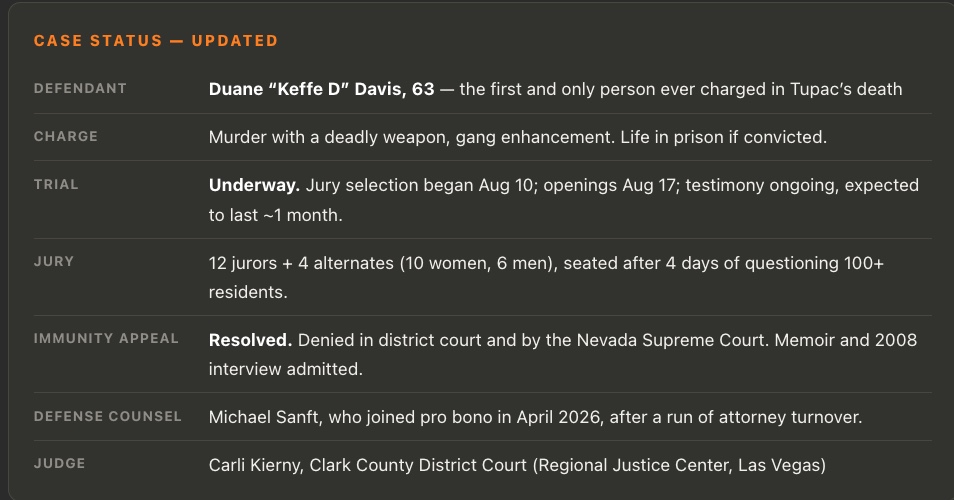
This piece updates our earlier explainer, The Tupac Shakur Murder Case Goes to Trial, which ended with the trial still pending and an immunity appeal unresolved. Both questions now have answers. Testimony is underway and expected to run about a month; we’ll keep updating as the case develops.
When we last laid out this case, the single biggest variable was a pending Nevada Supreme Court petition that could have blown it up before a jury ever heard a word. That door has closed. Davis’s bid to get the charges tossed on immunity grounds failed — in Clark County District Court and again before the Nevada Supreme Court — and Judge Carli Kierny ruled that both his 2019 memoir and his 2008 police interview can go in front of the jury. [TechTimes] With his own words cleared for admission, the trial began on schedule.
Thirty Years, One Courtroom
On August 10, 2026, jury selection opened in a Las Vegas courtroom almost exactly thirty years after Tupac was shot near the Strip on the night of a Mike Tyson fight. [CNN] After four days of winnowing more than a hundred prospective jurors, the court seated twelve jurors and four alternates — ten women and six men, among them a self-improvement coach and a mail carrier — and handed them one of hip-hop’s oldest open questions. [CNN]
The scale of what’s missing is worth stating plainly, because it shapes everything. There is no DNA, no recovered weapon, and no living eyewitness other than Davis himself, who by his own decades of storytelling was in the Cadillac. [TechTimes] That absence is exactly why the state spent years fighting to get his confessions admitted — and why the defense is spending this month trying to convince a jury those same confessions were fiction.
Two Openings, One Paradox
Chief Deputy District Attorney Binu Palal opened for the state on August 17 with a simple motive: revenge. He told jurors the killing was retribution for the beating of Davis’s nephew, Orlando Anderson, in a casino brawl hours earlier, then walked them through his theory of the night — that Davis obtained a .40-caliber Glock, assembled a crew in a white Cadillac, and passed the gun to the back seat, where Anderson fired into Tupac’s BMW. [Court TV] To make the case, Palal played the jury Davis’s own recorded words. [AP] His closing line to the panel: nearly thirty years later, it was time to finally hold Davis accountable. [AP]
Then Michael Sanft stood up and did something unusual: he attacked his own client’s credibility. Sanft told jurors the state was dressing up fiction as fact, put a slide on the screen that read simply “Bulls—” over Davis’s statements, and argued there was nothing tying Davis to the crime scene. [AP] [NewsNation] His sharpest point doubled as an attack on the investigation: Davis wasn’t charged back in 1996, Sanft said, because law enforcement itself knew he was “full of crap.” [NewsNation]
That is the paradox at the heart of this trial, and it may decide it. Davis is both the accused and the prosecution’s best source against him. Legal analysts watching the openings, including Mark Geragos, noted the obvious trap: after telling jurors not to believe a word Davis ever said, the defense can hardly put him on the stand and ask them to believe him now. [NewsNation]
The First Witnesses
Testimony opened grimly. On day two, Clark County forensic pathologist Dr. Lisa Gavin detailed Tupac’s fatal wounds as prosecutors displayed autopsy photos; some members of the Shakur family left the courtroom rather than see them. [AP / PBS] A former LAPD detective testified that Davis had once been a brief suspect in the separate murder of The Notorious B.I.G. but was ruled out — a reminder of how many myths orbit this man. [AP / PBS]
The day’s fireworks came from the Death Row side of the room. Reggie Wright Jr., the label’s former head of security, walked jurors through the night at the MGM Grand and Suge Knight’s Club 662. [FOX5] Then James McDonald, a former Mob Piru associate who ran security at 662, took the stand as a self-declared hostile witness — telling the prosecutor to treat him as one and grumbling that he’d rather be anywhere else, even as he offered candid detail on the Crips-Bloods conflict framing the case. [CNN] The reluctant, summons-only witnesses are their own story: three decades on, the people who can speak to that night still don’t want to.
Where’s Diddy?
If you came to this case through the headlines, you came through Sean Combs — the alleged million-dollar bounty that, as we covered before, supercharged the story in 2024. So here’s a notable update: that thread is largely absent from the actual prosecution. The state’s theory in the courtroom is the older, more grounded one — revenge for the nephew’s beating, proven through Davis’s own confessions — not a Combs murder-for-hire. [Court TV]
That gap between the folklore and the filing is the quiet lesson of week one. The bounty claim still lives in a parallel civil suit and in Davis’s own bravado, but a criminal trial runs on admissible evidence, and prosecutors chose the motive they could actually prove. The most viral part of this story may never reach the jury at all.
What’s Next
The trial is expected to last roughly a month, which means a verdict is weeks away, not days. The biggest open question now isn’t procedural — it’s whether Davis testifies. After a defense built on calling his prior statements worthless, taking the stand would hand prosecutors a cross-examination they’d relish, and most observers expect him to stay silent. [NewsNation] In pretrial jailhouse interviews he kept insisting he only confessed to sell books and provide for his family, and that he knows who killed Tupac but didn’t do it himself. [8 News Now]
Whatever the jury decides, the significance is already fixed. For thirty years the Tupac case belonged to the culture — a story we told and retold, with no one ever answering for it in a court of law. Now twelve strangers in Las Vegas will do what documentaries, podcasts, and barbershop debates never could: return a verdict. Not another theory. A finding of fact.
The Trial, Day by Day
Where the Keffe D trial stands. Tap any entry to expand.
Verdict in · updated Sep 1, 2026