
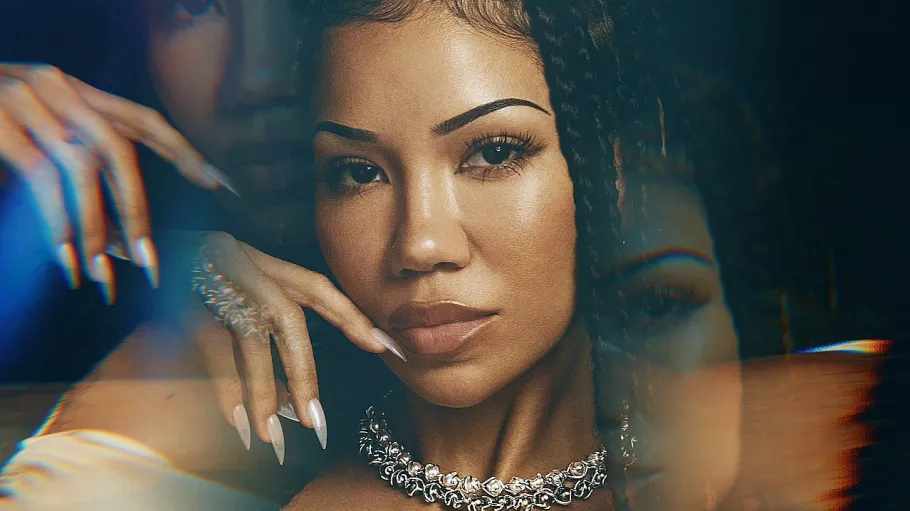
Jhené Aiko has been on the Billboard 200 since November 2013. She has been nominated for seven Grammys, made an Album of the Year shortlist, and watched four projects land in the top 10 without ever landing on top of it. This week she finally did, with a record she put out three days after announcing it. The number that got her there was 74,000 equivalent album units, which is both a real achievement and a data point worth sitting with, because it tells you what a No. 1 album costs in 2026.
The number, and what is inside it
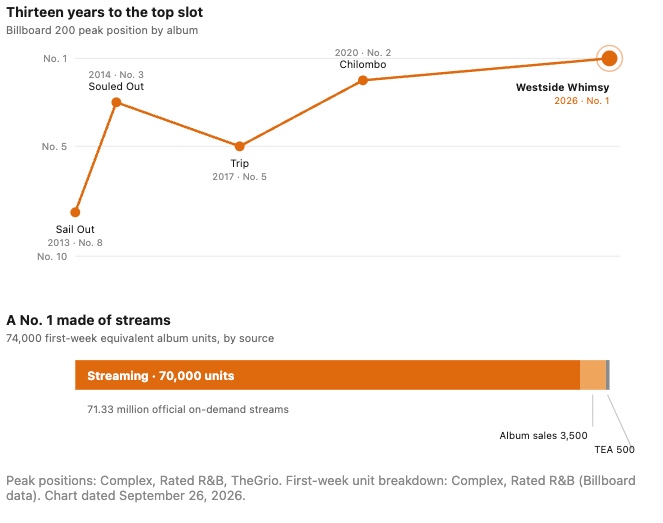
Westside Whimsy opened at No. 1 on the Billboard 200 dated September 26, 2026, with 74,000 equivalent album units [Complex]. Of that total, 70,000 units came from streaming, generated by 71.33 million official on-demand streams of the album’s tracks. Album sales accounted for 3,500 units. Track-equivalent albums contributed 500 [Rated R&B].
Run that split out and roughly 95 percent of the week came from people pressing play. Fewer than one in twenty units involved anyone deciding to own the record. That is not a knock on the album. It is the shape of the modern chart, and it is worth naming plainly rather than burying under the headline, because the headline and the mechanics are telling two different stories.
The projection industry had this close. Ratings Game Music called it for No. 1 at around 73,000 units days before the chart posted, noting what it described as an unusually quiet release week [Ratings Game Music]. Complex reported early projections nearer 62,000, which the final figure cleared comfortably [Complex]. The album also topped the Top Streaming Albums chart and the Top R&B Albums chart in the same week [TheGrio].
Twelve years, ten months
The career arc is the more interesting number. Aiko first entered the Billboard 200 in November 2013 with Sail Out, which peaked at No. 8. Souled Out reached No. 3 in 2014. Trip hit No. 5 in 2017. Chilombo got to No. 2 in 2020 and earned an Album of the Year nomination [Rated R&B]. Six top-10 projects, and the top slot stayed just out of reach for twelve years and ten months, which TheGrio reports is the second-longest wait between a first Billboard 200 entry and a first No. 1 among female soloists, behind Solange at thirteen years and eight months [TheGrio].
That comparison is more useful than it first appears. Solange and Aiko are not stylistic twins, but they occupy a similar position in the industry’s imagination: artists whose work is treated as atmosphere rather than event, praised steadily, rarely positioned as commercial tentpoles. The pattern that produces a thirteen-year gap is not a talent problem. It is a marketing category problem. Records built for repeat listening rather than first-week spectacle are exactly the records a units-and-week-one system is worst at measuring.
Which makes the streaming-heavy composition of this week read differently. A catalog artist whose audience returns rather than rushes is precisely the kind of artist streaming should eventually reward. It took the format a decade to catch up to her.
What 74,000 units buys in 2026
A No. 1 album on 74,000 units would have been unusual a decade ago. Today it is unremarkable, and that shift deserves attention on its own terms. The chart no longer measures how many people bought something. It measures how much attention an album absorbed in seven days relative to everything else released into the same seven days.
Ratings Game Music’s note about a quiet release week is the whole mechanism in one clause. In a market where the top slot is contested by whoever happens to have shipped that Friday, the release calendar is a competitive variable, not a background detail. Nobody has suggested the timing here was strategic, and there is no reporting that says it was. But the outcome illustrates something real: for an artist who has spent twelve years finishing second and third, the difference between No. 2 and No. 1 can come down to what else was on the schedule.
None of that subtracts from the achievement. It reframes what the achievement is. This is not evidence that Aiko suddenly sells more than she used to. It is evidence that the thing she has always done, build an audience that keeps coming back, converts into chart position under the current rules in a way it did not under the old ones.
The rollout that was not a rollout
Several outlets describe Westside Whimsy as a surprise release, announced roughly three days before it arrived on September 11 [Hot 97], with The Source characterizing it as a digital-only project released without a traditional promotional campaign [The Source].
Worth flagging honestly: that framing sits awkwardly next to the record’s own history. Wikipedia’s entry lists “Break” as a single released in November 2025, nearly ten months before the album [Wikipedia]. An album with a single out the previous year is not a surprise in the sense the word usually carries. The more accurate description is a compressed announcement window on a long-gestating project, which is a different and less romantic thing.
The distinction matters because “surprise release” has become shorthand for a specific kind of power move, the artist so established they can bypass the machine. What appears to have happened here is closer to the opposite: a short runway because a long one was never offered. If the record had been positioned as a major fourth-quarter release, the conversation around it in week one would have looked very different, and so might the number.
The guest list reads like a map
The twenty-track album features Kendrick Lamar, Ab-Soul, Larry June, Tyga and Ohma [Rated R&B], with production credits including Boi-1da, Sounwave, Fisticuffs and PartyNextDoor [Wikipedia]. Revolt noted the Kendrick and Larry June appearances when the album arrived [Revolt].
That is not a chart-services feature run. Lamar, Ab-Soul and Sounwave are the TDE orbit Aiko has been adjacent to since Sail Out. Larry June is Bay Area. Tyga is Los Angeles. The title says Westside and the credits back it up. This is a record built out of a specific geography and a specific decade of relationships, which is why it reads as a body of work rather than a playlist assembled for placement.
It also explains some of the streaming shape. Nine tracks from the album landed on Spotify’s Top Songs Debut U.S. chart, with “So Good” featuring Lamar topping the Top Song Debut U.S. chart [The Source]. Depth across a tracklist, not one song carrying a week, is what a returning audience looks like in the data.
The lane nobody was watching
Multiple outlets report this as the first R&B album by a woman to top the Billboard 200 in 2026 [Rated R&B] [TheGrio]. Nine months into the year is a long time for a genre that has spent the last decade being described as ascendant.
The gap is the story underneath the story. R&B by women has been commercially healthy and critically respected throughout that stretch without being treated as a priority release category by the people who plan release calendars and allocate marketing budgets. When an album from that lane finally tops the chart, it happens on a quiet week, with a three-day announcement, on 74,000 units. That is not a coincidence so much as an outcome.
Aiko’s own response was characteristically low-volume. She posted “Thank you for listening” and, in the comments, “What’s mine is ours” [Revolt].
What the milestone actually measures
The easy version of this story is that patience paid off, and that version is not wrong. But it is incomplete. A first No. 1 arriving in year thirteen, built almost entirely from streams, on a week where the competition thinned out, is a milestone with a lot of context attached.
What it measures is an audience that stayed. Aiko did not win this week by converting new listeners at scale or by dominating a news cycle. She won it because a decade of people who found her through Sail Out and Chilombo pressed play 71 million times in seven days without anyone telling them to. In a chart system that increasingly rewards attention over ownership, the durable audience finally became the valuable one.
That is the part worth watching. Not whether she holds No. 1 next week, but whether the industry reads this correctly: that the artists it has been categorizing as background have been building exactly the kind of listening behavior the current chart is designed to count.
Editor’s note on sourcing. Billboard and Variety both returned paywalls during reporting and are referenced only for claims stated in their own headlines. First-week figures, chart placements and career peaks in this piece are drawn from Complex, Rated R&B, TheGrio, The Source, Revolt, Hot 97 and Ratings Game Music, which report them consistently. The album it displaced at No. 1 could not be confirmed. The “surprise release” framing and the November 2025 single “Break” are in tension across sources and the piece flags that rather than resolving it. Hot 97’s claim that the last woman in the genre to lead the chart was SZA is single-sourced and is not repeated here.