
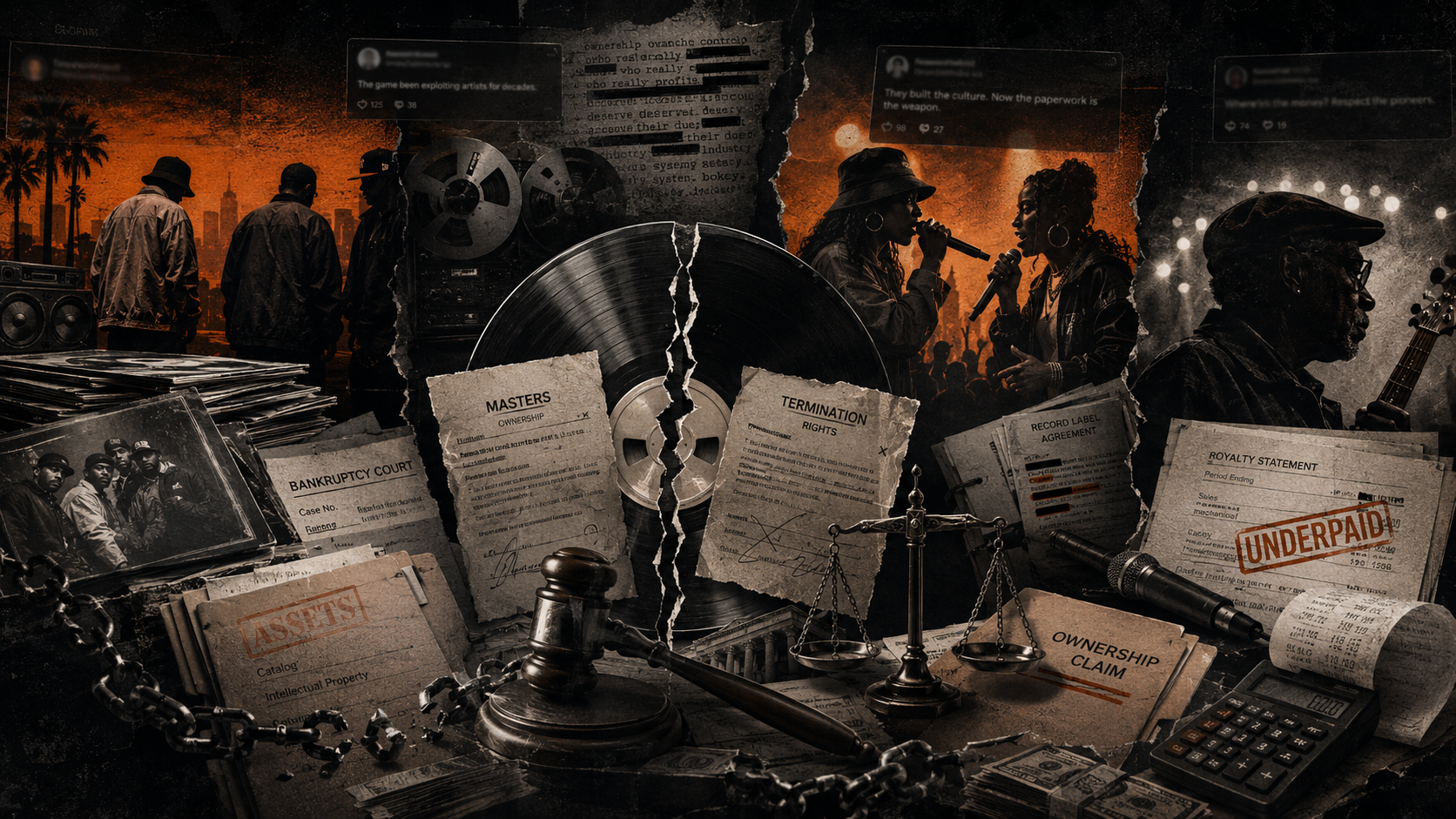
Hip-hop’s ownership wars are being decided in three active federal cases. In June 2026, the U.S. Court of Appeals for the Eleventh Circuit ruled that 2 Live Crew cannot reclaim their five-album catalog from Lil’ Joe Records because member Brother Marquis (Mark Ross, who died in 2024) had previously filed for bankruptcy, trapping his termination interests in an un-administered estate and voiding the group’s statutory majority. In January 2026, Judge Denise Cote dismissed Salt-N-Pepa’s copyright termination lawsuit against Universal Music Group, ruling the artists never personally owned or transferred their master recordings — because their 1986 deal was with producer Hurby Azor’s company Noise In The Attic Productions (NITA), not directly with a label. And in May 2026, George Clinton filed a federal lawsuit in Detroit alleging UMG withheld over $1.1 million in royalties across Parliament-era recordings and later collaborations, using an unrelated estate dispute as pretext — even after a federal judge had already ruled in Clinton’s favor on that dispute in September 2025.
The Ownership Wars: Three Cases Defining Who Controls Hip-Hop’s Catalog
In 1990, a federal judge in Broward County, Florida declared an album legally obscene. In 2026, the Eleventh Circuit told the group that made that album they cannot reclaim it. Between those two moments, 2 Live Crew helped carve out more legal breathing room for American popular music than almost any act in history — winning on First Amendment grounds, winning at the Supreme Court on fair use, watching their victories become the foundation for a genre’s speech rights. Then they tried to use a different part of the same law to get their catalog back, and lost. The paperwork beat them. That’s the second wave: not what hip-hop can say, but who will ever own what it said.
The First Wave: How 2 Live Crew Became a First Amendment Landmark
2 Live Crew’s legal history reads like a case study in how the law expands when it is forced to confront something it was never designed to accommodate. When Broward County Sheriff Nick Navarro pushed a test case on whether a rap album could be criminally obscene, a federal judge agreed in Skyywalker Records, Inc. v. Navarro, formally declaring As Nasty As They Wanna Be obscene under the Miller test — the first time in U.S. history that label had been applied to a sound recording. [Justia] The ruling led to arrests of group members for performing songs from the album, and to a record store owner being prosecuted for selling it. [Wikipedia]
The ruling did not hold. On appeal, the Eleventh Circuit voided the obscenity judgment, and the criminal prosecutions ended in acquittals and overturned convictions. [HipHopDX] That reversal became a First Amendment benchmark: explicit, bass-heavy, sex-obsessed rap could still be protected speech. Then came the copyright chapter. When 2 Live Crew parodied Roy Orbison’s “Oh, Pretty Woman,” Acuff-Rose sued. The case climbed to the Supreme Court, which held in Campbell v. Acuff-Rose Music, Inc. (1994) that a commercial parody could qualify as fair use — a decision that didn’t just protect one song but became core doctrine for hip-hop’s entire remix and satire tradition. [Cornell Law] The GRAMMYs’ retrospective on the 50 artists who changed rap names 2 Live Crew among them specifically for their obscenity and fair-use fights, noting their albums gave hip-hop “a sexual freedom of expression” that runs through artists from Plies to City Girls. [Grammy.com]
Uncle Luke underscored this in August 2024 when, during an Instagram Live session, he posted a video demanding that Ice Spice, Megan Thee Stallion, Sexyy Red, and other explicit female rap artists send him a check — half-joking, half-serious about the fact that 2 Live Crew’s speech battles created the legal space their careers occupy. [AllHipHop] It’s a telling detail: cultural credit flows, but economic control does not.
The Eleventh Circuit Reversal: When Bankruptcy Law Beats a Jury
Fast-forward three decades. 2 Live Crew invoked copyright’s termination right — the statutory provision that lets creators reclaim their work after a set period — to take back five albums from Lil’ Joe Records. In 2024, a jury sided with the group. That verdict was reversed on June 2, 2026 by the Eleventh Circuit in Lil’ Joe Records, Inc. v. Won. [Justia]
The mechanism that killed the termination attempt is precise and brutal. Member Mark Ross — Brother Marquis, who died in 2024 — had previously filed for bankruptcy. Under the Bankruptcy Code, his termination interests became property of his bankruptcy estate at the time of that filing. Because those interests were never scheduled or administered by the bankruptcy court, they remained trapped in the estate even as Ross tried to exercise them. The Eleventh Circuit held that Ross’s interests could not validly be used to sign the termination notice — and without his share, the group lacked the statutory majority required. [Courthouse News] [Digital Music News]
The jury said the artists should get their work back. The appeals court said the bankruptcy estate said otherwise. The creators who punched the original holes in First Amendment doctrine for an entire genre tried to use a different part of the same law to reclaim the recordings those battles produced — and the answer was that a decades-old bankruptcy proceeding mattered more than their foundational role.
Salt-N-Pepa: The Producer-Deal Architecture That Locked Out Termination
If 2 Live Crew illustrates how bankruptcy can neutralize termination rights, Salt-N-Pepa illustrate how the standard ’80s producer-deal structure can do the same without anyone filing a single bankruptcy petition. In May 1986, Cheryl “Salt” James and Sandra “Pepa” Denton signed a recording agreement with Noise In The Attic Productions, Inc. (NITA) — a company owned by their producer Hurby Azor. NITA, not the artists, was designated “sole and exclusive owner” of the master recordings under that contract. On the same day, Azor separately transferred ownership from NITA to Next Plateau Records, the indie label that is now under the Universal Music Group umbrella. [Atlanta Black Star]
Decades later, Salt-N-Pepa filed termination notices under Section 203 of the Copyright Act and sued UMG in May 2025, seeking a declaration that their termination rights were valid plus over $1 million in damages. [Rolling Stone] On January 8, 2026, Judge Denise Cote dismissed the lawsuit. Her ruling: the 1986 agreements “do not indicate that Plaintiffs ever owned the copyrights to the sound recordings or that they granted a transfer of those rights to anyone else.” Because the artists never personally executed the transfer that moved masters into the label system, there is nothing for them to terminate. [Variety] The case is now on appeal before the Second Circuit, where Salt-N-Pepa are represented by counsel known for the “Blurred Lines” litigation. [Music Business Worldwide]
The timing around their Rock Hall induction sharpened the contradiction. During the November 2025 Rock & Roll Hall of Fame ceremony, Salt James said directly from the stage: “As we celebrate this moment, fans can’t even stream our music. It’s been taken down from all streaming platforms because the industry still doesn’t want to play fair.” [AllHipHop] Their first two albums — Hot, Cool & Vicious and A Salt With a Deadly Pepa — had been removed from streaming in 2024 amid the legal dispute, along with major catalog hits including “Push It,” “Shoop,” and “Let’s Talk About Sex.” [Rolling Stone] UMG called the suit “baseless,” arguing it had attempted to pay royalties directly to the artists. A national group of entertainment lawyers filed a brief backing Salt-N-Pepa, warning that if the dismissal stands, entire generations of hip-hop and R&B acts who signed via producer entities in the ’80s and ’90s will find their statutory termination rights permanently foreclosed. [AllHipHop]
George Clinton: Royalties Frozen While the Canon Celebrates
George Clinton’s catalog is hip-hop’s invisible backbone. Parliament-Funkadelic riffs anchor Public Enemy’s “Bring the Noise,” N.W.A.’s “100 Miles and Runnin’,” 2Pac’s “Can’t C Me,” and dozens more. The N.W.A. sample — a two-second guitar loop from Funkadelic’s “Get Off Your Ass and Jam” — was the catalyst for Bridgeport Music, Inc. v. Dimension Films (6th Cir. 2005), in which the Sixth Circuit established a strict rule: “Get a license or do not sample.” [The Root] That rule has shaped how sample-heavy hip-hop gets made and priced ever since, though it applies primarily in the Sixth Circuit — the Ninth Circuit and several other district courts have explicitly declined to follow it, and its reach remains contested.
In 2026, Clinton is suing Universal Music Group for over $1.1 million in withheld royalties across Parliament-era recordings and later collaborations, including his independent production work with the Red Hot Chili Peppers. [Billboard] His lawsuit argues that UMG is using a separate legal dispute — a claim by the estate of late Parliament-Funkadelic keyboardist Bernie Worrell that Clinton had improperly withheld Worrell’s share of earnings — as a blanket excuse to withhold royalties across entirely unrelated accounts, including work created years after Worrell’s involvement with the group. [Music Business Worldwide] What makes UMG’s position particularly difficult to defend is the timeline: on September 4, 2025, a federal judge already granted summary judgment in Clinton’s favor in the Worrell dispute, ruling that all of the estate’s claims were time-barred under the Copyright Act’s statute of limitations. That case is on appeal — but as of Clinton’s lawsuit filing, the primary legal justification UMG was using to freeze his money had already been rejected at the trial-court level. [Complex]
Clinton’s position in this ecosystem is historically precise. He navigated exploitative contracts in the funk-soul era — the same commercial environment that erased Big Mama Thornton’s claim on “Hound Dog” and absorbed countless Black innovators’ catalogs into white-owned corporate structures — and then watched his work become hip-hop’s primary raw material without a clean revenue trail back to him. His current suit is less about a single missing check than about a pattern: the funk godfather whose riffs underwrote three decades of rap finds a label using one bandmate’s estate dispute as a pretext to withhold his money across the entire scope of their relationship, including work that has nothing to do with Parliament or Worrell.
The Legal Mechanics: Why “Get Your Masters Back” Is a Slogan, Not a Strategy
Looked at from outside the courtroom, these three cases sound like the same problem with the same solution: wait out the bad deal, send a termination notice, reclaim the catalog. The law and the contracts make that framing almost entirely wrong.
Copyright termination under Sections 203 and 304 of the Copyright Act is a statutory escape hatch: after a set number of years, creators or their heirs can revoke a prior grant and reclaim ownership, even over a “forever” assignment. But the right only applies to transfers the artist personally executed; it doesn’t reach works made for hire; and it doesn’t touch transfers that came through certain legal processes — including bankruptcy sales. Three structural patterns in classic-era hip-hop and R&B deals reliably neutralize it.
The first is the producer-company chain. The Salt-N-Pepa litigation is the cleanest example: the artist’s signature appears only on the deal with the producer’s company. The label’s ownership derives from the producer’s company assigning rights onward — a paper the artists never signed. Courts have used this to hold that there is nothing to terminate, even though that chain is the entire reason the major owns the catalog. If the Second Circuit agrees with Judge Cote, this doctrine will close termination permanently for every act that worked through the “artist → producer company → label” pipeline — which, as the entertainment lawyers’ brief noted, describes the standard deal structure of the ’80s and ’90s across hip-hop and R&B. [Variety]
The second is the bankruptcy carve-out. In 2 Live Crew’s case, the Eleventh Circuit held that termination interests are property of the bankruptcy estate at the moment of filing. Because Brother Marquis’s interests were never scheduled or administered, they stayed in the estate — inaccessible to him when the group tried to exercise them, and therefore unable to contribute to the majority needed to make the termination notice valid. [Courthouse News] The statute that was designed to give artists a do-over treats the bankruptcy process as a sale that the do-over can’t unwind.
The third is chain-of-title opacity. Clinton’s case shows what happens downstream: after decades of mergers, catalog sales, and corporate restructuring, the company an artist originally signed with may not exist. Once the chain is sufficiently complex, opacity becomes a revenue strategy. A label can point to one unresolved dispute in the chain — a bandmate’s estate, a predecessor’s contractual ambiguity — and use it to justify withholding royalties across the entire relationship, regardless of which specific works have any connection to that dispute. [Billboard]
The “Taylor Swift model” — re-record the hits, reclaim the market — breaks down for legacy hip-hop acts for compounding reasons: most don’t control the underlying publishing; early deals bundled everything into external entities; and re-cutting sample-heavy catalogs means re-clearing the samples, at the rates the Bridgeport standard helped create. Non-re-record clauses give labels a contractual weapon. And even where re-records are technically possible, labels can flood the market with discounted originals to crowd them out. The slogan assumes a simplicity the legal architecture was specifically designed to prevent.
Paperwork vs. Plaques: Canon Season and the Catalog Trap
While these ownership fights play out in courtrooms, institutions are busy sanctifying the same artists they are sidelining from their own catalogs. The GRAMMY retrospective names 2 Live Crew among the 50 artists who changed rap, framing their obscenity and fair-use victories as the legal underpinning for hip-hop’s explicit tradition. [Grammy.com] The Source calls their 1986 debut “the main precursor to the legendary Miami bass sound” and the blueprint for “almost all other modern, R-rated and X-rated Hip Hop music.” [The Source] The Eleventh Circuit handed down its reversal of the jury’s pro-artist verdict the same month those retrospectives were circulating.
Salt-N-Pepa’s Rock Hall induction arrived alongside a streaming blackout of their most iconic work. “Push It,” “Shoop,” and “Let’s Talk About Sex” — songs in any playlist labeled “essential female rap” or “defining ’80s hip-hop” — were inaccessible to fans on major streaming platforms during the months their career was receiving its highest institutional honor. [AllHipHop] The same label that holds their catalog is participating in anniversary tributes and retrospective licensing — the commercial exploitation of legacy — while arguing in court that the artists have no legal claim to any of it.
George Clinton’s case completes the cross-generational picture. He bridges the funk-soul era and hip-hop’s golden age; his catalog is the connective tissue between Big Mama Thornton’s generation and Kendrick Lamar’s. The pattern doesn’t start with rap: Black innovators generating the raw material of whole genres, finding that the corporate custodians of that legacy argue about who to pay while the catalog generates streaming revenue, sync fees, and institutional prestige. [The Grio]
Counter-Moves: Building Around the Trap
Not every fight is backward-looking. Some artists are writing new rules through technology and through litigation before the bad deals have a chance to calcify.
Raheem DeVaughn has aligned publicly with EVEN, a direct-to-fan distribution platform that offers artists around 80 percent of revenue while keeping them in direct control of fan relationships. His framing is explicit: “I saw artists had an opportunity to make 80% of the revenue,” he said. [The Grio] The logic is simple: if you cannot reliably reclaim the past, build a present where you never sign the paper that creates the problem in the first place. DeVaughn sees moves by larger artists toward direct distribution as confirmation that ownership matters more than optics — a sentiment that reads as a direct answer to what 2 Live Crew, Salt-N-Pepa, and Clinton are trying to retroactively fix through courts.
On the litigation side, M.I.A.’s $2.8 million lawsuit against Kid Cudi and Live Nation is a different piece of the same architecture. She alleges she was improperly fired from a tour and that the termination was pretextual — a dispute over contract language around both artist payment and speech. [The Grio] It is not a masters case, but it reflects the same second-wave instinct: use the courts not to recover what was signed away in a bad ’80s deal, but to contest in real time how promoters and co-stars exercise economic and expressive control.
Together, these moves sketch a future where the frontline shifts from what you can say on a record to what platforms and contract structures you will accept to release it on.
The Next Generation Is Watching
Hip-hop’s first wave of legal fights punched holes in obscenity and fair-use doctrine so a generation of artists could talk explicitly and flip the canon without arrest or injunction. 2 Live Crew, Salt-N-Pepa, and George Clinton were either directly in those fights or building the creative ecosystem that depended on them. Now the same generation is in court again — and losing, not on the merits, but on the paperwork: a bankruptcy estate that never got administered, a contract chain where the artist never signed the decisive transfer, a bandmate’s estate dispute used to freeze royalties across an entire catalog. [Bloomberg Law]
The split between canon and control is sharpening. Every institution rushing to include hip-hop in its “greatest” lists, museum exhibitions, and induction ceremonies is producing content about artists who are simultaneously being told by courts that they have nothing to terminate, no standing to reclaim, and no royalties forthcoming. The gap between being celebrated and being compensated is not a glitch in the system. It is the system — one that was designed when nobody imagined a 40-year hip-hop canon and nobody intended for the artists to still be around, suing, when the catalog money got serious.
The next generation of artists is watching these cases. Some are building around the trap with new distribution models and smarter deal structures. Whether they succeed will depend less on retroactive victories in appellate courts and more on whether they treat Salt-N-Pepa’s dismissal, 2 Live Crew’s Eleventh Circuit reversal, and Clinton’s frozen accounts as cautionary architecture — and refuse to walk into the same building.