
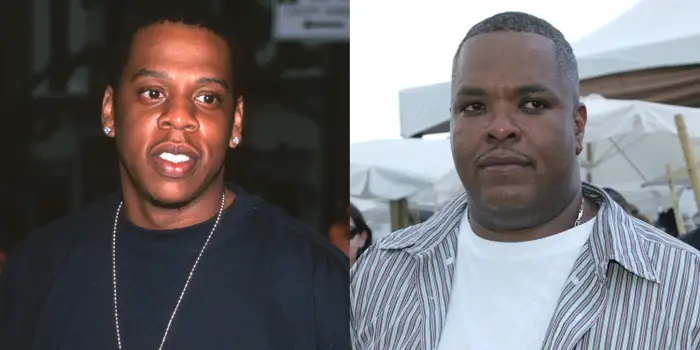
Every origin myth needs a scene, and one of Jay-Z’s most durable happened in a New York nightclub in December 1999. But an origin myth has an author and a subject, and those are rarely the same person. Jay-Z wrote himself as the author. Lance “Un” Rivera has spent a quarter-century as the subject — a supporting character in someone else’s legend, dragged back on stage whenever the story needs him. The 2026 version of their fight isn’t about a knife. It’s about who gets to decide what that knife meant.
The Night That Never Ends
In December 1999, at the Kit Kat Club during the release party for Q-Tip’s Amplified, Jay-Z believed advance copies of Vol. 3… Life and Times of S. Carter had leaked, and suspected Rivera, then a record executive, of a hand in it. [Complex] During the confrontation, Rivera was stabbed. Jay-Z turned himself in, initially pleaded not guilty, and ultimately took a plea to misdemeanor third-degree assault, receiving three years of probation rather than prison. [Billboard]
On paper, that’s a closed case — adjudicated, sentenced, decades gone. But hip-hop doesn’t file things under “closed.” A legal ending is not a narrative ending, and this is a story that keeps getting reopened by the one man with the platform to reopen it.
Flipping the Phrase
The first sign that Jay understood the incident as raw material came fast. On 2000’s The Dynasty: Roc La Familia, he and R. Kelly cut “Guilty Until Proven Innocent,” a title that inverts the courtroom’s foundational promise. [Genius] The argument underneath it was that the media had already convicted him — that public opinion ran ahead of due process.
Notice what that move does. It takes a real event with a real second party and reframes it entirely around Jay’s experience of being watched, judged, doubted. It’s a brilliant piece of narrative jiu-jitsu, and it set the template: the stabbing would live in Jay’s catalog as a chapter about his scrutiny, his resilience. Rivera, the person actually stabbed, was already becoming set dressing in his own story.
The Disputed Blade
Complicating everything is that the most basic fact — who held the knife — has never stayed settled. Over the years, Rivera himself and no less than Nas have publicly suggested Jay-Z wasn’t the person who physically stabbed Rivera, and that Jay accepted responsibility for the broader confrontation. [Vibe] Jay-Z, for his part, later folded the incident into his memoir Decoded, treating it as one more verified entry in the ledger of a man who lived what he raps.
Here’s the irony: ambiguity that would sink most people only thickens the legend around Jay. “He took the weight” is itself a flattering frame. But for Rivera, the contested account is another kind of loss — even the story of his own stabbing gets told, retold, and revised by other people. He doesn’t just lose the narrative. He loses authorship of the thing that happened to him.
Origin Myth vs. Life Sentence
Track how differently the same night aged for each man. Jay-Z became one of the most successful entrepreneurs hip-hop has ever produced, a figure whose reach runs through music, sports, spirits, and streaming. [GRAMMY] The stabbing became a small, useful stone in that monument — proof of authenticity, evidence of a man who came from somewhere real.
Rivera built a genuine career as a music executive. Yet search his name and the 1999 stabbing crowds out nearly everything else; even fresh coverage tends to orbit that one night. That asymmetry is the whole ballgame. For one man the event is a line in a much longer story he controls. For the other it became the story — a life sentence of association handed down by someone else’s pen.
2026: The Bar Heard Everywhere
That old history came roaring back in late May 2026, when Jay-Z delivered a viral, roughly three-minute a cappella freestyle at the Roots Picnic, spraying subliminals at a range of peers — and landing one squarely on Rivera: a line daring rivals to test him, capped with [Black America Web] “ask Un how I’m playing,” reportedly paired with a stabbing gesture. [OneTwoOneTwo]
Timing matters here. The freestyle didn’t drop in a vacuum — it arrived inside Jay’s rollout marking 30 years of Reasonable Doubt, a moment engineered for attention. [HipHop-N-More] Three minutes of a cappella got the entire internet parsing his bars while other artists were dropping full albums to less noise. The stabbing reference wasn’t nostalgia. It was content — deployed, on schedule, by a man who has always understood exactly what it’s worth.
Rivera Takes the Mic
For once, Rivera answered on his own terms. On The Art of Dialogue, he first read an open letter that was, strikingly, full of grace — praising Jay’s impact and calling his rise proof of what happens when talent meets opportunity, while urging him to plant “seeds of hope” rather than revisit decades-old violence. [Okayplayer] Then, in the interview around it, he got blunt.
Rivera framed the bar as a marketing decision, not a diss: he said Jay’s moves are built on rollouts, and that he had once again become part of one. [theJasmineBRAND] His terms were almost transactional: if Jay wants to sell “dangerous” using Rivera as the example, fine — but find another way, [The Source] unless the checks start coming. Strip the politeness and the demand is radical in its simplicity: if my trauma is your marketing asset, pay me like one.
The Real Feud
This was never really about a knife. Rivera has said more than once that he forgave Jay long ago. [HotNewHipHop] His grievance is about authorship — about who holds the pen on a shared history, and who just has to live inside the version that pen produces. Jay-Z’s references reinforce a story about authenticity and survival that has helped build an empire. Rivera argues those same references keep flattening a whole man into a single violent night.
That’s the tension worth sitting with, because it’s bigger than these two. Hip-hop runs on mythology, and mythology runs on real people who don’t always get a say in how they’re cast. The genre teaches us to admire the artist who “lived it” — but living it usually means someone else was there too, becoming a prop in a story they never agreed to tell. Rivera’s open letter is, in the end, a simple question aimed at the culture as much as at Jay: when one person’s pain becomes another person’s brand, who owns the story — and who just has to keep starring in it?